Rebuilding Place in the Urban Space

"A community’s physical form, rather than its land uses, is its most intrinsic and enduring characteristic." [Katz, EPA] This blog focuses on place and placemaking and all that makes it work--historic preservation, urban design, transportation, asset-based community development, arts & cultural development, commercial district revitalization, tourism & destination development, and quality of life advocacy--along with doses of civic engagement and good governance watchdogging.

Thursday, November 07, 2013

Frustrations about DC's planning and zoning process in the context of the Zoning Rewrite: Part 2, popups (additions, and teardowns)

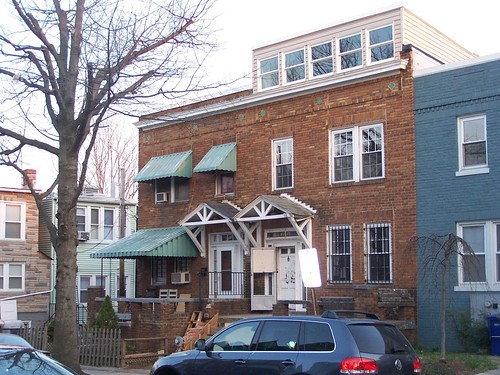
I got to the hearing late, so I missed the bulk of Councilmember Graham's testimony asking the Zoning Commission to address the issue of popups--that is discordant third floors being built onto existing rowhouses.  The City Paper Housing Complex blog has a piece about it this morning, "Graham Asks Zoning Commission to Put an End to Pop-Ups."

I have written plenty about this over the years.  The definitive piece is this, "Changing matter of right zoning regulations for houses to conform to heights typical within neighborhoods, not the allowable maximum."

But it's also discussed in these follow up pieces, "Other arguments for mandatory design review" and "Speaking of the value of city-wide design review."


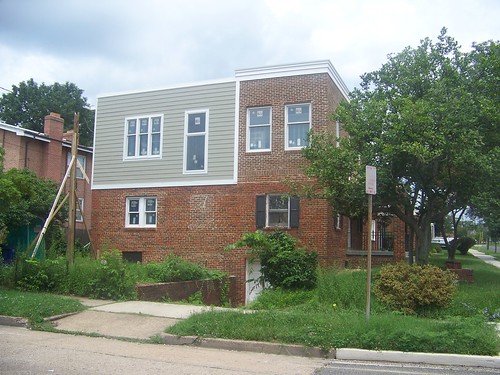
This is on Delafield Place NW, on the 1300 or 1400 block.

The basic problem is pretty simple.  Zoning allows for bigger and taller residential buildings than was typical during the time when most of the city's neighborhoods were constructed. 

As I wrote before:
This is the source of the three primary anti-neighborhood/anti-character building construction and alteration practices (although this list is not exclusive):

(1) rear additions that are extremely large


(2) addition of an additional floor--usually adding a third story to a two-story rowhouse, in a manner that is typically out of character

(3) teardowns--demolishing a house that is "small," in order to be able to build a larger house. This tears at the character of neighborhoods in two ways, by eliminating an original house of an architecturally significant style, and by inserting a new, larger house, one that is usually of a significantly different design and style compared to other housing stock in the neighborhood. (Note that teardowns aren't a significant problem in DC, because the cost of housing is so high generally, that it is difficult to do a teardown and make a profit, except in situations where one house is located on two or more lots.)

As part of the zoning rewrite process, protections for neighborhood character should be a mandatory provision within the code, inserted at the outset of the approval of the new code, not something to be added in, neighborhood by neighborhood, after the code is introduced.  "Afterwards" is usually too late to stop problems from occurring.
Over time, some people want to add third floors (or additions) and zoning allows it.  But typically they use materials and designs that are discordant so the final results look terrible.  In historic districts, this isn't much of an issue, because an extra level of review, including design review, is required.

In response to a question about this from Commissioner Peter May, OP Deputy Director Jennifer Steingasser said it was a takings issue and "hard" because the agency isn't set up to do design review--they'd have to add architects and other staff-- and data on the prevailing height would have to be collected on a block-by-block basis.

The funny thing is that we talked-argued about this a couple years ago, I said they just needed some interns.  She thought it would be much harder.  But basically, every face of a block in the city can be coded as having a prevailing height of either two-, three- or four-stories.  To approve changes to building ought to require a hearing and a design review meeting.

I don't see why it is so hard to do.

And it is frustrating that some of the most basic problems "in the zoning code" aren't being addressed by the rewrite process.

Labels: , , , , , , , , ,

Friday, July 19, 2013

More on design review

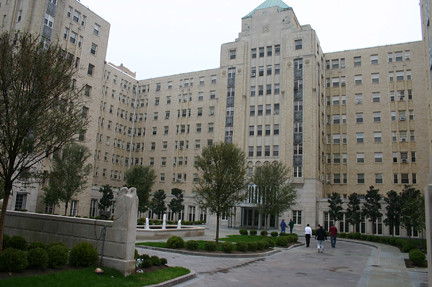
Kennedy Warren Apartments, Washington DCKennedy Warren Apartments on Connecticut Avenue NW, Washington DC.  The building was only partially completed.  It was started just before the Depression and so they didn't finish it.  The building was expanded, completing the original design, last decade.

1.  I had this letter to the editor in last week's (July 10th) Northwest Current about Councilmember Cheh's legislation to extend large tract review requirements to housing developments.  My point is that the LTR regulation has no teeth, and without the provision of additional "remedies" that can bring about necessary changes, a change to the law is meaningless.

-------
The Current’s June 19 issue reports on legislation to tweak the large-tract review process in response to concern that it fails to give the public the opportunity to weigh in and receive a response concerning large matter-of-right housing developments, such as the Cafritz apartment building project on Connecticut Avenue.

New real estate developments shape our neighborhoods and the city for decades and generations, so it is incumbent on us to get them right at the outset. For the legislation to have any impact, it would need to provide "remedies" and procedures that create an opportunity to change a project when it would be worthwhile and in our best interest to do so.

But the large-tract review process does not do this now. It is not an approval or disapproval process. It merely creates an additional level of interagency review, to ensure that substantive matters are not overlooked in matter-of-right projects. Only in one instance -- if the zoning is judged to be out of sorts with the Comprehensive Plan -- does the regulation provide an ability to stop a project. Otherwise, the project sails through, subject to the possibility of tweaks -- if the developer is amenable, as the process doesn't require the developer to respond to citizen input.

In 2011, when Advisory Neighborhood Commission 4B submitted a detailed response concerning the large-tract review application for the Walmart project on Georgia Avenue (ANC4B Large Tract Review Report on Walmart, 5/2011), the Office of Planning and Department of Transportation for the most part ignored every recommendation. The agencies did not even raise the ideas offered with their bosses (the elected officials, who for the most part wanted the path for Walmart to be smooth and easy), the developer (Foulger-Pratt) or the tenant (Walmart).


Right: rendering of the apartment building to be constructed by Calvin Cafritz Enterprises on upper Connecticut Avenue NW in the Chevy Chase neighborhood.

Furthermore, while the regulation calls for minimizing "adverse environmental, traffic and neighborhood impacts," the Office of Planning ruled that "economic impact" was not a "neighborhood impact" that needed to be addressed or mitigated. (This ruling should be challenged and/or litigated, as it appears to be counter to the intent of the regulation.)

All too many gaps in the building regulation process impede input from citizens, advisory neighborhood commissions and other stakeholders that is particularly desirable in the center-city context, especially as the city is in a growth phase. Long after the developers have sold off these projects, residents will be living with the results -- for good and bad.

Sadly, this bill does not provide the remedies and procedures needed to ensure the kinds of positive outcomes from new real estate development projects that we should be seeking as stewards of the city's present and future.
-------------

2.  In the thread on this topic from the other day, I mentioned that a couple weeks ago, there was a session on design review on the local NPR radio station's Kojo Nnamdi Show.  It featured Tom Luebke, director of the US Commission on Fine Arts, which does design review for DC's monumental core and certain other public buildings, and Roger Lewis.  Lewis is an architect and columnist for the Washington Post, but is also on the design review board in Alexandria, and Mr. Luebke had been the director for that board.

Lewis makes the point that to do design review you start with a plan, which should include design guidelines.

It's worth listening to the show.

Labels: , , , , , , , ,

Tuesday, July 16, 2013

Other arguments for mandatory design review

See "Changing matter of right zoning regulations for houses to conform to heights typical within neighborhoods, not the allowable maximum."

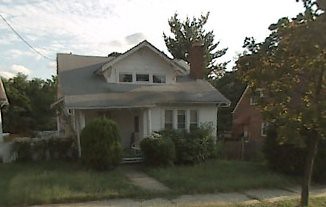
Basic colonial revival house, 6400 block of 9th Street NW
Colonial revival house, 6400 block of 9th Street NW

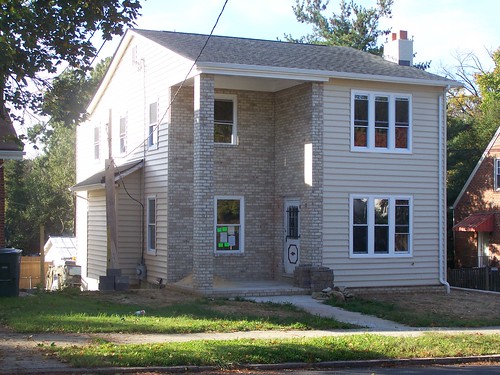
The house being rebuilt at the corner of 9th and Tuckerman Streets NW.  I think I will start calling this a tear up, because it's not a "tear down," which involves demolishing an existing house and building something bigger, usually much bigger, in its place.  Instead this is a partial rebuilding of the house within the original footprint (it's probably easier to get building permits to do this), but in a way that's very much ersatz.  In general the choice of materials and the sizing of architectural elements is off.
"Tear up" of a colonial revival house, 6400 block of 9th Street NW

Side view.  Note that this house's original design was somewhat different from the others because it is on a corner lot and they put in a side entry garage.
"Tear up" of a colonial revival house, 6400 block of 9th Street NW

Use of stone for a building height extension/cornice reconstruction for an 1880s Victorian brick rowhouse on the 800 block of 4th Street NE.  It probably hides a rooftop patio.
A recently constructed facade of stone, on an 1880s/1890s Victorian brick rowhouse, 800 block of H Street NEan 1890s

Labels: , , , , , , , ,

Wednesday, May 16, 2012

Changing matter of right zoning regulations for houses to conform to heights typical within neighborhoods, not the allowable maximum

There has been discussion in GGW and the Washington City Paper Housing Complex blog about opposition being fomented to DC's forthcoming zoning regulation update, because of perceptions that the changes allowed, some concerning eliminating parking requirements in certain places served by high frequency transit, will significantly change neighborhoods, reduce property values, etc.
I wrote about an element of this in this entry, "DC and the zoning rewrite and the approach not taken," about the road that was not taken in the rewrite, one that I recommended and that the Office of Planning considered positively, but was rejected by the Zoning Rewrite Advisory Committee (note that most of these kinds of advisory committees tend to be somewhat conservative, and most of the members are political appointees not necessarily deeply knowledgeable and future-oriented).
Generally, I am in favor of the rewrite, because the original code is suburban oriented and DC is a city.

But some of the discussion and reaction "against" the rewrite raises an interesting point about residential building size, which has been a problem for years anyway, regardless of any coming changes to zoning code.   

And I think we can solve the problem, with the rewrite or just by a change to the current code.

The problem derives from the fact that much of the city's residential building stock was constructed before 1950, and the house sizes that were typical back then are smaller than what many people prefer today, especially if they watch HGTV or are accustomed to tract home subdivisions in the suburbs.
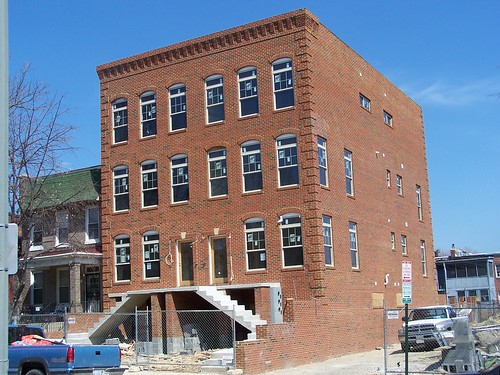
New construction, 1100 block of 5th Street NE
New rowhouse construction, 1100 block of 5th Street NE.  Actually, these are "flats."  Each rowhouse has at least two separate units.  Note the difference in height between the new buildings and the house to the left.  The height of the building to the left is typical of the  neighborhood and the period in which it was built, which was probably in the 1920s.  The newly constructed buildings are much larger than most houses in the neighborhood, and were built to the allowable maximum height.

Even if "McMansion" sized houses aren't allowed in most neighborhoods, the existing zoning code already allows significantly bigger residential houses to be constructed than are typical of most DC neighborhoods. These newer and much larger buildings tend to be significantly out of context by comparison to the existing building stock, and have the effect of diminishing place value.

In neighborhoods designated as historic, for the most part, the historic preservation regulations act as an "overlay" superior to the basic zoning regulations, and changes that are out of character concerning size generally aren't approved because of the various review processes in place.

In neighborhoods not designated as historic--even though the neighborhoods may in fact be comprised of housing that is considered "historic", just not legally--houses can be built or modified to the maximum allowed by the zoning regulations. 
1010 Irving Street NW with discordant third floor addition
1010 Irving Street NW.  What was once a simple two-story rowhouse has been augmented by a discordant third floor addition.

This is the source of the three primary anti-neighborhood/anti-character building construction and alteration practices (although this list is not exclusive):

(1) rear additions that are extremely large

(2) addition of an additional floor--usually adding a third story to a two-story rowhouse, in a manner that is typically out of character

(3) teardowns--demolishing a house that is "small," in order to be able to build a larger house. This tears at the character of neighborhoods in two ways, by eliminating an original house of an architecturally significant style, and by inserting a new, larger house, one that is usually of a significantly different design and style compared to other housing stock in the neighborhood. (Note that teardowns aren't a significant problem in DC, because the cost of housing is so high generally, that it is difficult to do a teardown and make a profit, except in situations where one house is located on two or more lots.)

As part of the zoning rewrite process, protections for neighborhood character should be a mandatory provision within the code, inserted at the outset of the approval of the new code, not something to be added in, neighborhood by neighborhood, after the code is introduced.  "Afterwards" is usually too late to stop problems from occuring.

In fact, from a planning standpoint, the approach of adding additional protections afterwards makes little sense. 
I argue that the point of planning and zoning is to produce and generate routine outcomes that "increase" quality of life, and when the outcomes from our planning and zoning processes don't do this routinely, it is an indicator of a failed process/set of regulations that need to be changed.

Demands for separate overlays for neighborhoods for the most part are a sign of a failure in a code, because a code should be "naturally" robust in terms of its provisions for placemaking and protections for neighborhood affirming qualities. (I made this point in testimony to the Zoning Commission in 2007, when they were deciding how to respond to the 2006 Comprehensive Plan.)

Lack of protection and the failure to have robust regulations is not a good thing, the debacle over Walmart being a more recent example--the city lacks substantive review provisions for "big box" stores as many of us found out to our chagrin. (Of course, it didn't help that elected officials basically "ordered" the Office of Planning to make sure the Walmart stores will happen.)

When Walmart arrived, the problems of not having adequate zoning regulations in place became obvious, because citizens had limited recourse and for the most part were unable to influence the process in any significant way--all because of the failure to have the right zoning regulations in place before they might be "needed." (It's called "planning" for a reason...)

This is why I recommended the Nashville approach as a framework for the zoning rewrite. The Nashville "Community Character Manual" provides 17 subzones for the land use contexts that most typify DC. 

For the most part, those zones and the supporting regulations provide a high level of protection for residents and other stakeholders, without requiring the development of additional regulations. That seems like a much sounder choice.

But regardless, a new DC Zoning Code could and should reverse "matter of right" regulations concerning allowable housing size. 

In another context, Ben Ross, a Montgomery County planning advocate, has made a similar point, that zoning codes tend to have it backward, that "matter of right" regulations tend to privilege the construction of the least quality project, and make it harder to construct the most desirable and highest quality project.  In other words, why don't we make it harder to do the wrong thing, and easier to do the right thing?  (See this 2011 blog entry, "New years post #6 -- the crazy thing about U.S. zoning is that it's not designed to maximize overall land value.")

Instead of making "matter of right" for the largest possible house, make "matter of right" for the size of a house typical of a neighborhood. 

Of course, this size would be coded by neighborhood.  On a block with two story rowhouses, two stories would be the "matter of right", on blocks with three story rowhouses, three stories would be the "matter of right".  But to build a larger house on the shorter block, or a shorter house on the taller block, special approval procedures would be triggered.

For years I have been surprised that a city so defined by historical excellence in planning (L'Enfant, McMillan Commission) and excellence in architecture, does not require design review for the entire city, regardless of whether or not a neighborhood or building is designated as historic. (Visitors to the city don't just comment on the architecture of the federal buildings, they also comment on the charm and attractiveness of the city's neighborhoods, especially those in the core of the city.)
This would be a way to right the terrible wrong that occurs in so many neighborhoods, when alteration of the housing stock is done in ways that diminish the value of place.   For example, this is what is happening to the house two doors down from me.

Before
House down the street

After
Nasty house being reconstructed two doors down

I can't think of a better example of why design review ought to be required in DC than this one. And I can give equally bad examples from similar projects within a block or two.

Sure the original house had been neglected for many years, but completely eradicating it in favor of some ersatz design totally disconnected from the neighborhood context shouldn't have been allowed--but it is, because undesignated neighborhoods have no significant design review requirements.
This is correctable as part of the zoning rewrite.

(Although a more robust design review regulation should also address other problems that weren't listed in my top 3.)

Labels: , , , , , , , ,

Monday, November 23, 2009

PG County "Envisioning" process

1. Remember that people in Prince George's County don't like it when you refer to the County as PG...

2. They have a visioning process going on now. See "Residents lend a hand in planning the future of Prince George's" from the Gazette. (It's similar to the Growth Policy process in Montgomery County.)

3. Interestingly (and worth going to just to observe), one of the sessions is just for youth. Forums still to be held are scheduled for Dec. 1 in Oxon Hill and Dec. 3 in Landover. A youth forum will be held from 10 a.m. to 1 p.m. Dec. 5 in College Park.

4. Residents interested in participating should visit the website, Envision Prince George's or call 301-952-3594.

5. From the website, which includes a blog and a comment section for residents and stakeholders:

Envision Prince George’s is a call to action to develop and implement a vision for our county with a vibrant economy and high quality of life for all. Envision Prince George’s will mobilize and empower county stakeholders to be directly involved in creating their future as the County continues to grow and prosper over the next two decades and beyond. Through a series of community forums and other activities, Prince Georgians will develop a shared vision for the county and take action to make that commitment real. To review our in-depth guide to the Opportunities and Challenges facing the County, please download the Envision Participant Guide.

Labels: , ,

Reprint of Crime Time (July 2006 blog entry)

A day in DC
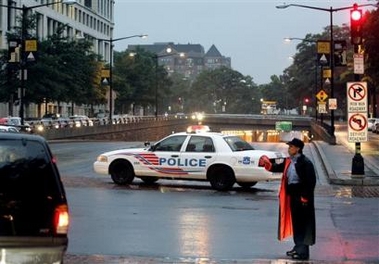
AP photo by Evan Vucci.


[The July 18th, 2006 issue of] the Washington Post has three pieces on the front page of the (DC edition) Metro section about DC's crime emergency. One, "Mayor Unveils Emergency Legislation," is about proposals to hire more police officers, fund more officers to work overtime, and legalizing surveillance cameras (given the city's history in violation of civil rights for demonstrators, I have some concern about this).

Another is by the columnist Marc Fisher, "D.C.'s Reaction to Killings Misses the Point," and he writes:

Never mind that crime has been dropping for years, and homicides are actually slightly down from this time last year. No, the city must take action. So Police Chief Charles Ramsey declares a crime emergency.

And in parts of the city where people swallow hard every time they step out of their houses, where every day feels like an emergency, resentment bubbles anew. Across Washington, we fall into another round of competitive suffering, an ugly sport that pits rich against poor and white against black.

Finally, the article "Police Had Suspects' Address," discusses something just as serious, that apparently a previous robbery victim had reported information to the police about the location of the suspects eventually arrested for the subsequent murder:

The information came from a 24-year-old Georgetown woman who was held up June 11 -- three blocks from the place where Senitt later would be slain. She said she provided the address on Robinson Place SE after learning that her credit card was used to make a purchase that was shipped there. ...

Police responded by telling her they could not get an arrest warrant without first doing surveillance at the apartment building and then conducting a lineup to determine whether she could identify suspects. She said she was sure she could identify her attackers and was waiting for a call from the police.

Instead, she said, on July 9 she saw the faces of the men who robbed her flash across a television screen because they had been arrested in Senitt's slaying.

Perhaps one of the biggest problems in dealing with crime in the city comes from a lack of sense of urgency on the part of investigators.

But the article also includes a quote from one of the leaders of the police officers' union, which shows that the average police officer appears to know little about the etiology of crime, especially murder. From the article:

The police work on the Senitt case also is drawing criticism of another sort from the union representing the department's officers. A document obtained by The Post shows that officers from each of the department's seven districts were called to respond to Georgetown the night of the slaying to set up a 20-block perimeter in hopes of catching the suspects.

That is highly unusual and rarely, if ever, happens when homicides occur in other, less affluent districts, said Officer Kristopher Baumann, chairman of the D.C. police labor committee for the Fraternal Order of Police Lodge 1.


Most murders in the city are crimes of anger and rage and occur between people who know each other. This number is as high as 70-80%. Police can have very limited impact on these types of murders--other than catching people for other crimes, convicting them, and putting them in jail, therefore reducing their ability to commit subsequent crimes, including murder.

The kind of murder that happened in Georgetown is of the type that can be immediately impacted by policing. If Officer Baumann doesn't understand this, he needs either more training or retraining.

You know how it used to be in vogue that cities had campaigns where everyone was supposed to read the same book and have a community conversation about it? Well, if I were mayor, one of the first books I would have people read would be Cities: Back from the Edge, which is one of the best books about bottom-up urban revitalization.

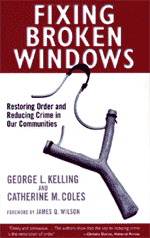
Maybe the second book, and clearly the Metropolitan Police Department needs to have a similar campaign, where every member of the department reads this book and discusses it, is Fixing Broken Windows.

There is a lot of controversy and misinformation about the policing strategy outlined and called for in this book. There are two basic points:

1. How the environment looks communicates to people about what is acceptable and unacceptable behavior. Disorder increases in unkempt areas.

2. The kind of criminals that commit big crimes also commit "small" crimes. So if you don't ignore small crimes, you can have significant impact on the crime rate, because catching people for "small" crimes ends up yielding people who also commit big crimes.

But it's not just the physical order, but the social and cultural order of the community that must be addressed.

A brief in The Atlantic Monthly, where the strategy was first developed in a few articles over a 15 year period, they write in the January 1997 issue:

"We used the image of broken windows to explain how neighobrhoods might decay into disorder and even crime if no one attends faithfully to their maintenance." 'Broken Windows' was a congent argument for emphasizing 'order maintenance' to prevent crime; the ideas it contained became the template first for the NYC Transit Authority's efforts to restore order to the subway and then for the NYC Police Department's new community policing strategy.

The Transit Authority achieved success only after a frustrating ordeal of persuasion and step-by-step implementation [which is described in the book]. The transit police were skeptical. "Where in the hell did you ever get the crazy idea that disorder was police business?" one patrol officer shouted at Kelling, "Our job is fighting crime."

Fighting crime is a lot of things, and the political culture in DC hasn't been supportive of looking at the real issues, some of which Marc Fisher touches upon in his column. Instead, most elected officials are quick to criticize Chief Ramsey, who does have some failings (especially on civil liberties) but who is working diligently to change the race-charged atmosphere of the police department, and get it focused on addressing the fundamental need for change within the department and within the city in which it works.

Or Ward Six City Council Candidate Leo Pinson, who calls for "regime change" in the department, according to this recounting of a recent candidates forum in the Common Denominator, "Council candidate says 'regime change' needed to fix MPD". Pinson, who was a PSA Citizen Coordinator, and is an MPD Volunteer Reserve Officer, reflects the sentiment of the officers, and it appears to lack the grounding in criminology that I would like to see in a City Councilmember.

Most officers grouse that the department makes it very difficult to be effective on the street, that they lean overboard towards perpetrators--e.g., it is easy for someone to file a complaint against an officer for the over use of force, and this leads to many officers becoming quite cautious. But the top echelon of the department merely responds to the political climate in the city. I guarantee you that Chief Ramsey wants criminals in jail...

Pinson is right that a regime change needs to occur, but in two respects the change that is required goes far beyond the department, to: (1) many of the elected officials and (2) within segments of the community that see police as the enemy rather than people working to make our city livable and safe.
Fixing Broken Windows (book cover)

---------------------- [added -- at the time of the original entry, the Broken Windows wasn't freely accessible online]

Also see the article "Broken Windows" from the Atlantic Monthly.

This article is from 1982!!!!!!!!!! After 27 years, you'd think it would be possible to have adopted such a focus within many police departments and communities, rather than it still being considered a novel technique!

Labels: , , , , , ,

Planning applied to crime reduction

As a planner, I easily fall into the trap of believing that the best way to address problems in a systematic fashion is to have a plan, even though I was admonished at a meeting at the Office of Planning last week that just because a plan might exist doesn't mean that it will be executed the way that was intended by the planners who wrote the plan.

(The example of Montgomery County and the Silver Spring Urban Renewal Plan was used, with regard to the library issue and how the County Executive wishes for their to be a bridge connecting a parking structure to the proposed library, which defeats the overall walking orientation that the streetscape-urban design elements of the plan are supposed to foster. See "Residents debate library design" from the Gazette.)

My response is always based on this line:

when you ask for nothing, that's what you get. When you ask for the world, you don't get it, but you get a lot more than nothing.

In short, maybe a plan isn't always implemented or it is not implemented or executed properly, but when you have a plan you have the opportunity to accomplish a lot more than if you never had the plan to begin with.

I think about this almost every time I read a story about systemic crime in DC.

Clearly, there needs to be a focused plan to attack crime in specific ways in Columbia Heights. See "'He was innocent. He did nothing to anyone.': As a D.C. mother mourns, a suspect is arrested in the fatal shooting of her 9-year-old son" from the Washington Post about the murder of the 9 year old boy shot through the door of his apartment, in a building where the front door lacked locks, in an area with frequent robberies.

Or there should be "security" plans for every school in the city (see "D.C. charter schools put out a call for protection: Officers should be helping to derail area's spillover violence, NE principal says" from the Post about problems at the Friendship Collegiate High School on Minnesota Avenue because of its location in an area of significant crime activity) or for areas around transit stations (see "Rock-throwers meet indifferent Metro employee" from Greater Greater Washington).

Or even Eastern Market on weekends. I am on the board of the Market, and during discussions about crime and other problems (vendor vehicles parked on the street while the vendor is working his/her booth are easy targets for criminals) made me realize that there needs to be a security plan for the greater market area on the weekends, it's a special event every weekend, and needs to be managed as such.

The most basic execution of the techniques of "crime prevention through environmental design" address evident risks in neighborhoods where crime exists in significant ways.

But you have to adopt the techniques of CPTED and have plans to execute the techniques before you can have any success. Also see "Architecture as Crime Control" from the Yale Law Journal.

Plus, the whole point of identifying persistent crime networks ("gangs") and perpetrators doesn't require advanced anti-terrorist military techniques from the Navy Postgraduate School (see "Iraq's lessons, on the home front: Volunteer veterans help California city use counterinsurgency strategy to stem gang violence" from the Post) as have been applied in Salinas, California.

I have been writing off and on for four years about anti-youth violence and crime programs in places like Boston (see "Straight Outta Boston" from Mother Jones Magazine) or the anti-gang programs spearheaded by David Kennedy (see "Crime: David Kennedy's Obsession With Drug Dealers" from Newsweek and "Don’t Shoot," from the New Yorker).

It is a matter of applying anti-gang techniques, focusing attention on areas of persistent crime, and applying the appropriate techniques -- anti-criminal and pro-environmental design -- not passing some law to put increased penalties on perpetrators.

See "D.C. Council proposes transit stop 'safety zone'" from the Examiner about the proposed legislation by to impose stronger penalties for crimes committed at bus stops. The issue is design (see the work by UCLA professor Anastasia Loukaitou-Sideris and others such as "Journeys to Crime: Assessing the Effects of a Light Rail Line on Crime in the Neighborhoods" and "Measuring the Effects of Built Environment on Bus Stop Crime") as well as anti-criminal techniques, not to mention successful prosecution of criminals.

It's about focusing on what needs to be addressed, with a plan, and organizing resources of all agencies, not just the police department, in these focused ways, in order to achieve fundamental reductions in criminal activity and improved safety for neighborhoods.

It's very frustrating that proven techniques such as these are very very very slow to be adopted in DC.

Maybe because it means fewer opportunities for politicians to talk to the press and go to crime scenes and feel important.

In the meantime, people suffer or die unnecessarily.

-----
Also see these past blog entries:

-- Crime Time (7/18/2006)
-- Crime Time #2
-- Crime Time #3
-- Crime Time #4 (7/31/2006)
-- Crime Time #5
-- Crime Time #6 (Baltimore)
-- Crime Time #7 (8/13/2006)
-- Crime Time 2008

Labels: , , , , , ,

Wednesday, September 16, 2009

Getting (master) plan crazy and bicycling

A real problem when you do planning and think in terms of systems, structures, and processes is that you think the answer for everything is more and better plans. I am describing myself of course.

Washcycle links to blogger/transportation issues commenter Froggie and his list of proposed bicycling improvements in the Huntington area of Alexandria, "A Christmas Wish-List for the Huntington bicyclist..."

The reality is that almost every one of his suggestions have regional dimensions, making me realize that "we" (the Washington Area) need a "master plan" for regional bicycling system improvements, just like we have master plan for regional roadway and transit improvements.

Now there already is such a plan, the Bicycle and Pedestrian Plan for the National Capital Region (also see Plan Briefing) produced by the Transportation Planning Board of the Metropolitan Washington Council of Governments, which is the designated metropolitan transportation planning organization for the region.

But without more innovative and ground level planning with broad public participation processes, the kinds of connections as identified in Froggie's post aren't likely to made.

I feel like this is evident in the DC Bicycle Master Plan. More or less, the scope of work for the project was focused on improving the bicycling environment within DC, with public participation processes focused on DC residents, and as a result, I think the plan missed certain issues such as improving bicycle-related connections into and out of the city, either through off-road bicycle trails as well as street entries into the city, whether or not there are on-road bicycle lanes, sharrow markings. or separated cycle tracks.

This is a point I made in the follow on paper (and blog entry), "Ideas for making bicycling irresistible in Washington DC," which was produced for the DC response to the Active Transportation initiative of the Rails-to-Trails Conservancy, and some of the RtTC initiative made it into the Federal fiscal stimulus package.

The paper included points such as these:

• Where demand is indicated through surveys, work with non-DC jurisdictions to enhance the ability to bicycle to and from DC (i.e., Georgia Ave., Wisconsin Ave., Riggs Road, New Hampshire Ave., South Capitol, Rte. 1, etc.). For example, people living and working in the Route 1 corridor in DC and MD are faced with dangerous riding conditions. The preference should be to focus on improving bicycling conditions on arterials and city and county streets, not the creation of separate or circuitous paths. Discuss this systematically with Montgomery and Prince George’s Counties specifically, since DC shares a physical border with these jurisdictions.

•Trail planning and development for recreational purposes is a separate purpose with different needs than every day cycling, and should be treated so.

• Regarding tourism and recreation objectives, consider the creation of bicycling-oriented “scenic byways” through the city with appropriate signage programs.

• Are there stations within the subway network (in DC and outside of DC) that are good locations to add bikestations? (Fund a pilot location within DC with the TEA grant.) (While discussed in the planning stages, a bike station is not being installed in the portion of the Silver Spring Transit center currently being constructed by WMATA and Montgomery County Dept. of Public Works and Transportation!!!!!!!)

But other than promoting the idea of better linkages, as well as coordinated cross-jurisdictional planning, I didn't suggest any specific trail or route additions, unlike Froggie.

The Adventure Cycling Association has created a proposed U.S. Bicycle Route System, comparable in scope to the Interstate Highway System. The plan would stitch together 50,000 miles of bicycle-friendly roads, byways and trails, and would have a common signage system.
Travel Trip Bike Route

A regional bicycle trail and route system in the Washington area should be similarly devised, planned, and marked (signed).

From the paper on making cycling irresistible:

• Enhanced route marking and signage system. (Seattle, Berkeley, San Francisco, London) e.g., why aren’t there map signs along routes (Austin), street markings in addition to signage, and contact information signs, etc. (The map tubes used at Downtown Circulator bus stops are another example of how maps could be installed along bicycle routes.)

• The current signage system could be augmented by including signs pointing to specific facilities and destinations adjacent to the route, including recreation centers, public schools, public libraries, and notable sites. For example, the Newton Street route in Brookland could direct riders to the Turkey Thicket Recreation Center and to public schools, while the route between Brookland and Capitol Hill could include directional signage to the Woodridge branch of the Public Library.

• Modify the blue DC wayfinding signs to better denote transit proximity and at the same time add information about supportive bicycling facilities.
bike route sign, Market/17th/Castro, San Francisco, July 26, 2008 by /\/\ichael Patric|{.
San Francisco Bicycle Route sign by /\/\ichael Patric|{

Labels: , , , ,

Friday, July 24, 2009

Why at this juncture DC is screwed

From "Progress, Problems After D.C. Schools Takeover" in the Washington Post:

The District's struggling public school system has made significant progress during two years of mayoral control, but lack of planning and transparency has hindered some reforms, the U.S. Government Accountability Office reported Thursday. ...

The report also describes a lack of clear strategic planning with specific targets that can be communicated to the community stakeholders.

Victor Reinoso, deputy mayor for education, said the Fenty administration was more interested in results than detailed blueprints. "Our emphasis has been on accountability and results, and less on plans which the city was quite successful in doing previously," he said.

GAO report: District of Columbia Public Schools: Implementation and Sustainability of Reform Efforts Could Benefit From Enhanced Planning

The basic "plan" for the "reform" of the DC public school system is to fire old teachers and hire new teachers.

Sure there are "bad" teachers. But as importantly, the system hasn't been focused on building quality management and support and training and development systems to support students, teaching, teachers, principals, schools, and families.

Over the years--my joke is that the reason that the schools are probably the worst performing local municipal institution is because home rule started first in the public school system--local leadership had become more concerned with the school system being an opportunity for patronage that concerns about achieving outcomes in the classrooms, for students, ceased being a priority.

I am the first to say that planning as a field has flaws. If you are asking the wrong questions and/or avoiding the most fundamental, substantive, and important issues, and planning around the answers to wrong questions, then your plan isn't going to be any good.

I know it's a cliche, but a "Failure to Plan is a Plan for Failure." From the article:

There are two adages I think of regarding planning and launching a business intelligence project. They are: "Failure to plan is a plan for failure" and "Each hour spent planning is worth two hours saved during implementation." ... Here’s a checklist for doing the job right:

  • Define the project.
  • Identify the users.
  • Develop a formal project plan.
  • Assemble the project team.
  • Assess all information and technical needs.
  • Select the software.
  • Configure the business intelligence application.
  • Deploy a support strategy.
  • Train all users.
The article is focused on software development, so this checklist needs modification for accurate application to other stettings. (And there are plenty of examples of failed software implementations). For example, the school's users include children, teachers, principals, support personnel, parents, community members, elected officials, etc. But in any case, a failure to plan will yield failure. So will a failure to connect to all the stakeholder groups that must be involved in order to achieve success.

It's true that planning can be so over detailed as to be problematic. But not planning at all--more importantly, not asking the right questions about purpose and outcomes and how to achieve the preferred outcomes and how to build the systems, processes, and structures to yield the outcomes without over-reliance on exemplary individuals--you can be certain that your efforts will fail.

The problem is that a focus on immediate results--call it accountability if you want, but it isn't really--without asking significant questions about what you are supposed to achieve, and what you are trying to achieve, and identifying gaps between what you are doing and what you are supposed to be doing means you're working hard but you sure as hell aren't working smart.

I jokingly call my work style "minimalist." I try to work smart, not hard, and work to apply theory and best practices to my projects to increase the likelihood of success from the outset, rather than in a panic in response to evident problems (that could have been predicted).

As Bismarck said:

"Fools learn from experience. I prefer to learn from the experience of others."

When you don't have that experience, and the people running DC's school "reform" efforts do not, plans are a necessary first step.

The same attitude about the irrelevance of planning to improving the schools permeates the executive branch of the DC Government, hence the headline of this entry.

Labels: , , ,

Monday, April 16, 2007

Planners Network national conference in New Orleans

Planners Network is the organization for progressive planning. They publish a journal of the same name, and do other interesting work. Below is their conference announcement:

*Planners Network 2007 Conference - New Orleans - May 30-June 2 -
Conference Theme - Race, Class and Community Recovery: From the Neighborhood to the Nation and Beyond

*Visit to see the lineup of presenters and workshops, for information about the plenary panel and the inaugural PN film festival, and to register. Information about accomodations, community-based workshops, fundraising options and our collaboration with The Great Gumbo, ACD/ADPSR's conference June 3-5 inBaton Rouge is also available.

Hurricane Katrina exposed tremendous rifts over class, race and community, not just in New Orleans but throughout the United States and around the world. It also shook the very foundation of planning and governance, whose failures were broadcast in high definition to the global community. Yet the effort to dig out and rebuild has been marked by tremendous innovation and will on the part of local communities, despite continued abandonment at the federal level.

The Planners Network 2007 Conference will confront issues of race, class, injustice and the failures of planning, while seeking to learn from the work of community-based organizations, dedicated planners and local residents.

Planners Network is an association of professionals, activists, academics, and students involved in physical, social, economic, and environmental planning in urban and rural areas, who promote fundamental change in our political and economic systems. The planning department at the University of New Orleans is the only accredited planning program in Louisiana, Mississippi or Arkansas, and has been extremely active in community-based planning efforts in the aftermath of the hurricanes.

Labels: ,

Sunday, April 15, 2007

Dare to be great

[Revised around 6 pm Sunday]

L'Enfant Plan, Washington, DC
L'Enfant Plan.

I wasn't able to attend the conference on the future of the Mall on Wednesday (I signed up but since I have missed so much work being sick I can't do anything like go to conferences, including having to miss APA). Fortunately, Phil Kennicott wrote it up in yesterday's Post, in "D.C. Needs to Capitalize On Its City-Like Qualities."

Dammit, DC is a city!

From the article:

It doesn't necessarily have to be that. Yes, as Tangherlini pointed out, the city's self-determination needs to be taken out of the hands of national politicians. But on a deeper level, there's an emotional and intellectual sea change that needs to wash over the city. In many ways, as various speakers pointed out, Washington is a very successful city. We have better mass transit than most cities in the country. We have better cultural institutions than most cities in the country. We have better neighborhoods -- more lovely, more walkable and, for what you get, in many cases more affordable -- than most cities in the country. As Alex Krieger, a professor at the Harvard University Graduate School of Design, pointed out, the city should present itself as "a national showcase for urban living." Which, despite the confidence crisis, is what we are.

Krieger's talk made the distinction between cities and capitals, and he argued that the American notion of a capital is of a city that is "purified," an agglomeration of clean, orderly citizens that is not, in the end, really a city at all. It took Washington a century to look like a capital. And it took another century to make it feel like a city. Now it needs to start thinking like a city, showing the 25 million annual tourists the cutting edge of architecture, sustainable design and development, and the bustle and bumptious energy of a real metropolis. A good start would be a few restaurants that serve until 4 a.m.

But there are a couple things that makes recognizing this very difficult:

1. Many residents aren't originally from the area.
2. They lack a sense of history generally, and tend to be underknowledgeable about urban history and local history specifically.
3. They are imprinted with the suburban development paradigm (automobile centric, low density, segregated uses) which they apply inappropriately to fundamentally urban issues. (Note that DC's zoning code is fundamentally a product of suburban thinking, especially with its orientation about servicing and accommodating the car.)
4. And these problems often imprint true urbanites from places other than NYC or Chicago, who don't understand how cities are supposed to work (this includes most residents of Washington, and those residents who believe in "the American Dream" and that things in suburbs, such as Wendy's franchises are a sign of modernism and achievement and ought to be available within the city as well.)
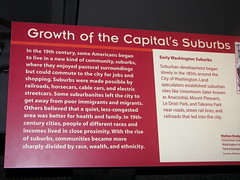
"Growth of the Capital's Suburbs," interpretation board, American on the Move exhibit, Smithsonian Museum of American History
Growth of the Capital's Suburbs, interpretation board, American on the Move exhibit, Smithsonian Museum of American History
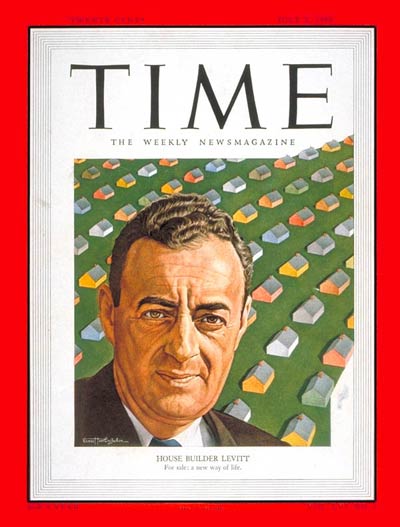
William Levitt on Time Magazine Cover
5. And too often this includes elected and high-level appointed officials.
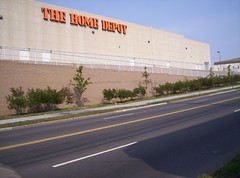
Blank wall anti-urban design, Home Depot, Brentwood, DC
The Brentwood Shopping Center, now called Rhode Island Place, in northeast DC is a perfect example of plopping a suburban design paradigm into the heart of the city. This opportunity should have been seized to repattern this area into a more urban feel, utilizing the air for housing and other mixed uses, leveraging the location immediately adjacent to a subway station. This was done by city officials, who were either unaware or unwilling to push urban design principles on this site and on the developer.
Brentwood Shopping Center, DC

I disagree with Kennicott's assertion that DC needs "cutting edge architecture" to be a city. It needs to recognize and revere what it has, which unlike most cities in North America other than Montreal, is a European feel, with vibrant neighborhoods, density, and an incredible transit system. This is our competitive advantage, that which makes DC unique vis-a-vis almost every other city in the United States, and an advantage that should be strengthened at every opportunity, not diminished.

To recap, for about 5 years, I have testified about what I see as DC's competitive advantages:

1. historic architecture
2. a walking city-based urban design
3. history and authenticity
4. a transit system that allows for non-automobility in the core of the city
5. the steady employment engine of the federal government (cf. Pittsburgh, Newark, Baltimore)

This was complemented by the neighborhood-based historic preservation movement, which worked to preserve DC's great neighborhoods during the many decades in which people didn't want to live in the city.

Note that Cameron Logan, a PhD student at GWU, is writing a fascinating dissertation on what he calls "The Constituent City," based on a report by the National Capital Planning Commission, published in 1950, which for the first time recognized that it was important to plan for the people who lived in the City of Washington, not just around the federal presence. (Lindsay Silver is also writing her dissertation on Capitol Hill and the neighborhood-based organizing there, the rise of the Capitol Hill Restoration Society, fighting freeways and federal government expansion, etc.)

The flipside of the strong neighborhood-based movements was a failure for advocates to focus on city-wide issues, and issues in areas where there were no or few residents, such as downtown, and in areas that lacked the capacity for significant organizing. Of course, one exception to this was the cross-city and multiracial anti-freeway coalition, the Emergency Committee for the Transportation Crisis, which successfully fought off the destruction of the city by freeways--various plans called for a couple of beltways within the city, such as through Dupont Circle, and I-95 along the northeast corridor railroad tracks.
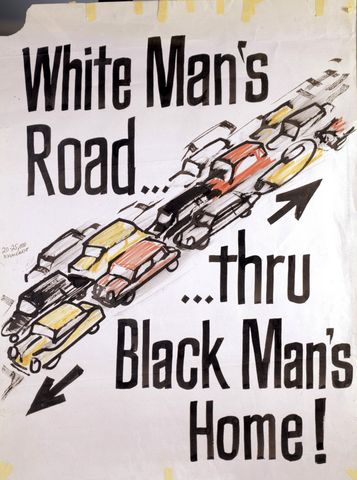
Freeway protest poster, Emergency Committee on the Transportation Crisis, Washington DC
This poster, drawn by Sammie Abbott, was displayed at a demonstration protesting the building of a highway through Washington, D.C. African-American neighborhoods. Artifact. Hand painted sign on paper. Date Made: about 1968. Dates Used: 1968 - 1973. D.C. Community Archives, ECTC Collection, Washingtoniana Division, D.C. Public Library

A few years ago, I toyed with the idea of creating a "Jane Jacobs" urban design reading group, never managing to pull it off (I need others to help, I have too much going on). I got a response from someone who argued that unlike NYC, by comparison DC is an "immature" city. The reality is that DC, especially downtown, had all the same characteristics of a traditional city, the kinds described by Cy Paumier in Creating a Vibrant City Center, where the pattern of downtowns (central business districts) as comprised of pedestrian-scaled streets, blocks, and buildings came about because of:

Concentration and Intensity of Use: "The intensity of development in the traditional central area was relatively high due to the value of the land. Maximizing site coverage meant building close to the street, which created a strong sense of spatial enclosure. Although city center development was dense, construction practices limited building height and preserved a human scale. The consistency in building height and massing reinforced the pedestrian scale of streets, as well as the city center's architectural harmony and visual coherence." (p. 11)

Organizing Structure: "A grid street system, involving the simplest approach to surveying, subdividing, and selling land, created a well-defined, organized, and understandable spatial structure for the cities' architecture and overall development. Because the street provided the main access to the consumer market, competition for street frontage was keen. Development parcels were normally much deeper than they were wide, creating a pattern of relatively narrow building fronts that provided variety and articulation in each block and continuous activity on the street." (p. 12)

The street grid, transportation practices and construction technology of the times, and the cost and value of the land led to a particular form of development on city blocks that focused attention on the streets and sidewalks, creating a human-scaled, architecturally harmonious built environment.

As construction technology advanced and taller buildings could be constructed, and as the walking and transit city was supplanted by the automobile, the scale of block development changed significantly, with a focus away from the pedestrian and towards the car.
Waffle Shop
Waffle Shop Downtown. Horydczak photo, Library of Congress.
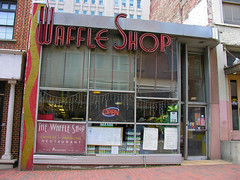
330593280_3e922e751c_b
Current photo of the Waffle Shop by Otavio DC.

But it got destroyed for the most part by developers like Oliver Carr, who rebuilt downtown into a bunch of superbuildings, destroying the context, destroying life on the street. Now, Waffle Shop is one of the only businesses left downtown that harkens back to the pre-1980s reconstruction of Downtown. (See chapter four of the book Dream City to understand what happened.)
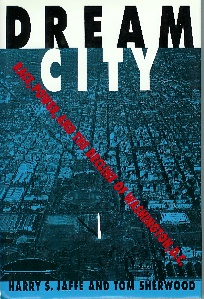
Dream City

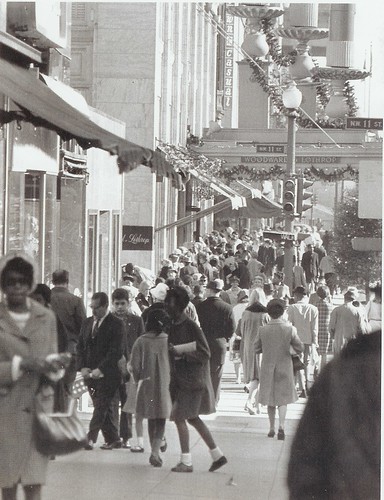
11th and F Streets NW, Washington, DC, December 1968
11th and F Streets NW, Washington, DC, December 1968. Washington Star photo.
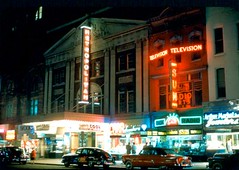
Metropolitan Theater on F Street in the 1950s.
Metropolitan Theater on F Street NW in the 1950s. Photo from Reston Paths.
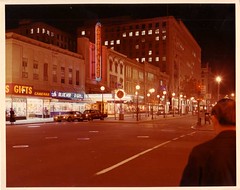
'F
F Street, NW, at 13th Street looking west, with "F Street Plaza," DDOT historical photo.

Here are some suggestions for reading about Washington and its history so you don't sound like a fool:

• Washington in Maps: 1606-2000 by Iris Miller
• Washington on View: The Nation's Capital since 1790 by John Reps
• Washington Through Two Centuries by Joseph Passonneau
Washington Then and Now by Peter Penczer (where you start to see some of the old photos of the city)
Washington at Home by Kathy Smith (about neighborhoods in the city)
• context statements for historic districts and thematic surveys (such as for transportation or warehouses) and the printed brochures for historic districts produced by the Historic Preservation Office
• even fiction by George Pelecanos, which describes here and there DC's old ethnic neighborhoods

Where DC drank tavern Washington.jpg
• the various books produced by Arcadia Publishing about DC are interesting (although for many the image research is a bit circumscribed)
• the journal Washington History published by the Historical Society of Washington, and the predecessor publication, Records of the Columbia Historical Society
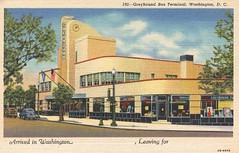
Greyhound Bus Terminal, Downtown, Washington

Labels: , , , ,

Monday, February 05, 2007

Center City, Downtown, the Central Business District

On the HistoricWashington e-list, Scott Roberts called our attention to an article in the new edition of the Washington Business Journal, "Downtown gets renamed, redefined and rebranded." From the article:

DC is redefining “downtown.”

The city’s Office of Planning has initiated a major effort to expand the boundaries of the traditional office and entertainment areas, creating a planning zone called Center City. The initiative more than doubles the area traditionally considered downtown by adding the North of Massachusetts Avenue (NoMa) area as well as the Southeast and Southwest waterfronts.

Another objective is to provide better links to tie the traditional downtown zone with merging business and entertainment districts, the waterfront and the National Mall. Center City will be promoted as a waterfront city with nearly half of its boundaries defined by the Potomac and Anacostia Rivers.

The effort grows out of a stark reality: there is little room left to build downtown, and office and mixed uses have to go somewhere. A July 2006 draft land-use analysis shows that the area designated as Center City has 90 vacant sites – 80 are in NoMa, Southeast/Southwest, Mount Vernon Triangle and the East End/Penn Quarter areas. Officials estimate the city could see 1.5 million to 3 million square feet of office space by 2011.

“We want to reframe people’s notions of downtown and have people understand that this is where there’s office and mixed use … and there are distinct neighborhoods not morphed into downtown,” says Harriet Tregoning, nominated byMayor Adrian Fenty as new planning director.

City officials have been shopping the effort to business leaders in recent months. A stakeholders meeting is scheduled for Monday, March 5, 2007, and the plan is to be formally introduced at a May event in the National Building Museum.

Frank Cooling responded that Philadelphia already calls its central business district "Center City." And of course, the Center City BID is an amazing advocate for improving downtown Philadelphia.

I responded:

This idea was in the Comp Plan. I didn't agree with it when I first read it. By expanding in this fashion, to you deconcentrate focus? Is there a reason to consider 1st St. NE in NOMA in a way comparable to F St. NW?

On the other hand, focusing on the core of the city does matter, especially given the strength of suburban office districts in Fairfax, Montgomery Alexandria, and Arlington Counties

OTOH/2, this initiative is mostly being forwarded by the business community without much input by residents of the city more generally (outside of the core*) and I am guessing without much input from the residents that live in those areas.

Testifying extemporaneously at the NoMA planning hearing, I suggested that because BIDs have become by default the primary "community" organizing entities within their geographies, that BIDs need citizen members (people to provide oversight on public interest grounds) appointed outside of the normal BID-controlled nominating process, because of the "substance" (you know the form vs. substance legal argument) of their fundamental privatization of the public realm.

Both the Downtown BID and the WCTC are engaged in branding efforts. I was interviewed for the former effort. I said that by becoming an office ghetto (see ch. 4 in Dream City) there are few reasons for non-workers to come downtown. However, that is changing significantly in the 7th Street area (not just because of the Verizon Center but because of the historic building stock on that street, respect of the historic storefront rhythm and the addition of a wide variety of other attractions, including retail--the Smithsonian museums, Goethe Institute, galleries, Lansburgh Theater, etc.). It's also changing on F and G Streets for similar reasons, and with the retail revitalization of the Woodies building.

I haven't participated in the WCTC efforts yet. They have launched a website to gather information from DC residents about what defines the city.

In some respects, I think this is pathetic, because I think people in those positions should know the answers already. (I think and write a lot about these issues of center city revitalization, branding, and cultural resources.)

My reply to the WCTC folk:

DC's identity (which you call brand) should be evident to all who work on economic development and quality of life matters in the District of Columbia.

For four years or so, every time I speak or write about this issue I state that DC has five competitive advantages:

1. Historic Architecture;
2. An Urban Design that is pedestrian-centric;
3. An authentic history and base of business;
4. A plethora of connected and efficient transportation assets that allow people to not be car-dependent;
5. The stable employment engine of the federal government (still strong despite all the cherry picking by the suburbs and West Virginia).

Furthermore, every time I discuss this I state that anything that government agencies or private sector companies do that diminishes any of these competitive advantages in turn tears at the competitiveness and quality of life in the city.

For example, this matters because retail attraction programs and other government initiatives tend to work to attract chains, which by definition are not unique. Likely this damages the ability to sell products to tourists.

The problem that DC has in terms of selling tourism, specifically the local experience, is the fact that the dominant narrative of the city is about the federal experience. This means that the average visitor intends to "consume" only this experience, which tends to be comprised of visiting:

1. White House
2. U.S. Capitol
3. National Mall and the Monuments, including the Washington Monument
4. The Smithsonian Museums, especially the National Air and Space Museum, and the Bureau of Engraving and Printing; and either or both
5. Alexandria
6. Georgetown

As far as the statistics that heritage tourism visitors stay longer and spend more money, all this is true, however, in DC visitors are spending this time and money on the attractions above, rather than local heritage assets. Local assets face a market development issue of major proportions.

-------------------------
* My reaction to the forthcoming dissertation by Cameron Logan of GWU on planning the "constituent city" of Washington from 1950-2000--focused on planning for citizens as opposed to the federal presence and the rise of the historic preservation movement--is that an unintended consequence of the rise of the neighborhood-based preservation movement was a dissipation of energy focused on preserving the building stock of Old Downtown. (I am sure people here at the time would disagree. I wasn't here. This is my hypothesis based on current conditions.)

Labels: , , ,