Rebuilding Place in the Urban Space

"A community’s physical form, rather than its land uses, is its most intrinsic and enduring characteristic." [Katz, EPA] This blog focuses on place and placemaking and all that makes it work--historic preservation, urban design, transportation, asset-based community development, arts & cultural development, commercial district revitalization, tourism & destination development, and quality of life advocacy--along with doses of civic engagement and good governance watchdogging.

Friday, May 17, 2019

For DC, a congestion charge is not the way to go

One problem with a congestion charge, federal government vehicles probably would be exempt, and foreign embassies and organizations like the World Bank probably wouldn't pay.  Daily Mail photo, "Foreign embassies owe £75m in unpaid London congestion charges and U.S. diplomatic staff have racked up the most debt with fines totalling £8.1m."

WAMU-FM/NPR reports that DC City Council has allocated money to study the imposition of a congestion charge ("Should D.C. Toll Streets During Peak Traffic Periods? Council Wants To Study ‘Congestion Pricing’").

Congestion charges have two different purposes.

(1) reduce traffic by inducing people to shift trips to other modes or to not make trips altogether.  (And by reducing traffic, they help to speed up the remaining traffic, including surface bus transit.)

This is done through the classic recommendations of instituting a "tax" where spillover costs are not normally captured within pricing.

(2) provide an additional source of funding for transportation projects, ideally prioritizing sustainable mobility initiatives.

First, much of the metropolitan area's "worst" congestion is in the suburbs, and is on highways, not in DC proper, although getting to and from DC is one of the contributing factors.

-- "3 DC-area roads make list of America's 50 worst traffic bottlenecks," Fox5

Most studies that rank "DC" bad for traffic call the entire metropolitan area after the center city.  The fact is that DC does have a problem with congestion on certain streets in the core (K Street, I Street primarily) the reality is that most of the streets in the core aren't that congested.

Transit--Metrorail primarily despite its current problems--works!
Washington Capitals fans at the Gallery Place Metrorail Station
Washington Capitals fans exiting the Metrorail system.  One great thing about having the city's main arena in the core, served by 3 subway lines directly, and just a few blocks from 3 more lines, is how even a preponderance of suburbanites take transit to events held there.

I make this statement by the fact that during rush hour, it's possible to run red lights on a bicycle without any fear of oncoming traffic.

The major exception is the main commuter arteries such as 16th Street, Blair Road, Rhode Island Avenue, New York Avenue (itself congested because of the way it connects I-95 and I-695 for through trips to Virginia and Maryland). Although, some of this traffic would be interdicted I supposed by people switching to other modes in response to a congestion charge in Downtown.

Second, and most importantly, for DC to successfully levy a congestion charge, it has to be inalterably the #1 destination in the region for commerce subject to minimal competition for business relocation.

That's the case in cities like Singapore, Stockholm, or London, which have already instituted congestion charges, or New York City for Lower Manhattan, which has agreed to include a congestion charge going forward--not because they care that much about congestion, but because they need a funding source for rehabilitating the New York City Subway system.

I don't think it's the case for DC.  Especially with the current federal administration and its willingness to eliminate agencies altogether or move them outside of DC and the DC metropolitan area.

My paralyzing fear is that Maryland and Virginia would actively market business relocation against DC, making the point that you can get to their business districts without having to pay a congestion charge.

I don't think either state or its jurisdictions can really be trusted on this.

In fact, when I saw a presentation by the then planning director of Arlington County at the National Building Museum in 2002, I went up to him afterwards and suggested he retitle his presentation "how to kill DC."  That continues to be the case, given how Crystal City has just landed Amazon as a major tenant and Rosslyn has been landing corporate headquarters such as Nestle Foods.

Granted, you can argue that high occupancy tolls are a form of congestion charge. But some argue that the reason that Virginia made I-66 within the Beltway a toll road is to encourage businesses to relocate to Virginia from DC, thereby being able to get to and from a new location without tolls.

Alternative one: transit withholding taxIf the point of doing a congestion charge is raising funds, what I have recommended for years, but the federal government would have to agree, and it would be helpful for the suburbs to agree too, would be a transportation withholding tax.

It's done in France--providing a majority of the operating funding for transit service (France has successful light rail systems in many of its regional cities, not just in Paris), as well as certain areas of Oregon (Portland, Eugene), and for the MTA system in New York State (although I argue there it is too gross-grained, out-state residents served by railroads should pay less than core residents served by the subway--instead the same rate is assessed across the board).

-- "Commuter/mobility tax discussion for DC," 2012
-- "Metrolinx Toronto: 25 potential tools to fund transit-transportation infrastructure," 2013

Alternative two: commuter tunnel and transitway networkIf the point of a congestion charge is interdicting nasty traffic, in addition to investing in more and better transit, I have argued for the creation of some roadway tunnels on commuter arteries, e.g., North Capitol-Blair Road, to shift commuter traffic away from surface streets, because it has deleterious impact on the quality of neighborhood life.

These would be covered by tolls, not unlike HOT lanes. Maybe they wouldn't fully pay their way, but by shifting through traffic away from neighborhoods, it could be a cost worth subsidizing.
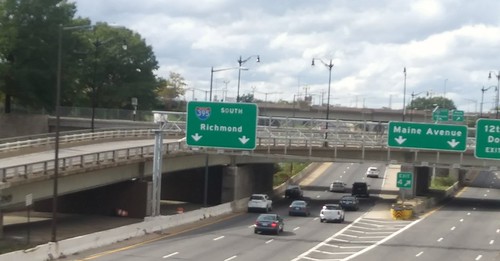
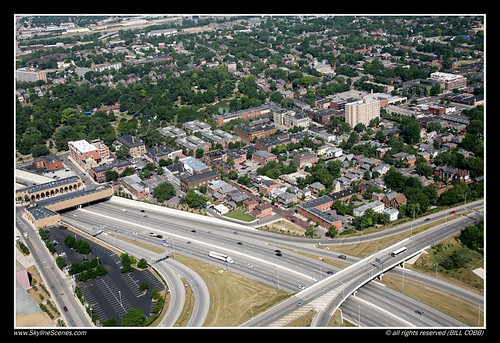
I-695 in DC looking west from 4th Street SW
The Southeast-Southwest Freeway (I-695) in DC looking west from 4th Street SW.


The program should include dedicated transitways.  DC will be testing some Downtown, and has implemented them on and off on 7th Street/Georgia Avenue NW. (Bus advocates in London argue that with dedicated transitways, bus throughput improvements would be even greater.)

-- "Dedicated bus lanes coming to H and I streets this summer," Washington Post
-- "It's been a drawn out process, but DC is in the process of creating transitways on 16th Street NW," 2017

This program could also include some road decking, such as on North Capitol Street and the Southeast-Southwest Freeway.

-- "Tunnelized road projects for DC and the Carmel Tunnel, Haifa, Israel example--tolls," 2011
-- "London Mayor proposes roadway tunnels to divert surface motor vehicle traffic and congestion" 2016
-- "Maryland HOT lane study versus "corridor management" and regional scaled transportation planning," 2018
-- "Who knew? There's been a freeway deck in Oak Park, Michigan over I-696 for almost 30 years," 2018

I haven't written about it, but tunnelizing DC-295/The Anacostia Freeway, would be a boon to the quality of life and economic potential of a large section of the city East of the River.
Anacostia Freeway (DC 295)


This video by Bossi of DC 295 has unrelated sound.  I'd turn it off before listening, unless you want to listen to an old Diane Rehm radio broadcast.

If we had true metropolitan transportation planning, the Maryland HOT lane study could be coordinated with a DC tunnel/decking study.  For example commuter tunnels on 16th Street and Georgia Avenue would make sense to be integrated into the Maryland system.

-- "Here's a look at who's using Northern Virginia's 495 and 95 Express Lanes," Washington Post, 2018
-- "Poll: 61 percent of D.C.-area residents favor plan to add toll lanes to Beltway, I-270," Washington Post

Labels: , , , , , , ,

Saturday, November 24, 2018

Who knew? There's been a freeway deck in Oak Park, Michigan over I-696 for almost 30 years

Freeways have been controversial in cities for many reasons.  They facilitate sprawl.  They sever neighborhoods.  They are noisy and impair air quality.  They've been used as a deliberate urban renewal device targeting low income communities and people of color.  They also support economic activity.

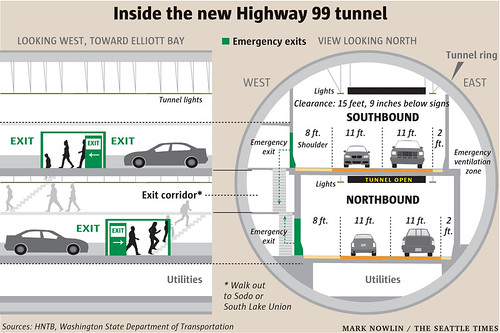
A more modern response to some of these problems is to tunnel freeways.  That happened with the "Big Dig" in Boston ("10 years later, did the Big Dig deliver?," Boston Globe) and is happening in Seattle, where the elevated Highway 99 is being re-created as a tunnel, although there the motivation isn't aesthetic, but has to do with the potential for earthquakes and re-engineering for withstanding them.

It ended up being cheaper to build a tunnel than to rebuild the freeway.  It will be opening early next year ("When does the viaduct close? How much is the tunnel toll? Your guide," Seattle Times).

Graphic of Highway 99/Alaskan Way Tunnel, Seattle
Graphic of Highway 99/Alaskan Way Tunnel, Seattle.

It's happened in a bunch of cities in Europe including Madrid, Marseille and Thessaloniki.  Singapore has a series of underground freeways although the country has dialed back on the expansion of this network.

-- "City Parks, Like Madrid Río, Stand Where Highways Did," New York Times
-- "6 Freeway removals that changed their cities forever," Gizmodo

DC has some decks over I-395 between the National Mall (where it is tunneled) and between Constitution Avenue and K Street NE.

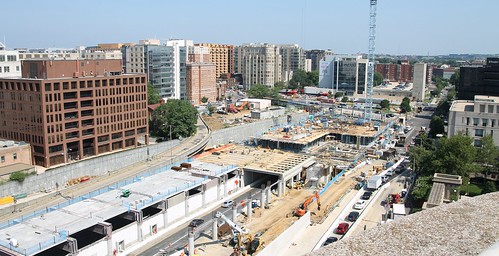
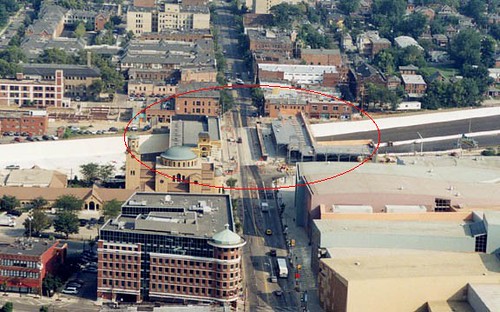
 A big development called Capitol Crossing is underway between Massachusetts Avenue and D Street, where a multi-building complex is being constructed.
Capitol Crossing freeway deck under construction

There's been talk about doing a similar development in Rosslyn, Virginia, but because the cost of construction is so high, it's not economically feasible to pursue it at this time, given the high vacancy rates for commercial office space in Northern Virginia.

I've suggested that such tunnels ought to be constructed in DC to divert commuter traffic from surface streets, because it has such deleterious impact on neighborhoods.

-- "Tunnelized road projects for DC and the Carmel Tunnel, Haifa, Israel example--tolls," 2011

Decks for parks.  The Bloomingdale Civic Association in DC is pursuing "decking over" part of North Capitol Street, not so much because they are looking to tunnel commuter traffic, but because of how the tunnel separates the Bloomingdale and Eckington neighborhoods, and they recently got a grant from the American Architecture Foundation to being planning for this.

They call this the Bloomingdale Village Square/Village Center project.

Separately, there is a parallel effort in the Dupont Circle neighborhood to deck over part of Connecticut Avenue where it is tunnelized, although I rue that it is not part of a broader package of complementary urban design improvements, something I'm long overdue in writing about.

-- Connecticut Avenue Streetscape and Deck-Over Project, DC Department of Transportation

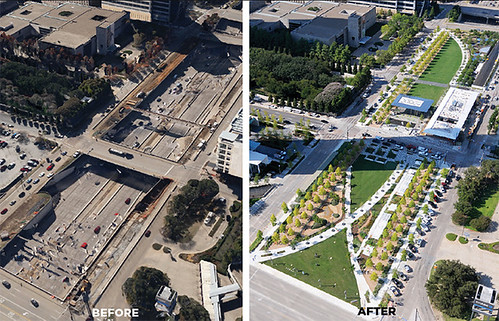
The Klyde-Warren Park in Ballas is one example of a deck over a freeway for a park, and it's gotten a lot of press over the past few years because of its trendsetting nature ("Cities Are Banishing Highways Underground — And Building Parks," Stateline).
Klyde Warren Park, Dallas, before and after photos

It took decades to build finish building a suburban freeway in the Oakland County section of Greater Detroit, because it had to be threaded within existing communities ("AFTER 32 YEARS, MOTOR CITY GETS NEW LIFELINE," Chicago Tribune, 1989).

Imagine my surprise earlier in the week to learn that there's been a park deck over the I-696 Freeway in Oak Park, Michigan in Oakland County for almost 30 years.
800px-Interstate_696_pedestrian_plazas_Oak_Park
This happened a couple years after I had moved to DC, and the primary motivation for construction was to enable  people's ability to walk to temple on the Sabbath in a comfortable manner in a heavily Orthodox Jewish community..

It happens that now there are problems with the bridge and parts of it need to be reconstructed ("Park-like Oak Park bridge over I-696 slated for $25-$30M replacement," Detroit Free Press).

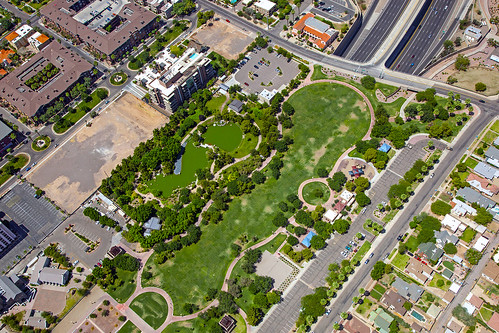
Apparently, part of I-10 is routed underground in Phoenix through the construction of a series of bridges over the freeway, creating a tunnel about one-half mile in length and is topped by a park ("a href="https://www.azcentral.com/story/news/local/phoenix-contributor/2016/11/01/why-does-downtown-phoenix-have-tunnel/92709238/">Why does downtown Phoenix have a 'tunnel?'," Arizona Republic). It was constructed in 1990.
Margaret T. Hance Deck Park, Phoenix, over I-10

Another building focused freeway cap.  In Columbus, Ohio, one of the overpasses for the I-670 freeway has a deck constructed alongside, for buildings, which connects the street fabric between the two sides of the freeway ("Ohio highway cap at forefront of urban design trend," Chicago Tribune).
I-670, Columbus, Ohio

I-670 freeway cap, Columbus, Ohio
Photo: Meleca Architecture and Urban Planning


A building cap over railroad tracks in Queens, New York.  This is comparable to the Lefferts Boulevard Bridge atop of the tracks at the Long Island Railroad Station in Kew Gardens, Queens, in New York City.  That bridge was constructed in 1930 and is in need of replacement ("A Bridge, the Rickety Heart of Kew Gardens, Gets a Reprieve," NYT).

Labels: , , , , ,

Tuesday, February 09, 2016

London Mayor proposes roadway tunnels to divert surface motor vehicle traffic and congestion

Central Artery before and after, Boston.  

According to the Guardian ("Boris Johnson unveils road tunnel plans to ease London congestion"). From the article:
“Around eight of every 10 journeys in London are made using our roads – whether by car, taxi, motorbike, bus, cycle, foot or freight – which is why it is vital that we think big. We must deliver long-term solutions that will not just make the most of the space we have for road users but bring environmental and amenity improvemhistents to local areas.” ...

He added: “By pushing forward strategic initiatives we are outlining today, we will lay the foundation for the next wave of improvements to everyone’s experience of the road network across the city.”

The major road tunnels are based on the strategies pursued in Stockholm and Boston, although the latter’s “Big Dig” proved difficult, costly and controversial. The success of flyunders in transforming parts of cities such as Madrid, where its inner ring road was partially buried, may make the smaller projects more viable. TfL believes a 1.3km tunnel at Barking could create a new neighbourhood of 5,000 homes in a blighted area, and that either tolls or the housing could make the project pay for itself.
Who knew that there is the International Tunneling and Underground Space Association?

-- "Urban Road Tunnels," ITA
-- "MADRID CALLE 30: AN URBAN TRANSFORMATION PROJECT"

I mention this because I have suggested this in the North Capitol-Blair Road corridor in DC, and support it for through traffic on New York Avenue (the equivalent of a connection between I-95 through DC to Virginia)--this is not my idea originally, it was suggested in the New York Avenue Transportation Study about ten years ago. 16th Street NW would be another corridor where this is worth considering.

The justification is that the negative impacts on abutting neighborhoods are significant and worthy of mitigation.  The underground trip would be faster and therefore should be worthwhile for users, thereby justifying toll charges for the privilege.  See "Tunnelized road projects for DC and the Carmel Tunnel, Haifa, Israel example--tolls."

I didn't know about the Madrid example. Marseille removed a highway along the waterfront by shifting it to an underused rail tunnel. Thessaloniki built a tunnel around its historic waterfront to divert surface/through traffic and create a more pedestrian-centric environment along the waterfront.

In Long Beach, an undergrounded rail tunnel, the Alameda Corridor, was built to facilitate freight movement between the port and the freight railway system.

It could have been interesting to have also built a tunnel for truck traffic between the port and the highway system, since the road system is inundated with truck traffic generated by the port.

Miami is creating such a facility, the N.W. 25th Street Viaduct Project, between the Miami Airport's cargo hub and the local freeway system (pictured at left).*

Of course, Boston's "Big Dig" or Central Artery Freeway is another example ("10 years later, did the Big Dig deliver?," Boston Globe) although it is not tolled.

Note that the tunnel underpasses in various places in the city, such as at Massachusetts Avenue and Thomas Circle for the roadway system and on North Capitol Street between M Street and Rhode Island Avenue, were early attempts to facilitate traffic movement but without providing simultaneous improvements in conditions for neighborhoods and the urban street fabric.

Capitol Crossing, before.  

The Capitol Crossing development, which will deck over of the I-395 freeway between Masachusetts Avenue and D Street NE is an example of decking over an existing facility, without creating a new tunnel.


Reknitting the street grid in Washington by decking over more of I-395.

==========

* Separately, I wonder if the Long Bridge reconstruction project--the bridge carries passenger railroad, freight railroad, and subway trains over the Potomac River between Southwest DC and Arlington County--should add lanes for a bi-directional dedicated busway.

It could serve National Airport when the subway is closed as well as tour bus traffic and other bus traffic to and from DC.

Labels: , , , , , ,

Tuesday, December 15, 2015

Top DC area transportation stories of 2015

[At some point, the numbering becomes arbitrary.]

1.  Gasoline/oil price drop.  While this started as a 2014 story, as the price dropped in half from June 2014 to the end of the year ("Oil Prices: What's Behind the Drop? Simple Economics"), now forecasters argue that low prices are here to stay, given drop in demand, increase in supply.

This impacts the cost-effectiveness of electric vehicles, increases vehicle miles traveled ("VMT Increases 19th Straight Month, Federal Report Shows") and reduces the demand for transit.  VMT has been decreasing on a per capita for some time.

2.  WMATA (DC area Metrorail subway service) tunnel fire at L'Enfant Station in January results in one death, continues to demonstrate safety and other operational failures.  Ridership continues to drop, while nationally, transit ridership is increasing.

In the fall, the US Department of Transportation assumed safety oversight for WMATA.  Later, Secretary Foxx of the US Department of Transportation, said that WMATA has no business working on expansion until it gets its operations right

Washingtonian's December cover story is on Metrorail ("The Infuriating History of How Metro Got So Bad").

3.  Continued degradation of the quality of WMATA's transit service/financial problems/ difficulty in hiring a general manager.  Paul Wiedefeld, who held various top jobs in Maryland, was finally chosen.  During the search process, top USDOT personnel took jobs elsewhere.  Elissa Knove is Deputy CEO of Metrolink in Southern California and Peter Rogoff is the new GM for Sound Transit in Seattle/Puget Sound (New Sound Transit CEO excited by big light-rail expansion," Seattle Times).

4.  In Maryland, Republican Governor Larry Hogan drops the Red Line light rail program for Baltimore City and County and reshapes the state's commitment to and the cost of the proposed Purple Line light rail program in Montgomery and Prince George's Counties.  A few months later, plans to improve Baltimore-area bus service are put forward to make up for the dropping of the Red Line.

5.  The May Amtrak crash in North Philadelphia kills 8 and injures more than 200, leading to more calls for Positive Train Control, and problems on the Northeast Corridor line, at least for awhile.  The investigation for causes continues.

6.  The ongoing debacle of the DC Streetcar, in testing for more than one year, when cities like Dallas manage to complete the test phase and start revenue service in 6 weeks, gives automobility opponents of transit a lot to cheer about and anti-government folks the ammunition they need to denigrate the ability of government to perform generally and to construct infrastructure specifically.

Still, more than $500 million in new development is underway or planned on the H Street corridor, which can be attributed to the forthcoming streetcar.

By comparison, the Cincinnati Streetcar construction and launch project has entered its testing phase, although it is not scheduled to launch until September 2016 ("City: 'Live-power' streetcar tests in Downtown Tuesday," Cincinnati Enquirer).  Construction started in 2012.  This is ironic because the Cincinnati project is managed by John Deatrick, former chief engineer for DC Department of Transportation.

Photo by Sarah Ann Jump, Fredericksburg Free Lance-Star.

7.  Tolling expansion.  In Virginia, the commitment is made to extend the I-95 lanes two miles further south to facilitate merging, although some believe it should be extended even further ("Stafford Supervisor rents billboard to get commuters views on traffic," Fredericksburg Free Lance-Star).

Plans to extend HOT access on I-395 ("Virginia to extend I-95/395 HOT lanes north to D.C. line," Washington Post).

Proposals put forward to toll I-66 ("State Approves I-66 Inside the Beltway Plan: Tolls Begin in 2017," Fairfax County) also used by Republican candidates in the 2015 election cycle to lambaste Democratic opponents.  New tolls and proposals for tolls in more places in Hampton Roads (Tolls articles archive, Norfolk Virginian-Pilot).

In Maryland, Governor Hogan cuts toll rates ("Governor Hogan Rolls Back Tolls Statewide," press release) the Inter County Connector begins to see increase usage, and the I-95 ETL toll lanes north of Baltimore experience more usage after opening in December 2014.

8.  Silver Spring Transit Center  (at right) finally opens in late September, without any ribbon cutting, because of the many year delays in opening ("Multiple missed opportunities in the creation of the Silver Spring Transit Center"). It's another example of transit infrastructure construction problems calling into question government performance.

9.  Death and violence associated with Metrobus service in DC (stabbing death at 8th and H Streets NE, shooting death of community journalist Charnice Milton at Pennsylvania and Minnesota Avenues SE while waiting for a bus, shots fired leads to a period of re-routing night-time bus services away from Elvans Road SE).

10.  Dulles Airport continues to lag National and BWI Airports.  Virginia Governor McAuliffe wants to put more money into marketing and other improvements ("Virginia Gov. McAuliffe proposes a $50M boost for Dulles Airport," Washington Post).  WMATA decides not to drop the 5A bus to Dulles, since the Silver Line won't serve the airport for a few more years.

11.  Railroad passenger service expansion moves forward.  Plans to expand Union Station and to improve rail service between DC and Richmond continue to move forward.  DC launches a "State Rail Plan" planning process ("State Rail Planning Initiative in DC"). Virginia Railway Express grows.  Why doesn't the Virginia Department of Rail and Public Transportation DC to Richmond Southeast High Speed Rail planning process hold a meeting in DC?  C100 lawsuit against the Virginia Tunnel CSX expansion project fails.

12.  Biking.  DC proposes legalizing the Idaho Stop for bicycling.  Former Episcopal Bishop gets serious jail time for killing a bicyclist while drunk ("Former Episcopal bishop Heather Cook sentenced to seven years for killing cyclist," Baltimore Sun).  In DC, fines are supposed to go up for certain traffic infractions ("Violate DC traffic laws? It's gonna cost you — a lot," Washington Post).

After 12 years, Andy Clarke steps down as president of League of American Bicyclists (Q&A: The League's outgoing president on state of biking," BikePortland), goes to work for Toole Design, the transportation planning consulting firm based in Silver Spring, Maryland.  Greg Billing succeeds Shane Farthing as director of Washington Area Bicyclist Association.

13.  Richmond hosts UCI Road Racing world championships in September to such success that Discover Richmond Magazine and Richmond Magazine name bicycling as "Richmond's person of the year in 2015." The Virginia Capital Trail, a 55-mile path between Williamsburg and Richmond, is almost fully completed, over a ten year period, along with other bike infrastructure improvements spurred by the Road Championships.

14.  More transit oriented development in Fairfax County in the catchment area of the Silver Line, accompanied with belated acknowledgement of the need to improve pedestrian access around Silver Line transit stations ("U-Va. professor takes steps to measure Tysons’ path to a pedestrian paradise," Washington Post, and ridership below projections ("Silver Line ridership in Tysons well below Metro estimates," WAMU-FM).

15.  Car sharing.  Car2Go expands to Arlington County, Virginia.  Zipcar loses the franchise for car sharing exclusivity on WMATA station grounds to Enterprise Rent-a-car.  In DC and other locations, Car2Go adds a $1 surcharge per trip, capped at $90/year.

16.  More bike infrastructure improvements and planning.  More bikes and stations for bike sharing as Motivate, the successor firm to Alta Bike Share, invests in capacity, improvements, and innovation.  More bike lanes.  DC starts using brighter green paint in bike lanes.  The Potomac Yard trail in Alexandria and Arlington opens.

Montgomery County starts a new bike master planning process, focusing on "comfort."  Prince George's plans the Central Avenue Corridor trail ("Comments on Central Avenue Connector Trail concept") and looks to join in on bike sharing ("Prince George's considers connecting with Capital Bikeshare," Washington Post).  Baltimore, after some failed attempts, looks to launch bike share service as well.  Richmond too.

But why does DC continue to install bike non-compliant sewer grates?  Why was the opportunity to build a cycle track on Military Road missed? ("Lost opportunity to build cycletrack on Military Road").

A Split vehicle on Dupont Circle.

17.  New mobile-enabled transportation services continue to be launched in DC including jitney type services by Bridg and Split, carpooling via Uber, etc.  I don't think they are the "game changers" claimed by the firms, but they do expand choices and facilitate mobility.

Local firm TransitScreen deploys transit information media presentations around the country.

18.  More bike capacity on trains: weekend Penn Line MARC train service and simplified bike service now available on Amtrak along the C&O Canal National Park and Great Allegheny Passage trails between DC and Pittsburgh ("Amtrak Offers More Bike Service on the Capitol Limited").

19.  Gabe Klein, former Director of DC Department of Transportation authors a book, Start-Up City, published by Island Press.

 20.  People continue to die in traffic accidents.  In DC, more pedestrians die than motor vehicle operators and passengers ("Crossing a street in DC can be a dangerous undertaking," Washington Post).

But that makes sense to me, given that the nature of DC's road network means that extremely high speeds--a factor common to a preponderance of accidents nationally--are much less of an issue compared to driving conditions in the suburbs and exurbs.

Labels: , , , , , , , ,

Wednesday, October 15, 2014

Fox 5 (WTTG--TV) automobile-centric perspectives in transportation reporting (and tolls)

We were watching the news the other night and there were three transportation stories.  All were very much "driven" by the perspective of the car driver.  One was on automobiles taking cuts at the intersection of the Key Bridge and Canal Street in Georgetown and repainting to create a distinct "island" and the installation of .lane delimiters to prevent that behavior.  The newscasters were proud because this was done in response to one of their previous stories.  (I've already forgotten the second story.)

High Occupancy Toll Lanes on Freeways and mistaken charges.  The third story ("Man gets $17000 E-ZPass fine for unpaid $36 express lane tolls") was about how a guy got screwed by TransUrban, the operator of the High Occupancy Toll lanes in Northern Virginia, the I-495 Express Lanes.

He had a transponder and automatic replenishment on his EZPASS account, but on some trips the transponder wasn't acknowledged by the recording equipment.  (Most new tolling systems don't employ toll booths, but automatically record and bill trips through the system.)

He said he wasn't notified of the trip recordation errors.  He ended up getting 17 summons--each with a $1,000 fine--for each unpaid trip.  The FOX5 investigative reporter helped him get this knocked down to under $15 each, but he was still screwed.

Then there was the inane discussion between the anchors and the reporter about the toll system, etc., that was pretty much devoid of substance.  Certainly they didn't provide any substance of how the lanes came to be.  Or that there isn't a good system for dealing with these kinds of problems, because the toll roads are controlled by a private operator, not the State of Virginia.

Image from AA Roads.

The real issue of HOT Lanes and private sector operation of roads.  While the newscasters were patting themselves on the back for helping the guy, they didn't show much knowledge or depth about the culture behind the HOT lanes scheme--which is pushed by conservative interests, and apparently is a big agenda item of the libertarian Reason Foundation, which has published a number of reports on the topic.

While the lanes are touted because they provide "free" access for HOV (High Occupancy Vehicle) and transit use, the vast majority of users are single occupant vehicles.  In short, HOT lanes add capacity for the people willing to pay.

The Miami Herald has a nice investigative piece, "Toll lanes becoming all the rage in Florida," on the back story behind the creation of these types of freeway lanes in Florida.  Of course, providing that level of information is beyond the depth and capacity exhibited by local television news programs, including WTTG-TV.

Also see "The hidden price of public-private partnerships" from the Toronto Globe and Mail. From the article:
Governments are essentially “renting money” they could borrow more cheaply on their own because it’s politically expedient to defer expenses and avoid debt, Prof. Boardman added. P3 has become a “slogan” with often dubious benefits, he said. 
Based on a new study of 28 Ontario P3 projects worth more than $7-billion, University of Toronto assistant professor Matti Siemiatycki and researcher Naeem Farooqi found that public-private partnerships cost an average of 16 per cent more than conventional tendered contracts. That’s mainly because private borrowers typically pay higher interest rates than governments. Transaction costs for lawyers and consultants also add about 3 per cent to the final bill.
The states say they don't have money for freeway expansion, so the private sector builds the lanes in return for multi-decade long contracts.  For example, the concession for the Midtown Tunnel in Norfolk, Virginia is 58 years.

In Virginia and Maryland, HOT lanes were initiated by Republican governors, but are now part of what is considered normal, standard operating procedure.

Arlington County's principled opposition.  Because Arlington County, Virginia's Master Transportation Plan is specifically focused on reducing single occupancy vehicle trips they did not approve of extending such lanes on freeways (I-395 ad I-66) in their county.  And that is the rub.  Do such lanes encourage more driving or ease congestion?

Needless to say, the Washington Post editorial page didn't favor Arlington's position ("When plan = vision and policy is consistent:; Arlington County and HOT lanes").

Note that the ArCo opposition wasn't about tolls, but about the way such lanes promote more driving.  (They may or may not have a position on privatization as well, but that wasn't an element of the suit.)  The County was punished by the State Legislature for their opposition, and retaliated by taking away the county's ability to assess tourism taxes on hotel stays.

Tolls and the Silver Line.  Tolls have been a major funding source for the Silver Line, paying upwards of 50% of the total cost.  The State of Virginia has provided very little funding towards the system's construction.

Besides federal funding, the majority of funding has come from tolls assessed on the Dulles Toll Road, control of which was transferred to the Metropolitan Washington Airports Authority, which is the agency given ultimate responsibility for funding the Metrorail expansion project, because of the ostensible reason that the purpose of the line is to provide access to Dulles International Airport (cf. "Short term vs. long term thinking: transit, the Washington Examiner, Fairfax/Loudoun Counties vs. DC").

Prices have escalated over the course of the construction of Phase One, which added five stations serving Tysons Corner, McLean, and Reston in Fairfax County, opening for service in July, and will continue to do so ("Silver line changes equals higher toll road charges," WUSA-TV).

Labels: , , , ,

Wednesday, May 14, 2014

Moving towards the ultimate Parking Space Management System: License-Plate Enabled Parking from Digital Payment Technologies

The City of Miami Beach Parking and Transportation Department has just introduced "License Plate Enabled Parking" as an element of their street parking management system, using equipment and software applications from Digital Payment Technologies, a Canadian firm.

According to the press release announcing the introduction:
With LEP, consumers simply enter their license plate number at the pay station when paying for parking and then continue on to their destination. They do not have to return to their vehicles to display a parking receipt, nor do they need to remember specific parking space numbers. With DPT's integration with Parkmobile, consumers also have the option of paying using their mobile phone.
The system is explained by the infographic (left) and can be integrated with a wide variety of related services that simplify parking management, payment, enforcement etc.

The system integrates technology from three separate firms:

-- LUKE II multi-space pay stations by DPT
-- Mobile payment service from Parkmobile
-- License Plate Recognition (LPR) system from Genetec

and it happens that Miami Beach outsources parking enforcement, to OmniPark.

Reductions in citations likely?  I can see the system resulting in fewer citations being issued, because people can get notices about when the meter is supposed to expire and just add payment.  That will reduce fine revenue sure, but it will also reduce consumer aggravation, which is a net benefit.

Towards a transponder based system and implications for gas taxes vs. mileage charges.  But the system isn't designed like the EZPASS toll system where you could have a card device on the windshield that would register once you parked (maybe you'd have to hit a button) and the transaction could be initiated automatically.

It occurs to me that a transponder-enabled fee collection system dealing with parking and integrated with toll collection systems makes it easy enough to do mileage-based charging.

I've argued that it is a lot more complicated to have individual accounts for everyone instead of just charging a higher gas tax, but as can be seen with the LEP system, you only need to add a couple more elements and a fee collection system integrating parking, tolls, mileage, and insurance is "easy enough" to create.

Of course, you need a wi-fi mesh network "everywhere" to be able to integrate such a system and it has to work all the time.

Other interesting Miami Beach parking policies for residents.  Separately, the Miami Beach T&P Department has two programs that provide benefits to residents paying for parking. Programs like those in DC would go a long way towards addressing some of the resident aggravation about the various parking programs in DC.

First, the city provides a flat rate of $1 per hour for resident parking at street meters, which is a 43% discount off the $1.75 per hour rate. Second, residents using the ParkMobile online app for parking within the city are not charged the transaction fee that is normally charged for using the app to pay for parking.

Labels: , , ,

Thursday, April 17, 2014

DC proposal for HOT lanes doesn't seem to make sense

The point of HOT or High Occupancy Toll lanes is (1) adding lanes (2) accessible only by paying tolls (3) financed through private ventures expecting toll revenues to be high (4) but allowing vehicles with multiple passengers ("high occupancy") free or reduced pricing.

Basically they are HOT or "High Occupancy" or pay "Tolls" lanes -- HO/T lanes.

The lanes can be controversial because much of the momentum for creating them is ideological (such as in Virginia and Maryland, where projects were pushed forward by Republican Governors) and desperation to come up with money for freeway expansion, because they are more about generating new revenues and could be seen as inducing more driving, just for people who are willing to pay a premium price.  See "For Virginia commuters, new era begins with HOT lanes" and "Highway historian looks at HOT lanes projects" from the Washington Post.

Arlington County did not allow HOT lanes to be installed on freeways in their jurisdiction, because they believed that such lanes would be contradictory to their Master Transportation Goals that de-emphasize "single occupancy vehicle" trips ("Arlington Will Withdraw HOT Lanes Suit," Arlington Now).

Washington Post graphic showing where proposed HOT lanes in DC would be placed.

Yesterday's Post has an article "DC considers adding carpool, toll lanes to part of the 14th Street bridge," stating that DC's Dept. of Transportation is proposing some high occupancy toll lanes on the city's freeways "to reduce congestion."

HOT lanes in DC wouldn't be new lanes, but repositioning of current lanes.

But I don't think they'll have much impact on reducing congestion because driving in DC on these roads is a function of moving "between other places" and if the origin and destination points don't have comparable congestion reduction measures in place, HOT lanes in DC won't make much difference.  Also see "DC HOT lanes plan will bump into reality" from the Washington Post.

They might raise some revenue though.  And since they wouldn't involve the construction of new lanes, the costs to impose the tolls wouldn't be that great.

Still, I would argue that this is yet another proposal in need of guidance from a Master Transportation Plan.

But I could be swayed if the city would commit all the revenues to other transportation improvements elsewhere in the city.

Labels: , , , ,

Tuesday, February 11, 2014

Tolls, parking taxes, elections, oh my!

1.  Candidates for office pander to motor vehicle operators.  Maryland gubernatorial candidate Doug Gansler promotes cutting tolls on the Inter County Connector by half to increase use of the relatively under-used $2 Billion highway.  He avers that revenues will be the same.  See "Gansler proposes 50 percent discount for frequent users of Intercounty Connector" from the Washington Post.

The Inter County Connector is a toll road in Upper Montgomery and Prince George's Counties in Maryland, supporting exurban development.  Photo during construction.

I think of this as typical pandering for votes.  After all, nationally, almost 90% of total trips are accomplished via motor vehicle--in Maryland, it would be less than the national average because of transit systems in the Washington and Baltimore areas.  Most people who vote are drivers and would see advantages to cuts in tolls.

Note that someone else running for re-election, Andrew Cuomo in New York State, has just done something similar for Staten Island residents.  See "New York State Agrees to Cut Toll for Verrazano Bridge" from the New York Times.  According to reports, the MTA is under-resourced and can't really afford this cut.  

Too bad Mr. Gansler isn't advocating more funding for transit, to cut fares...  But according to his issues page, transportation isn't separated out as a separate issue.  His jobs & economy webpage talks about manufacturing, without acknowledging the significant changes that have occurred within the various industrial sectors as a result of globalization.

2.  The advocacy group Purple Line Now is holding a Transportation Forum with Maryland's Gubernatorial Candidates on Tuesday, February 18 at the Montgomery College Cultural Arts Center on the Takoma Park/Silver Spring campus
Candidates who declared or filed their intentions by the end of January 2014 were invited to participate in the event. At this time,  Attorney General Doug Gansler, Delegate Ron George, Mr. Charles Lollar and Delegate Heather Mizeur have confirmed.  Candidates will share their position on the current transportation situation in Maryland, their vision for the future, and what they, as governor, would do to help that vision become a reality.

The event is free to the public but space is limited and all seats must be reserved in advance by completing this easy Ticket Form.
3.  Advocacy groups ought to create a unified advocacy agenda for sustainable transportation to use during elections.  While that the forum is great, I think it would be even better for advocacy groups to come together and create a citizens platform for sustainable transportation and ask for the endorsement of such a platform by the candidates.  

I'd say groups like Purple Line Now, Action Committee for Transit, BikeMaryland, and the Coalition for Smarter Growth to name a few, need to work together on this.

Otherwise, candidates mostly get a pass, and get to mouth platitudes.  We're making a mistake if we are expecting the candidates to be our saviors.  Note that all of Maryland's candidates for Governor, except for Ron George, fail to list transportation as a plank in their campaign platforms.  Here is Ron George's, which doesn't mention sustainable transportation at all:
VIII.  Create a Pro-active Transportation Plan     
  • Create a true lock-box for the Transportation Trust Fund that no legislative body can draw from for other needs so all interested parties can have predictability.
  • Put all gas taxes toward state road and bridge creation and improvements. (note the aforementioned repeal of the 2013 gas increases and its required forced automatic increases.)
FWIW, I recommended a similar course of action during the last election cycle--of the creation of a common sustainable transportation advocacy agenda and platform.  

Right: a panel for an election brochure by Hans Riemer.  He did not win election in 2006, but he did in 2008.

I will say that in 2006, Action Committee for Transit made the Purple Line a campaign issue in Montgomery County and state elections, and I think this was vitally important in getting that project back on track after it had been sidetracked in favor of the ICC by the previous Republican state government administration.

In my opinion, ACT deserves most of the credit for the moving forward of the Purple Line project, especially as a light rail and not a bus project.

4.  People don't like tolls in Norfolk, Virginia.  Speaking of tolls, the Elizabeth River Tunnel in Norfolk, Virginia has been tolled to pay for an additional tunnel.  Rather than pay for it, the State of Virginia agreed to a 50+ year deal with an international consortium, guaranteeing a minimum return of 13.5%.  People in those parts aren't happy about it and say that an increase in the state gas tax could have paid for this and other infrastructure needs.  

Anyway, after tolls were introduced last week, traffic dropped significantly.  See "Traffic down 21.8 percent after first week of tolls" from the Norfolk Virginian-Pilot.

If they would just cut the price in half...

5.  We need taxes on parking, but don't expect big changes in land use as a result of the tax. Streetsblog calls our attention to an Atlanta Bicycle Coalition post, "Here's an idea," suggesting that a tax on parking lots and structures would encourage denser, more urban uses.  

Left: parking lots surround the Southeast Federal Center area in DC sometime in the 1990s.   Photographer: Carol Highsmith.

While I agree that parking should be taxed, and the monies used for sustainable transportation, in part to pay for the negative costs parking imposes on a city, it's somewhat facile to believe that such a tax will induce different forms of land use in places where the automobile is the dominant form of transportation.  The tax is just passed through to the customer.  (Note that in DC, parking provided free by employers is not taxed, and it should be.)

It's only when transit is a viable alternative and a lot of people use it that it begins to make financial sense for cities and developers to change land use and transportation paradigms to support transit, walking, and biking and placemaking, and not roads and freeways and parking.  

In DC, where 50% or more the trips to the Central Business District are made by transit, building parking is unnecessary.  But it didn't used to be.  Through the 1990s, Downtown was full of parking lots.  It was only as more people changed their residential and employment patterns in ways where using transit was optimized--helped of course by the federal government providing subsidized transit passes to federal workers--that the previous dynamic in favor of automobile commuting was reversed.

Right: graphic from the Baltimore Sun.

Note that there are some interesting examples of parking taxes.  Baltimore uses its parking tax to pay for the Baltimore Circulator, which is a free intra-city transit service.  See "Making the case for intra-city (vs. inter-city) transit planning."

To be fair to the ABC, it wasn't til I was on a walking tour at a conference in a city without a fixed rail transit system and where transit was mostly unused, before I fully understood this issue.

In that city, it's not unreasonable for residents to be reflexively opposed to development, because virtually everyone will travel to and from the site via car.  In DC, especially for projects built near the subway stations, a majority of the trips will be conducted by transit, or depending on the location, by walking or biking.  The increase in car traffic from transit-adjacent development can be pretty minimal.

The point is to focus on enabling transit and transit-centric development.  It takes a long time to do so.  It took between 20 and 30 years to begin seeing the impact of the Metrorail system on DC, both in the core and outside of it, in neighborhoods served by transit stations.  

Now it's taken for granted.  (But mostly by people who don't know or don't remember what it was like before.)  But it wasn't facilitated by a tax on parking...

Labels: , , , , ,

Thursday, October 24, 2013

UMD School of Architecture Lefrak Lecture: Martin Wachs, Wednesday October 30th


2013 Annual Samuel J. Lefrak Lecture and Seminar 
Dr. Martin Wachs
"Taking Charge: Taxes, Tolls and the Crisis in Transportation Finance."
University of Maryland
School of Architecture, Planning, and Preservation

Lecture: Wednesday, October 30, 2013
8:00 pm to 9:45 pm: Auditorium
With reception to follow

Seminar: Thursday, October 31, 2013
9 am to 10:30 am: Room #1200: Dean’s Conference Room

---------
Martin Wachs is one of the leading academic researchers (emeritus professor at UCLA; senior researcher at the Rand Institute studying transportation financing.  It's worth your going to hear him speak.

He has many reasonably recent publications on transportation financing.

Labels: , , ,

Tuesday, July 02, 2013

Road building, induced demand, and tolls

It's a well accepted principle in transportation planning that if you build more roads and lanes, after a period of congestion improvement, congestion again increases as more people make more trips.  This is called "induced demand."

Right: graphic on length of time improvements from driving trips on the I-495.  Source: Inrix Traffic. Laris Karklis and Bonnie Berkowitz/The Washingon Post.

So it's possible that the report in the Washington Post ("Drivers see less congestion on area roads") that with the addition of High Occupancy Toll lanes in Northern Virginia and the tolled Inter County Connector in northern Montgomery County, along with general declines in driving per capita ("The End of Car Culture" from the New York Times) that pre-date the recession, is merely a blip resulting from current conditions, and one can't extend from it--especially if/when the economy picks up.

On the other hand, I wonder if there is a wrinkle to the general induced demand argument.

It's true that as long as it's basically free to consume a resource once you have acquired the means to do so (in this case a car) people will consume as much of it as they can.

Toll rate sign, I-495, Northern VirginiaCongestion is a non-cash expense that influences decisions people make about when and how and whether or not to make trips.

A perfect example is recounted in the Post article, describing how a woman working in Rosslyn got a job much closer to home.  This is a positive benefit of congestion as it "encourages" (choice) people making better decisions about how to use their time, where to work, to take transportation costs into account when making choices, etc.  From the article:

“It absolutely was a factor,” said Jennifer Hoh, describing her decision to take a job with a 20-minute rush-hour commute in Reston. It took about an hour and a half on traffic-snarled roads to reach her previous job in Rosslyn.  “Now work is a nine-hour day,” she said. “When I was in Rosslyn, the commute made it a 12-hour day.”

But what if the increase in road capacity is tolled, rather than free?

Can selective road expansion reduce congestion without necessarily increasing demand and the overall number of trips?

It's a question worthy of more study.  With regard to the article there are four issues and I guess you'd have to do more complex statistical analysis to separate out the effects:

1.  reduced driving overall;
2.  reduced driving due to the economic downturn;
3.  people making better location decisions concerning trip times/length;
4.  additional road capacity that is tolled as opposed to being untolled.

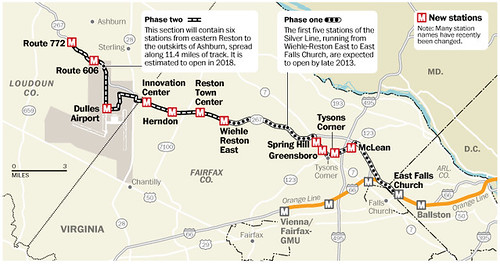
Silver Line heavy rail, WMATA, line alignment and routing mapRight: Silver Line station map.  Washington Post graphic.

And an additional factor is being introduced to the region, with the provision of direct subway connection to the Tysons Corner area, the largest employment center in the metropolitan area outside of DC.  While it will take a couple years to play out, having subway connections to that area will increase the number of trips but also will shift some trips to transit, thereby contributing to congestion reduction as well.

This is the case even though the trip time to get to Tysons by transit will be long and not cheap (especially during rush periods).

From the New York Times article:

But America’s love affair with its vehicles seems to be cooling. When adjusted for population growth, the number of miles driven in the United States peaked in 2005 and dropped steadily thereafter, according to an analysis by Doug Short of Advisor Perspectives, an investment research company. As of April 2013, the number of miles driven per person was nearly 9 percent below the peak and equal to where the country was in January 1995. Part of the explanation certainly lies in the recession, because cash-strapped Americans could not afford new cars, and the unemployed weren’t going to work anyway. But by many measures the decrease in driving preceded the downturn and appears to be persisting now that recovery is under way. The next few years will be telling.

“What most intrigues me is that rates of car ownership per household and per person started to come down two to three years before the downturn,” said Michael Sivak, who studies the trend and who is a research professor at the University of Michigan’s Transportation Research Institute. “I think that means something more fundamental is going on.”

Labels: , , ,

Tuesday, November 27, 2012

Virginia's road-building process is flawed, new study contends

See the article from the Norfolk Virginian-Pilot.

The basic problem is lack of public oversight, as these projects are greenlighted by the Governor's Office.

And the Governor serves for one term only (although former Governors can run again and serve nonconsecutively, now US Senator Mark Warner just decided not to do this).

So the projects, like the High Occupancy Toll Lanes* recently launched in Northern Virginia ("Virginia has high hopes for HOT lanes on the Beltway" from the Washington Times) or the plan to build a new expressway tunnel in Hampton Roads funded by tolls ("Va. officials moving forward with tunnel tolls project" from the Norfolk Virginian-Pilot) can be very ideological.

The report, An Analysis of the Virginia Public-Private Transportation Act of 1995, is published by the Southern Environmental Law Center. (press release)


Left: the Metro Expresslanes promotional campaign in Los Angeles included heavy duty outreach, including participation at street festivals, etc., and the sales of EZPass transponders from the van and in other public places.

* The opening in the last couple weeks of HOT lanes in Northern Virginia and Greater Los Angeles is another item on my long list of topics that I intend to write about.  The big problem is that HOT lanes promote "solo" driving at the expense of carpooling and transit.  State transportation departments are okay with this because of the revenue.  Local authorities concerned with promoting less traffic and more sustainable transportation modes, like Arlington County ("County Emerges Victorious As State Gives Up HOT Lanes" from the Arlington Now blog) are not so enamored.  Although I will say I have been impressed with the pre-opening promotional activities in LA.

Labels: , , , ,

Tuesday, November 15, 2011

Tunnelized road projects for DC and the Carmel Tunnel, Haifa, Israel example--tolls

(With apologies to Doug Willinger.)

1. Blair Road NW, Washington, DC.

For awhile I have been racking my brain, trying to figure out how to deal with the traffic impasse created as North Capitol Street trickles down into Blair Road, through Takoma, across the Maryland-DC line, to Georgia Avenue.

In the Takoma area the road is two lanes--an old country road--and is backed up for long periods of the day, doesn't make the area very congenial for walking and biking, can be dangerous, especially between Cedar Street and Piney Branch Road where there is no room for bikes and cars to jointly use the road during rush periods, and probably makes it harder to improve the little commercial district at 4th and Blair Streets.

The proposal for the North Central Freeway was supposed to follow the Metropolitan Branch Railroad line--north on the east side of the tracks and south on the west side of the tracks--but this would have destroyed the quality of life in the area (a very short portion of the route under Rhode Island Avenue was proposed to be tunneled).

Doug Willinger (various websites) has always said that a completely tunnelized freeway should have been considered.

While for many reasons, I don't favor big freeways, above- or below- ground, I am starting to think that the only way to address the Blair Road-Takoma conundrum would be to create a tunnel "freeway" for the through traffic focused mostly on getting from Montgomery County to DC's Central Business District.

The Reno (Nevada) Retrac project, where they took an at-grade railroad line and put it below grade, is an example of how it could be done, although I would argue for a completely underground and enclosed system.
Reno Retrac project

The Carmel Tunnel project in Haifa, Israel is an example of doing something sort of similar. Apparently there were massive traffic problems daily in Haifa, because of a mountain being "in the way" of where people wanted to go. Because they had to go around, traffic jams for most of the day were the result. The article "Tunnel scheme cutting travel times" from Traffic Technology International, briefly describes the project.

To deal with the congestion, they built a tunnel through the mountain. It's paid for by tolls. The price is about $3 for automobiles, $9 for public vehicles, and $15 for trucks.

2. New York Avenue/Route 50 tunnel

As I mentioned over the weekend, the New York Avenue Transportation Plan recognized that the big problem with traffic on New York Avenue is that because the road functions as a through freeway link from I-95 and the Baltimore-Washington Parkway to I-395 in DC, connecting to Virginia, much of the traffic on the road is "through traffic" not intended to stop in DC.

This through traffic makes much of the road--from the DC-Maryland line to Downtown DC--traffic engorged, unsightly, and uncomfortable, with negative contributions to quality of life for residents.
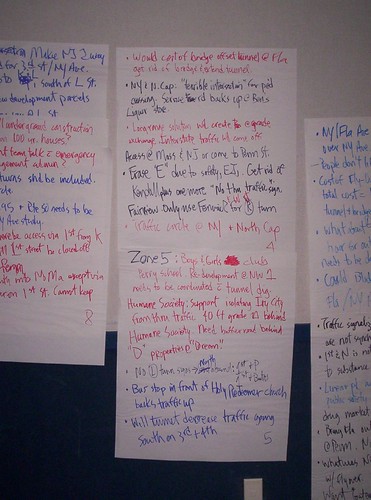
New York Avenue Corridor public meeting
Community comments at a New York Avenue Corridor plan public meetings, 2005.
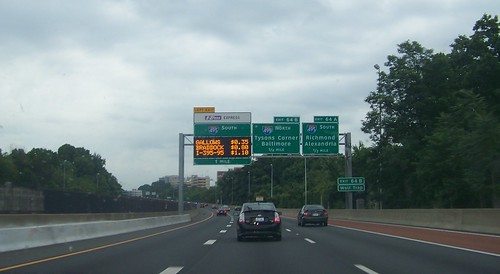
To deal with it, the planners on the study recommended that a partial tunnel be constructed, from somewhere between Brentwood Road NE and Florida Avenue, connecting to I-395 at New York Avenue, and tunnelizing that connection there.
i-395_sb_exit_003_05

They didn't go for broke and recommend a complete tunnelized solution from the DC-Maryland line to the I-395/New York Avenue junction, not because they didn't see the need, but because of the cost.

After all, the Central Artery Project ("Big Dig") in Boston cost over $14 billion for 3.5 miles. This length would be about 5 miles.

Still, one way to make it happen would be to charge tolls, just like the Carmel Tunnels project in Haifa.

3. Add a subway line on New York Avenue?

To make a New York Avenue tunnel project even more expensive, they could put a heavy rail subway line into it as well, from Bladensburg Road to Mount Vernon Triangle, although it could be conceived of, in part as a leg of the proposed separated blue line, which would continue west to Georgetown and then into Virginia.

4. General discussion on tolls

Since these tunnels would mostly be focused on serving nonresidents, except in how they would mitigate the negative impact of use of these roads on quality of life, tolling is a logical response, as a way to impose fees on the users for the costs that they normally impose on others without paying.


Labels: , , , , ,