Rebuilding Place in the Urban Space

"A community’s physical form, rather than its land uses, is its most intrinsic and enduring characteristic." [Katz, EPA] This blog focuses on place and placemaking and all that makes it work--historic preservation, urban design, transportation, asset-based community development, arts & cultural development, commercial district revitalization, tourism & destination development, and quality of life advocacy--along with doses of civic engagement and good governance watchdogging.

Tuesday, April 07, 2015

Executive Power vs. the will of the people and the DC Attorney General

Unlike most other jurisdictions, DC doesn't have control over criminal prosecution of adults, a responsibility retained by the federal government as a vestige of federal control over the "District of Columbia."

While I didn't vote for Karl Racine, who won election to be DC's first popularly elected Attorney General, I have advocated for years that DC have an elected Attorney General, for a number of reasons.

-- Another reason to support an elected Attorney General in DC (2009)
-- DC Attorney General election (2014)

In the 2010 election voters approved a charter amendment to make the AG elected, to balance the sometimes conflicting responsibilities of representing the executive branch as well as the people, whose will is expressed through the creation and implementation of law.

The "people" voted in favor of an elected attorney general to provide a check on executive power, and to specifically have a representative of the people's interests vis a vis "the law" as it relates to the executive and legislative branches.

In addition, I like to believe the support was in part to create another element of the maturation of the city as a polity, in extending the structure of political organization to include an elected AG, which hopefully upon sound execution of the responsibilities of the office, could eventually lead to the federal government devolving responsibility for adult criminal prosecution to the local government.

At all levels of government, there are myriad examples of the need for an independent attorney general, to act in the breach, in the face of executive branch malfeasance and overreach,

In the meantime, to limit checks on the executive branch, Mayor Bowser proposes to create a separate executive branch legal structure ("D.C. mayor seeks to curtail power of new elected attorney general," Washington Post). From the article:
D.C. Mayor Muriel E. Bowser has proposed diluting the role of the city’s elected attorney general by consolidating power to review city laws, land deals and other legal business with attorneys on her staff, the attorney general said Friday.

The move calls into question whether the District’s first elected attorney general will be able to carry out the job envisioned in 2010, when 76 percent of D.C. voters chose to directly elect a chief attorney “responsible for upholding the public interest.”
Because the AG position was created by a charter amendment, the Mayor's proposed changes, which would change the responsibilities of the AG and the AG office, should be put to a vote of the people, as an additional amendment to the city's Home Rule Charter, and not addressed legislatively.

Labels: , , , , ,

Saturday, October 16, 2010

Another wrong judgement by the Washington Post: an elected Attorney General is a good idea and should be supported

I was pleased to see last year that Councilman Phil Mendelson put forward legislation to have the DC Attorney General (whose role is more circumscribed than the typical position elsewhere, as both local and federal criminal acts in the city are prosecuted by the Federal District Attorney's Office, which is the only instance nationally where this is the case) elected by the people, rather than serve as a position appointed by the Mayor.

From Wikipedia:
In the federal government of the United States, the Attorney General is a member of the Cabinet and as head of the Department of Justice is the top law enforcement officer and lawyer for the government. The attorney general may need to be distinguished from the Solicitor General, a high Justice Department official with the responsibility of representing the government before the Supreme Court. In cases of exceptional importance, however, the Attorney General may choose to represent the government himself or herself to the Supreme Court.
The individual U.S. states and territories, as well as the Federal capital of Washington, D.C. also have attorneys general with similar responsibilities. The majority of state attorneys general are chosen by popular election, as opposed to the U.S. Attorney General who is a presidential appointee.
If you read social psychology, there is a research thread on what is called boundary spanning, people whose place/position in life requires them to serve multiple constituencies simultaneously.

As Peter Nickles has proven, serving as Attorney General, it is very easy for the AG to serve the Executive Branch and politics, while underserving the simultaneous role of the Attorney General for representing and serving the people.

See "Bond between D.C. mayor and city's attorney general has grown stronger through the years" from the Post and "Vincent Gray Calls For AG Peter Nickles To Resign" from the Washington City Paper. A quote from Vincent Gray is in the City Paper article:

"'Two years ago, I voted to confirm Peter Nickles as Attorney General, with a belief and trust that he would put the interests of the people first, as required by D.C. law. There is no question about the fact that the Attorney General’s client is the District of Columbia, not the Mayor. That’s what the Office of the General Counsel to the Mayor is for. The Attorney General is supposed to be the people’s lawyer.
Unfortunately, it’s become increasingly clear that Peter Nickles not only sees himself as the Mayor’s lawyer, but also as the Mayor’s political hatchet man, and enabler of the Mayor’s cronyism. His politicization of the office is inappropriate at best, and illegal at worst. And by protecting the Mayor’s cronies, he has put the interest of the Mayor squarely ahead of the interest of his actual client. He has betrayed the public trust too many times to be an effective public advocate. Mayor Fenty should relieve him of his duties immediately.'"
But the Post, for the most part, has been advocating positions that limit and restrict democracy. I have argued before that the reason for this is that the Post has done investigative journalism for years about DC and Prince George's County transgressions and for the most part nothing happens. So they've become fed up and the editorial page promulgates positions that favor democratic authoritarianism.

Such is the case with today's editorial: "A referendum to reject : The case against an elected D.C. attorney general."

The argument is pretty specious, that the people running for office would have to raise a lot of money, and it would make them subject to special interests.

While this is in fact an issue, the reality is that for the most part Attorneys General in other "states" are more activist and involved in representing the people, taking up consumer fraud, the people's interest in nonprofit management of organizations, and other issues.

The AG position is one of the most prestigious in all of government, and it is likely that good people would vie for the job and would balance the sometimes conflicting roles of representing government and representing "the people."

-- National Association of Attorneys General

Once again, the Post is wrong.

Vote in favor of creating an elected Attorney General in the District of Columbia.
-------
Note that for a few years, I have also advocated that the U.S. Attorney General also be elected separately, rather than appointed by the President with confirmation by the Senate. Again, the Department of Justice ought to have two masters, the people, and the Executive Branch.

Labels: , , , , ,

Thursday, January 16, 2025

(Reprint) Electing a Federal Attorney General and a Chief Inspector General | Expanding Democracy

Confirmation hearings for Pam Bondi as the AG ("Pam Bondi Needs to Explain Whose Side She’s On,"  Bloomberg, "Trump’s Attorney General Pick Admits There Is an Enemy List After All," New Republic, "The Perplexing Case of Pam Bondi," New York Times) from the first article:

It’s hard to imagine a more important role in the incoming presidential administration than that of attorney general. President-elect Donald Trump has signaled that he plans to use the Justice Department to pardon Jan. 6 rioters, seek retribution against those who have opposed or investigated him, and deport millions of undocumented immigrants.

It’s a good sign that Bondi’s hearing is scheduled to span two days — that should accommodate extensive questioning. There are many questions that deserve answers, but here are five key areas: 

  1. Election denials.
  2. Retribution
  3. Loyalty tests
  4. Favoring donors
  5. Conflicts of interest

This raises the question of loyalty: Does she consider her client the president, or the American people? And if Trump asks her to carry out an order that is illegal or unconstitutional, will she refuse it? What will be the policy for recusal for her and for other attorneys?

reminds me of an idea I've had for 17 or so years, making the federal Attorney General an executive office elected official with the agency and its reporting agencies like the FBI, independent of the President.  From the NYT:

As attorney general, Ms. Bondi would oversee 94 regional U.S. attorney’s offices staffed by over 6,000 federal prosecutors, plus the F.B.I.; Drug Enforcement Administration; Bureau of Alcohol, Tobacco, Firearms and Explosives; U.S. Marshals Service; and Bureau of Prisons, with an annual budget over $37 billion.

But, more than prior presidents, Mr. Trump has made clear that he expects unwavering devotion from his appointees. And the attorney general more than other cabinet members must at times exercise independence from the president, particularly with respect to criminal charging decisions. The question, then, is whether Ms. Bondi can do that as the attorney general, despite her prior work with and around Mr. Trump, or whether she will enable his worst instincts.

Most problematically, Ms. Bondi publicly supported Mr. Trump’s false claims that the 2020 election was stolen from him. After the election, she proclaimed that “we won Pennsylvania,” and she invoked “evidence of cheating” and “fake ballots.” Ms. Bondi also went beyond rhetoric; she worked with other Trump advisers to build a strategy in Pennsylvania to use those false claims to challenge the 2020 election results in the courts — unsuccessfully, it turned out.

The justification of this concept is that law belongs to "the people" and is supposed to be free of bias.  And how the first Trump Administration weaponized the Department of Justice 

It likely will be worse this time.

Our country is too divided to be able to make necessary changes to government structure, like the small state bias of the Senate and the existence of the Electoral College versus the popular vote for deciding the winner of the Presidential election.  This is another item that should be added to that list.

=====

Published 4/20/21

Today's Washington Post reports ("DHS watchdog declined to pursue investigations into Secret Service during Trump administration, documents show") that the Inspector General for the Department of Homeland Security rejected calls for some investigations of the US Secret Service.  

While the IG said they had limited resources and other priorities, it is also alleged that they didn't want to do the investigations because it would implicate the Trump Administration.

A big problem with the Inspector General process, and this is true of both Democratic and Republican administrations, although Trump took the abuse to new heights ("The internal watchdogs Trump has fired or replaced," CBS News) is that the positions are appointed by the President and the Executive Branch isn't fond of criticism and investigations of what it does ("Congress may not like when Trump fires an inspector general — but it can’t stop him," Federal Times).

Actually this is true at all levels of government.  They don't like oversight.  In fact I wrote about this wrt education test scandals in DC in 2013:

-- "Why inspector generals often don't seek the whole truth..."

For than a decade, I've argued that the Federal Attorney General, to whom reports the Department of Justice, including the FBI, should be popularly elected, because the law and criminal justice system belongs to and derives from "the people," not the President.

-- "Ideally, the Federal Attorney General would be separately elected," 2017

1.  Elect the Attorney General/Make the Department of Justice an independent Executive Branch agency.  Note though in response, some people argue with justification that this could politicize the legal process and the Department of Justice even more than can occur currently.  

Again, Trump took the politicization of the Department of Justice to new lows, with his chief henchman William Barr, who has always pushed an "Executive Power" agenda ("What to do with an attorney general who disdains justice?," Washington Post).

I have to believe my alternative would be better.  The campaign would definitely raise the profile of law, Constitutional Law, and the federal criminal justice system.

My concept, although just like with locally and state elected Attorney Generals, it's possible this wouldn't work out the way I want it to, is that this would provide an independent check on the abuse of Executive power of the President and the Executive Branch.

What I would do is have this position elected in the off Presidential election cycle, with the idea that this could boost voter turnout in the election cycle that usually suffers a reduction in voting.

Like with the President, there should be a two term limit.

2.  Federal Inspector Generals.  After reading today's article, it occurs to me the same thing should happen with the Inspector General position.  Create a Chief Inspector General and directorate.  Have that person popularly elected, in the off-year election cycle, with a two term limit.

And have all the various Inspector Generals report to the Chief Inspector General, not to their specific agency, and by extension, the President.

-- Association of Inspectors General
-- Council of Inspectors General on Integrity and Efficiency

The model of oversight would be the various cities that have Public Advocate or Comptroller or similar positions that take their responsibilities for oversight super seriously.

Another model is the California Civil Grand Jury process, where county-specific civil grand juries are appointed for a one year term to investigate local government functioning.  This is a process different from the grand juries convened to consider criminal matters.

Labels: , , , , ,

Thursday, October 09, 2014

DC Attorney General election: why I won't be voting for Karl Racine...

A few years ago, citizens voted in a referenda to have an elected Attorney General.  It's a bit tricky because in other jurisdictions, the "Attorney General" (or Prosecutor) has responsibility for trying crimes.  In DC, those responsibilities rest within the US Attorney's Office, one of the many effects of DC being under the control of the federal government.

For that reason, DC's top legal officer has been an appointed official, focused more on meeting the legal needs of the government, particularly the Executive Branch.  Over the past few administrations, the office and position have been reorganized to be more like an AG office, and strife between the legislative branch and the executive branch over this office and "who it represents" led to the referendum.

While the referendum passed in 2010, opposition to the creation of the position by the Executive Branch and quiescence amongst the Council led to the City Council voting to delay the election for four years to 2018, because they said the ability to organize the functions of the office wasn't present.

Paul Zukerberg, a lawyer who has in the past run for City Council on a pro-legalization of marijuana platform, was key to getting the election up and running by taking the city to court, and winning.

Since then four others have joined the race:  Lorrie Masters; Karl Racine; Edward “Smitty” Smith; and Lateefah Williams.

The Post, which routinely editorialized against creating an elected Attorney General, as part of its general somewhat authoritarian agenda on local politics and governance (see the 2010 blog entry, "Another wrong judgement by the Washington Post: an elected Attorney General is a good idea and should be supported"), endorsed Karl Racine  ("Karl Racine for DC attorney general"), and I hate to say, that's probably the best reason to not vote for him.

It makes sense that the Post endorsed Racine, because as a letter writer to the paper pointed out, "In DC attorney general race, Karl Racine represents the influence of money."  Also see "DC’s Attorney General Jumps Into a Race He Didn’t Want: Did Irvin Nathan use a staff meeting to endorse Karl Racine?" from the Washingtonian.

Another is Racine's pandering in campaign literature.  In the last few days I got a couple different pieces of campaign literature from him with one focused on early childhood education and providing "wrap around" services for impoverished families.

While I do think childhood education must be focused upon in order to interdict multi-generational poverty, it's not the job of the Attorney General, and is mission creep of massive proportions.

Everybody values education.

I want an Attorney General to represent the people's interest in law, civil rights, etc.

They are connected.  But the AG position was never conceptualized as a primary element of the K-12 education infrastructure.

In any case, I'm inclined to vote for Zuckerberg because of his efforts to get the office back on the ballot, the way that the electorate intended.

Labels: , , , ,

Sunday, February 24, 2019

Politico Magazine profile of DC AG Karl Racine | + some miscellaneous legal matters

Written by local journalist Harry Jaffe, co-author of Dream City: Race, Power, and the Decline of Washington, D.C., an important work on DC during the first Barry Administration and a great unintentional discussion of Growth Machine politics, charlie calls our attention to this profile of DC's AG, "Meet the Man Curbing Trump’s Power Without Anyone Noticing."

Karl Racine at a press conference on the Emoluments Clause case.  Photo: Getty Images.

Obviously, I know about the emoluments case, where the DC AG is one of the lead plaintiffs in a case against President Trump concerning (in)direct payments from foreign governments via his property interests, something that is forbidden in the Constitution.

But the article also covers a bunch of items that I didn't know about, including how he has spurred the revitalization of the Democratic Attorneys General Association and the "nationalization" of electing Democratic AGs at the state level, something that the Republican Attorneys General Association had been doing for some time.

From the article:
But while the public has been mesmerized by Trump’s legal troubles, Racine has been quietly building out Democrats’ ability to check his administration at the state level. Without much notice, he’s quietly emerged as perhaps the single most important player in restoring Democratic clout in America’s legal system.

As D.C. attorney general, Racine is leading the ongoing emoluments suit against the president over foreign governments’ allegedly corrupt patronage of the Trump International Hotel in downtown Washington, along with Maryland AG Brian Frosh. As co-chair of DAGA, he has helped coordinate the legal and political strategies behind the lawsuits suing the Trump administration over issues including the separation of children and parents at the Mexican border, upholding the Affordable Care Act and protecting DACA recipients. And more substantial yet, Racine was the architect of one of the least-discussed but most far-reaching results of November’s elections: Democrats winning a majority of the nation’s attorney general positions—an electoral success with far-reaching implications for workers’ rights, immigration, civil rights, consumer protections and the ability to erect a judicial wall against the Trump administration.

And concerning locally-focused agenda items:
n the meantime, he’s managing 300 attorneys as the D.C. AG, focusing on work that is less publicized and more tangible in the lives of Washingtonians. His lawyers have forced landlords to repair substandard buildings, moved 1,723 children out of foster care, and gotten more than $10 million in relief to D.C. consumers. He’s also joined the leadership of the bipartisan National Association of Attorneys General, in line to be president in two years.

Racine says his heart is in reforming juvenile justice and creating pathways to keep kids out of the criminal justice system.
====
Building capacity and justification for local takeover of criminal prosecution?  My thing about the DC AG is the desire for the office to build the capacity to eventually be able to take over local criminal prosecution, which because of DC's status as a federal district, is the only place in the US where the Department of Justice handles this function, whereas in states, it's under the control of the state and localities.  In terms of prosecution, the DC AG handles cases involving children and youth.

-- "DC Attorney General election,"2014
-- "Another wrong judgement by the Washington Post: an elected Attorney General is a good idea and should be supported," 2010
-- "Another reason to support an elected Attorney General in DC," 2009
-- "More democracy as a solution for the need for an independent Attorney General," 2007

Reshaping local criminal prosecution Post-Ferguson and #BlackLivesMatter.  In the post-Ferguson environment there's been a backlash against the carceral state and the criminalization of poverty.  In some jurisdictions, such as Cook County, Illinois ("Prosecutors should create innovation offices to improve justice and public safety," ABA Journal), Philadelphia ("Larry Krasner's Campaign to End Mass Incarceration," New Yorker), new prosecuting attorneys have moved their offices in a different direction.

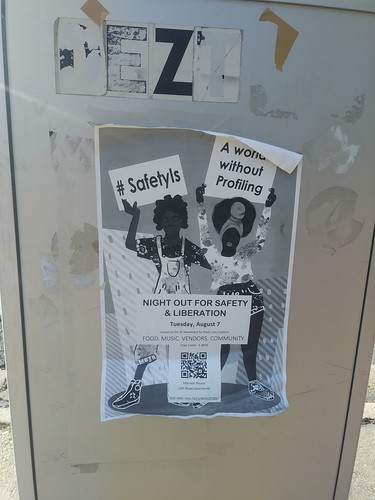
Flyer for "Night Out for Safety and Liberation"DC, #BlackLivesMatter, policing and prosecution.  In DC #BLM hasn't been particularly successful in pushing an anti-prosecution agenda although it's had some victories.

A couple weeks ago, DC announced it would be moving certain gun crimes to the Federal system, to get longer sentences ("U.S. to push D.C. gun cases into federal court as Washington struggles with a 40 percent murder spike," Washington Post).

While activists have complained about this recent move, I've always been struck by how prison sentences in bigger cities like Washington tend to be "more lenient" than those handed down in suburban jurisdictions.

For example, in a case where two DC residents robbed a store owner who had a store in DC but lived in Montgomery County, they committed the crime in MoCo which gave them multi-decade sentences, whereas for other violent crimes they had committed previously but in DC and Prince George's County they received shorter sentences ("2 sentenced to over 35 years in prison each for armed robbery, shooting at Montgomery County home," Fox 5 DC; "Two Men Sentenced for Silver Spring Robbery, Shooting," Bethesda Magazine).

National politics and the US Attorney General: shouldn't the US AG be popularly elected?  Plus, especially under the Trump Administration, because law "belongs to the people," I believe that the US Attorney General position should be popularly elected, with the DOJ as a separate Executive Branch agency.

Labels: , , , ,

Friday, December 28, 2007

More democracy as a solution for the need for an independent Attorney General

While I was away, the city's Attorney General resigned, indicating that the Mayor's General Counsel was meddling and second guessing. See "Singer Quits Post; Aides Cite Clashes With Fenty Counsel: Top Lawyer Felt Sidelined, Some Say," from the Washington Post.

Most if not all states have an elected attorney general. DC has pretensions of being a state, yet too often the executive and legislative branches of government do not function at an equivalent level. cf "Residents Keep D.C. Vote Fight Brewing: Tea Party Protest Evokes Famed Boston Revolt," from the Post.

In response to the resignation, Councilmember Mendelson has offered legislation putting more strictures on how the Executive (the Mayor) can deal with the Attorney General, see "Mendelson Moves to Redefine Attorney General's Role." From the article:

Under the bill, applicants would need at least seven years' experience in the District; a vetting process for the position would be required; the term would be six years; and there would be protections against removal. These qualifications are similar to the ones the council approved for the inspector general's job in 2003.

And the Washington Post editorialized some mumbo-jumbo on the same topic, in "D.C.'s Attorney General: As Linda Singer departs, the position's independence must be preserved."

In the U.S. form of government, the people are sovereign. The law belongs to the people. Therefore, make the Attorney General an elected position, and the Attorney General would ultimately be responsible to the Citizens of the District of Columbia. (Elsewhere I have suggested that this be done at the Federal level as well, that the Department of Justice and the law belongs to the people, not the President.)

Such a proposal could go on the ballot in the 2008 General Election, and if passed, could become operative with the 2010 Primary and General Elections.

Also see National Association of Attorneys General

Labels: , ,

Tuesday, April 20, 2021

Electing a Federal Attorney General and a Chief Inspector General | Expanding Democracy

Today's Washington Post reports ("DHS watchdog declined to pursue investigations into Secret Service during Trump administration, documents show") that the Inspector General for the Department of Homeland Security rejected calls for some investigations of the US Secret Service.  

While the IG said they had limited resources and other priorities, it is also alleged that they didn't want to do the investigations because it would implicate the Trump Administration.

A big problem with the Inspector General process, and this is true of both Democratic and Republican administrations, although Trump took the abuse to new heights ("The internal watchdogs Trump has fired or replaced," CBS News) is that the positions are appointed by the President and the Executive Branch isn't fond of criticism and investigations of what it does ("Congress may not like when Trump fires an inspector general — but it can’t stop him," Federal Times).

Actually this is true at all levels of government.  They don't like oversight.  In fact I wrote about this wrt education test scandals in DC in 2013:

-- "Why inspector generals often don't seek the whole truth..."

For than a decade, I've argued that the Federal Attorney General, to whom reports the Department of Justice, including the FBI, should be popularly elected, because the law and criminal justice system belongs to and derives from "the people," not the President.

-- "Ideally, the Federal Attorney General would be separately elected," 2017

Note though in response, some people argue with justification that this could politicize the legal process and the Department of Justice even more than can occur currently.  

Again, Trump took the politicization of the Department of Justice to new heights, with his chief henchman William Barr, who has always pushed an "Executive Power" agenda ("What to do with an attorney general who disdains justice?," Washington Post).

I have to believe my alternative would be better.  The campaign would definitely raise the profile of law, Constitutional Law, and the federal criminal justice system.

My concept, although just like with locally and state elected Attorney Generals, it's possible this wouldn't work out the way I want it to, is that this would provide an independent check on the abuse of Executive power of the President and the Executive Branch.

What I would do is have this position elected in the off Presidential election cycle, with the idea that this could boost voter turnout in the election cycle that usually suffers a reduction in voting.

Like with the President, there should be a two term limit.

2.  Federal Inspector Generals.  After reading today's article, it occurs to me the same thing should happen with the Inspector General position.  Create a Chief Inspector General and directorate.  Have that person popularly elected, in the off-year election cycle, with a two term limit.

And have all the various Inspector Generals report to the Chief Inspector General, not to their specific agency, and by extension, the President.

-- Association of Inspectors General
-- Council of Inspectors General on Integrity and Efficiency

The model of oversight would be the various cities that have Public Advocate or Comptroller or similar positions that take their responsibilities for oversight super seriously.

Another model is the California Civil Grand Jury process, where county-specific civil grand juries are appointed for a one year term to investigate local government functioning.  This is a process different from the grand juries convened to consider criminal matters.

Labels: , , , , ,

Wednesday, July 26, 2017

Ideally, the Federal Attorney General would be separately elected

Changing the structure of the national government is almost impossible given the current conditions, but even in the best of circumstances it's very difficult.

When it comes to "society," we need to distinguish between "the people"/society and "government."  Government is created "by the people" so that we can be organized at the local-regional-state-national scale. 

I argue that law, since it is the way that relations are constructed and mediated between people within society, belongs to the people more than to the "government" ("Executive Power vs. the will of the people and the DC Attorney General," 2015)

It's why I argued that the DC Attorney General should be popularly elected although I am somewhat disappointed by the results thus far.

Elected AGs disconnect "ownership" and more importantly control of the law from the Executive Branch. 

As we can see from the Trump Administration, first in picking such a conservative as Jeff Sessions for Attorney General ("Jeff Sessions Confirmed as Attorney General, Capping Bitter Battle." New York Times), and now Trump's desire for the Justice Department to back off investigating Russian involvement in the 2016 Elections and culpability within the Trump campaign ("(President Trump and Jeff Sessions no longer on speaking terms," AOL), there is value to having "critical distance" between "the Justice Department" and the rest of the government, and this is in keeping with the concept that law, as a basic organizing instrument of society, belongs to the people first, and to elected officials second.

In short, I argue that the Attorney General of the US should be popularly elected, separately from the President.  And the Department of Justice should be under the AG.

Some years ago I mentioned this once at an event held by Ralph Nader, and he understood the value of the suggestion, even if the main speaker did not.

=====
I don't think Jeff Sessions ("Hearing Highlights: Sessions Questioned on Links to Xenophobia," NYT) could have been elected as Attorney General, given the various positions he holds on:

-- civil rights protections
-- voting restrictions
-- asset forfeiture
-- lengthening sentences regardless of case circumstances
-- private operation of prisons
etc.

It would be great for these kinds of matters to be discussed in the context of a campaign every four years.

To help increase voter turnout, I'd have this office be elected in the off-year cycle for national elections, not during the Presidential election cycle.

Labels: , , , , ,

Saturday, June 11, 2011

Local corruption and ethics

The Post has published a bunch of articles, columns, and editorials about corruption in DC and Prince George's County.

When they did their first go-around wrt PG County, I opined that they missed the point, that systems of corruption are engendered by how land use and development policy works there. That as long as the County Council and County Executive significantly insert themselves into the approval processes, there is a great deal of opportunity for corruption.

It's not any different in DC. While the Post is right to editorialize today, "City under a cloud: The District needs ethics reform; this bill isn't it," that the currently proposed legislation on ethics is inadequate, it's good to see them think a bit more systematically as expressed in the editorial. (Generally, I find that writers for daily newspapers are almost congenitally unable to think in terms of systems, which I ascribe to the fact that a newspaper is published every day and they keep focused on articles for the next day, and lack the "luxury" of thinking more long term.) From the article:

Instead of creating dubious layers of government where investigations can go to die, the council should strengthen the agencies — the office of campaign finance, the inspector general and the attorney general’s office — already in place. The office of attorney general, which already has an ethics officer, seems the appropriate place to vest more authority — particularly since it will become an elected office in 2014. It’s to the lasting shame of the council that, in a fit of pique with then-Attorney General Peter Nickles, it stripped the office of most of its subpoena powers. Another problem is the attorney general’s inability to bring criminal cases against those who commit offenses against the city.

Note though that the Post was against an elected attorney general position ("The case against an elected D.C. attorney general"). I was not. For exactly this reason, that we need to develop more positions in government that have strength, and that we build more checks and balances into the system.

(Note that the initial effort by CM Mendelson was to put more legislatively-passed provisions on the AG position. I, and others I presume, encouraged him to instead put forward legislation making the AG position independent of the Mayor, as a separately elected position. And that's what he did.)

In fact, now I think that the Inspector General position should be elected as well, so that the position is protected from undue influence of the Executive.

The problem with the Home Rule Charter is that it makes the Executive (the Mayor) all powerful, and that the City Council can pass laws, but exempt themselves from the requirements that pertain to the Executive Branch--DC Council can award contracts without RFPs--this was a problem with the proposal to redevelop the Florida Market (which is why I can never support Vincent Orange, who ringleaded that deal, or Harry Thomas, who kept that going after he replaced VO).

Since there is so much pressure within the local economy to jump in bed with developers (see "The City as a Growth Machine: Toward a Political Economy of Place" by Harvey Molotch), the point is to build robust systems that are resilient in promoting the right behavior.

One way is to change the City Council positions so that they are not "part time."

What I would like the various local statehood campaigns to do is to refocus, at least for awhile, on good government, and ridding our city of the corrupt practices that run rampant.

We can all contribute to this effort by starting with reading Corrupt Cities: A Practical Guide to Cure and Prevention and by exploring the Governance and Anti-Corruption website of the World Bank.
book cover, Corrupt Cities: A Practical Guide to Cure and Prevention by Robert Klitgaard, H. Lindsey Parris

Labels: , , , ,

Monday, July 20, 2020

US Attorney General Barr's screwing up of the US Attorney's Office in DC as a justification for spinning off local prosecutions

This building houses the US Attorney's Office for DC.

Because DC is a federal district, not a state, the US Attorney's Office, which in other federal prosecution districts (like the Southern District of New York) only handles federal criminal matters, handles local prosecutions of adults.

It's a great training ground for the Department of Justice, but at some level, the office can be disconnected from the local jurisdiction. By contrast, in most other cities the local prosecutor is publicly elected, and therefore, more connected to the issues and concerns of the voting population.

I have written a bunch of entries over the years, in support of creating a locally elected AG, and that office building the justification for the devolution of local prosecution authority to the local AG.

DC has a locally elected AG now, but there doesn't seem to be any traction wrt devolving local adult prosecutions to that office.

-- "Executive Power vs. the will of the people and the DC Attorney General," 2015
-- "Politico Magazine profile of DC AG Karl Racine | + some miscellaneous legal matters," 2019

More recently, the DC US Attorney's Office has been through a lot of turmoil because of Executive Branch interference in the prosecutions of Michael Flynn, Roger Stone, and Paul Manafort and the machinations concerning the appointment of a US Attorney to run the office.

The National Law Journal reports ("Inside the Disharmony at the DC Federal Prosecutor's Office") that there is a great deal of unrest within the office because of this ("A Loss to the Pursuit of Justice': Praise for Roger Stone Prosecutor Who Resigned").

Granted the disharmony is more about the prosecution of federal crimes, and the way the office positions are used to reward political functionaries, who at least under the current administration, tend to have zero experience or connection to DC.

So it's possible that this isn't affecting much the part of the office that does local prosecutions.

But it does provide further justification for splitting off and devolving local matters to the locally elected AG.

=====
The Federal AG should be popularly elected.  Separately, because "law belongs to the people, not the president" for a long time I've argued that the US Attorney General, who heads the Department of Justice, should be popularly elected, separate from the election of the President/Vice President.

The way that President Trump has used the law as a cudgel, and his pardon and suasion capacity to shape "justice" his way is yet another example of why to do this, although my argument about this predates Trump's election.

-- "Yet another example of why the US Attorney General should be popularly elected," 2020
-- "Ideally, the Federal Attorney General would be separately elected," 2017

I suppose knowing about how President Nixon misused the AG's power, and even President Kennedy appointing his brother, are other examples of why some disconnection of the criminal justice function from the President's power would be desirable.

Labels: , , , ,

Tuesday, July 09, 2013

Incremental piecemeal fixes to DC politics and governance mostly don't help

Image from the Fair Elections for New York Facebook page.

In the Sunday Post, DC City Councilmember David Grosso has a short op-ed ("Why DC needs public campaign financing") about why we need public financing of local elections--to strike a blow against "pay to play" politics, which was recently detailed (but totally unsurprising) in a series on the local NPR station, WAMU-FM ("Deals for Developers, Cash for Campaigns: A WAMU Investigation").

Pay to play sucks, but the reality is that because local business is primarily either real estate or government jobs (municipal unions) the people and organizations most motivated to get people elected are highly self-interested.  I don't see how much it can change.

Whether or not public financing of elections is important, and I concede that it is, the bigger problem is the lack of strong governance systems and civil society more generally.

I'd be willing to support public financing (which hasn't even made my top 12 of things that should change in local governance) if Councilmember Grosso would be supportive of other changes--which, judging by his opposition to moving the election primary to June from the too-early April date that is now in place--that would have far more impact.  See "D.C. primary election date could be moved again" and "D.C. Council will vote Wednesday on changing primary election date" from the Post.

The best discussion of the proposed changes I'd make is here, "Continued musing on restructuring DC's City Council (mostly)," and these is the master list (note that 1, 2, 3, 15, 17, 18, and 19 weren't included in that list but are added in the spirit of comprehensiveness):

1.   Create an independently elected Attorney General and build the capacity of this office to take control of local prosecution of crime (this responsibility is currently handled by the Federal Government);

2.   Create a public planning and budgeting process for capital improvements, sale of civic assets, and alley closings;

3.   Create a public and transparent process for tax abatement and eminent domain requests (see "Make eminent domain fair for all" from the Boston Globe; the recommendations pertain to both issues);

4.   Increase the number of wards;

5.   Increase the number of councilmembers (thereby making it harder to pass legislation);

6.   Move the legislature to part-time service and reduced pay;

7.   Reduce the size of councilmember staff  (I could go either way on this one; what bothers me is how much staff time is spent on incumbency protection);

8.   Increase the research capacity of local government;

9.   Institute term limits for elected officials;

10. Change the date of the primary election to extend the electioneering period;

11. Institute ranked choice voting for local elected officials;

12. Institute additional campaign finance limits for local elections;

13. Create an elected public advocate/ombudsperson (and a civil jury process to investigate government agencies);

14. Reconstitute a school board with oversight over pre-K to 12 public education, traditional and charter schools;

15. Use participatory budgeting methods for appropriating constituent services funds requests and grants to nonprofit organizations ("More on ethics: discretionary funding-constituent funds");

16. Build civic capacity and infrastructure ("Neighborhood planning meta-website);

17. Strengthen the capacity of Advisory Neighborhood Commissions to be better and fairer representatives (""Networked solutions" for some problems with ANCs in DC" and "A neat solution to (some of the) petty corruption in DC government-related civic organizations");

18. Change the planning process to include the production of formal sector and neighborhood comprehensive land use plans ("Planning process failures generally and the upcoming DC Central Library planning process," "Rethinking community planning around maintaining neighborhood civic assets and anchors," and "A key problem in "community" planning: not simultaneously defining community-wide and neighborhood goals and objectives").

19. Various tweaks as needed to planning and zoning processes such as a Big Box Review Ordinance ("Lessons from Walmart's foray into Washington, DC"), community benefits negotiations ("Community benefits agreements revised again" and "What community benefits are supposed to be versus what people think they are about"), and urban design requirements ("New years post #6 -- the crazy thing about U.S. zoning is that it's not designed to maximize overall land value" and "Changing matter of right zoning regulations for houses to conform to heights typical within neighborhoods, not the allowable maximum").

Attorney General (item 1).  I have taken the liberty of adding the elected Attorney General position to the list, which hadn't included it, because it is already slated to start in 2014, because the Executive Branch has proposed a number of changes to government which would eviscerate the impact of having an independently elected AG (see "Making an elected AG work for D.C." and the letter to the editor by CM Tommy Wells, "Elected attorney general should retain control of city legal staff," both from the Post).

Capital improvement planning (item 2).  Most every other jurisdiction runs capital budgeting on a six-year time frame, with a running two-year plan.  DC doesn't.  So there isn't a defined public process for planning long range capital improvements .  Instead, projects are handled in the annual budget.  The CFO and Mayor's offices have internal capital improvements planning processes, but they aren't public processes.  They should be.

Tax abatements, alley closings, and eminent domain requests (item 3).  Another thing that creates opportunity for corruption concerns these requests, which are typically initiated by legislation created by individual Councilmembers.  The CFO produces reports on the capital impact, but the reports aren't complete and independent analyses.  (Unlike the process recommended by the professors who wrote the opinion piece in the Boston Globe.)  There should be an open and transparent application and consideration process for such matters.

Public Advocate (item 13).  An elected Public Advocate would replace the DC Auditor General which reports to City Council and the Inspector General which reports to the Mayor, with an independent official position.  For obvious reasons--independence from the Executive and Legislative Branches)--this would be an important step forward for accountability.

A good example of why an independently elected Public Advocate/IG makes sense is the hullaballoo in Chicago, where Mayor Rahm Emanuel is stonewalling independent investigation of city agencies by the IG there.  See "City stonewalling audit on garbage collection, inspector general says" from the Chicago Sun-Times.

Without independence, accountability is significantly constrained, as was the case with in-house investigations in DC's Chief Financial Office ("D.C. Council votes to require CFO to publish all audits" from the Washington Times).

Participatory Budgeting (item 15) and ANCs (item 17).  I've written about these issues a lot, this just incorporates the recommendations into the master list.

Neighborhood planning (item 18) and changes to planning and zoning processes (item 19) also cover issues I've written about extensively.  They are important enough to be added to this master list.

------
Note that Statehood for DC isn't even listed.  I don't know how important it is to getting our own house in order.  Personally, I don't believe that statehood is an inherent right, you have to earn it.  Territories didn't become states without making their case for good government and sound practices, which was covered in bill setting the process of creating a state.

Labels: , , , , ,

Wednesday, April 01, 2015

Misguided proposal on how to fund DC's Office of the Attorney General

DC has recently created a separate, independent agency for the "State" Attorney General, comparable to how many other jurisdictions have an elected Attorney General, who while representing "the government" also represents "the people," thereby justifying a separate election process.

(Unlike other jurisdictions, criminal prosecution of felony offenses is under the control of the federal government, one of the many artifacts that have derived from the "District" of Columbia ultimately being under control of Congress, as the national capital is not a separate state.

That is a big area outside of the control of the DC Attorney General although my hope is that as the office develops, executes and builds maturity, Congress will cede control of criminal prosecution to the city.)

The first election for Attorney General was held last fall, and Karl Racine won, taking office in January.  Asking for an annual budget increase of $20 million, he argues ("DC's attorney general seeks bigger budget," Washington Post) that now that there is an independent AG office, funding should be increased to support the various areas that the office should address.

While I don't doubt that is the truth, he proposes rather than use general funds appropriated to the office, a budget increase could be funded out of the fines and judgement awards earned by the agency's activities.  Currently those monies go to the general fund.

Seeking funding through a percentage of fines and legal judgments creates the opportunity to misuse the legal process to generate funding, not unlike problems with police departments seizing assets of alleged criminals to fund activities.

DC's Metropolitan Police Department has been a fervent proponent of asset seizures, which sets a troubling precedent for other DC Government agencies.

-- Stop and Seize | Collections | The Washington Post, series on asset seizures by state and local police departments

I'd rather the agency be funded through normal appropriations processes.

Labels: , , , , , ,

Tuesday, April 05, 2011

Probably the DC Government Inspector General position should be popularly elected as well

In the most recent election, there was a ballot referendum calling for making the DC Attorney General position popularly elected. I supported this referendum, although I had suggested having the position come up for election in the so called "off cycle" when the ballot doesn't have the Mayor on the ballot, and that's not how the referendum was worded.

The referendum passed, and therefore effective with the 2014 election, the Attorney General will be popularly elected.

(FWIW, I believe that the Attorney General of the United States should also be popularly elected. One wrinkle in DC is that the federal government still controls the prosecution of adult crimes, so that here, the DC Attorney General focuses on a variety of public protection issues, and the prosecution of juvenile crime. Delegate Norton is advocating that the federal government yield to DC the authority to prosecute adult crimes. However, I feel that can come as a hopefully successful track record is developed for the locally elected AG.)

Given the problems of independence that an Inspector General seems to have in DC (see "DC inspector general plays lap dog to corrupt pols") from the Examiner) with regard to local government, maybe this position should be popularly elected as well.

From the article:

The IG's ineffectiveness here begs a more serious question: Even if Willoughby had been able to investigate the Sulaimon Brown case, would anything have happened? The answer, from many law enforcement officials, past and present, is in doubt.

"If you want to bury something," one former District legal official told me, "send it over there. Willoughby is not a prosecutorial type, not an investigator. When he gets in a political thicket, he's not willing to stick his neck out."

Labels: , , , , ,

Sunday, February 10, 2013

The DC Chief Financial Officer position: what is to be done? Make it elected!

When DC went into receivership in the 1990s and the Federal Government created the Financial Control Board to manage the financial affairs of the city, a Chief Financial Officer position was created to independently manage the financial affairs of the city.  The CFO is appointed by the Mayor to a 5-year term, by the  Mayor, with confirmation by the City Council.

For the past 11+ years, the CFO has been Natwar Gandhi.  While the city's finances have been managed fairly well under his tenure including high ratings of the city's bonds and finances, a variety of improprieties occurred within the various units under his purview.  Recently he resigned, effective in June.

Besides those problems, a recent press release by the DC Library Renaissance Project about the CFO's evaluation of a land sale deal of city-owned property in the West End makes good points that the evaluation of the deal was incomplete, disadvantaging the city.  See "After Gandhi’s Resignation, Questions About West End Library Deal Remain Unanswered." From the press release:

The information that D.C. Council members were provided by the CFO, while not untrue, omitted a key variable: the estimated fair market value of the land to be sold. Without further analysis of their own, Council members would not have had adequate information to evaluate the deal.

At stake is the value of three properties in the West End “sold” to a developer, Eastbanc, through a complex and unprecedented land swap. The deal calls for a new library facility, new firehouse, and new affordable housing — together worth $30 million according to Eastbanc — in lieu of payment for the land.

The CFO’s report states, based on values from its own tax database and those of an independent valuator, that the land sale would reduce the city’s assets by approximately $30 million. The Mayor, D.C. Council members, and community groups assumed that $30 million in new construction matched the $30 million reduction in assets, making the deal seem reasonable.

In his testimony, however, the CFO noted that deed and recordation fees totaling $1.45 million would be forgiven as part of the deal. Since deed and recordation fees in D.C. are based on a formula of 1.45% of the total estimated fair market value, the real value of the land is $100 million, not $30 million. So transferring ownership to Eastbanc is a giveaway worth roughly $70 million.

There are definitely issues and problems with how the CFO office operates.  There needs to be more openness and transparency with regard to evaluation of tax abatement requests and other matters, as well as contracting (which is under the Executive Branch).

The kinds of proscriptions offered in this old Boston Globe op-ed about eminent domain, "Make Eminent Domain Fair For All," offer some good guidelines for how to tighten DC government procedures with regard to these kinds of decisions about financing.  From the article:

• Requiring... that any exercise of eminent domain for economic development have a primarily public purpose rather than a merely incidental one.

• Requiring the government to demonstrate the public benefit through a full-scale financial analysis that could be challenged in court.

• Requiring that eminent domain not be used for a solely fiscal purpose and that it instead must be part of a comprehensive land use plan.

• Requiring that the affected neighborhood have adequate participation in the planning process, a right that would be backed up by state-provided technical assistance upon the neighborhood's request.

• Requiring that the state demonstrate good-faith dealing with the owners of the property targeted for taking prior to exercising the eminent domain power.

Today's Post has an article, "DC mayor wants to rethink strong CFO role," where Mayor Gray suggests that the city's elected officials should take back control of this function of government.

Scary. Many of DC's elected officials have clear conflicts of interest or other ethical issues that make it difficult for citizens to believe that they would carry out these responsibilities responsibly--after all that's why the Federal Government created the CFO set up to begin with.

Make the CFO an elected position

Just as years ago I had suggested that the city's Attorney General position should be popular elected ("DC elections and the referendum on the Attorney General" and " Another wrong judgement by the Washington Post: an elected Attorney General is a good idea and should be supported") and that will happen effective in the 2014 election, I recommend that the CFO position be popularly elected as well, to increase the checks and balances existing between the various branches of local government and to make a more direct link between "the people" and the necessity of financial stewardship propriety within local government.

The city has an opportunity to strengthen its processes and democracy at the same time by making the CFO or a "Comptroller" position popularly elected.

In New York City, the Comptroller is popularly elected, and limited to serving a total of 3 terms.  The Comptroller position in New York State is also popularly elected, without the term limit.  I'd recommend a term limit for the position.

(Comptrollers can be elected in other jurisdictions as well, such as at the county government level, or at the state level, such as in Texas.)

Making the CFO elected would, along with my previous suggestion (in "Continued musing on restructuring DC's City Council (mostly)") of creating an independently elected "Public Advocate" or Ombudsperson position, incorporating also the functions of the Inspector General (which currently is a position that serves at the pleasure of the Mayor, and is not fully independent), be a significant contribution to improving openness and transparency in DC government.

Labels: , , , , , ,

Sunday, January 31, 2021

DC Attorney General's opinion on the appointment of the US Attorney for DC and DC's rising crime rate

In 2012, I wrote a blog entry about the then new master plan for the Seattle Police Department and what a step forward that was.  I still remember commenter charlie's reaction, that the master plan said very little about addressing crime or reducing the crime rate. 

==========

DC is an unusual jurisdiction for criminal prosecution.  Because it is still the federal district, not an independent state, the US Department of Justice is responsible for the trying of adult criminal cases which in normal circumstances would be tried by the local jurisdiction.

In short, in DC, the US Attorney handles both federal and local crimes.  The DC Attorney General handles the prosecution of juvenile crimes and civil matters more generally.

I favored the creation of an elected Attorney General position in DC as a route to developing the competence of the local office and as a justification for moving towards the devolution of local criminal prosecution to the local government.

-- "Executive Power vs. the will of the people and the DC Attorney General," 2015
-- "US Attorney General Barr's screwing up of the US Attorney's Office in DC as a justification for spinning off local prosecutions," 2020

But I haven't really seen that argument put forth, and something I never considered has happened--that the AG, at least under Karl Racine, seems to have used his office to help forward the election of DC Councilmembers--four of the thirteen worked for the AG before running for office.

The AG has an op-ed in the Washington Post, "President Biden’s choice for U.S. attorney should reflect D.C. values," about how President Biden should take into account the preference of DC citizens as expressed on various issues, when making the appointment for the position.

He mentions issues like hate crimes, and how federal prosecution of gun crimes ups the sentence, and this is counter to what "the people want."

But like how charlie skewered me about my love of the Seattle Police master plan in terms of its failures to address how it would reduce crime, all I could think about when reading this is that violent crime in DC is up, the use of guns in crime is up, shootings are up, and that the murder rate--while down significantly from the peak in the 1990s, when 479  people were murdered in 1991 ("D.C. Touts Lowest Homicide Rate in Nearly 50 Years," NBC4)--and then dropped steadily to a heralded low of 88 in 2012,  has more than doubled eight years later.  Last year's total was 198 murders ("Homicides in D.C. hit 16-year high; shootings also have spiked," Post).

How come AG Karl Racine didn't mention DC's rising crime rate as an issue of concern to local citizens, and its relevance to the choice of a US Attorney for the District of Columbia?

Labels: , , , , ,

Wednesday, February 12, 2020

Yet another example of why the US Attorney General should be popularly elected

For more than 10 years, from time to time I write a post recommending that the US Attorney General, head of the Department of Justice, be popularly elected, and that the Department of Justice and its constituent units should be an executive branch agency independent of the President, because "law, fairness, due process, and justice" belong to the people.

There are myriad examples in recent history of the need for an independent attorney general, to act in the breach, in the face of executive branch malfeasance and overreach.

A separation of the justice agency from the rest of the executive branch through popularly electing its head happens in a majority of states, and often at the local level too, with popularly elected "prosecutors" although at the local level, such officials are mostly focused on prosecuting criminals not creating a fair justice system.

Progressive local justice.  The tension between prosecution and justice is why there is a movement about to elect "progressive" local prosecutors, although this agenda is controversial wrt reducing charges, bail, etc. ("Progressives Are Winning DA Races But Face Pushback," Governing Magazine); "Criminal justice: Police, progressive prosecutors battle over reform," USA Today).  From the USA Today article:
Boston-based Suffolk County (Massachusetts) District Attorney Rachael Rollins, the first woman of color to hold a DA post in the state, acknowledges that pushing a reformist agenda “is an uphill slog, but we are deeply committed.”

Rollins, who calls herself “smart on crime,” says a hallmark of the progressive wave is relying “on numbers, not anecdotes.” She is busy hiring “technologists and data experts so we can document all this and show how these policies are making a difference.”
Executive branch/Presidential tampering.  The way that President Trump is tampering with justice, in pardoning people associated with his biddings who have been found guilty of crimes, in appointing a bagman as leader of the agency--William Barr, aiming the agency at investigating his opponents and perceived enemies, and now with the latest happenings in the Roger Stone case, asking the Department of Justice to go easy on him, in the face of previous recommendations by people running the case, is a perfect example of why this split should occur.

The Roger Stone debacle.  The Washington Post ("Trump attacks federal judge, prosecutors in Twitter tirade defending Roger Stone") and other media are reporting on the latest developments in the Roger Stone matter, which is the subject of a twitter thread by the President. From the article:
The timing of Tuesday’s online attack prompted many to accuse Trump, who has a long history mounting public crusades against judges and courts over unfavorable rulings, of attempting to intimidate Jackson and secure a more lenient sentence for Stone. ...

Trump’s fusillade of tweets came shortly after news broke that the Justice Department had overruled the sentencing recommendation for Stone submitted by federal prosecutors, an action that followed Trump blasting the recommendations as too harsh.
This action led the prosecutors handling the case to resign in protest ("Prosecutors quit amid escalating Justice Dept. fight over Roger Stone’s prison term").

Plenty of AGs are happy to tamper.  OTOH, there is no guarantee in this day and age that whoever ran for the office would not be as mendacious as William Barr ("What to do with an attorney general who disdains justice?," op-ed, Washington Post).

But Elliott Richardson, Ramsey Clark ... But definitely in the past, there have been great, honorable people who served as the US Attorney General.

Probably, were this change to be made, I'd also recommend shifting the role of Inspector General within the executive branch agencies too, having them report to the AG as well.

Labels: , , , , ,

Wednesday, January 01, 2014

New Year's Post #1: Defining mediocrity up and the 2014 elections in DC

These days, DC ought not to be such a bad place to be an elected official.  The population continues to grow, DC now has a population of 646,000 ("[National] Population gains at near-historic lows," Washington Post); crime isn't such a big problem; the real estate market is reasonably strong although not perfect because of a diminishing role in the federal government's place in the market; and the city is in a pretty good place financially, although most of its loan capacity has been encumbered--it helps that DC is the only city in the US that collects and keeps 100% of the "state" income tax.

That being said, DC is no city on a hill.  Plenty of politicians have been brought down by corruption over the past few years and DC doesn't really stand out as a special example for other cities to emulate, with an exception or two on particular programs (like bikeshare).

When everyone's party affiliation is Democrat, there is no platform or party discipline.  I read an article about Massachusetts after Scott Brown was elected to the Senate that made the point that because the state is dominated by Democrats, everyone who wants to win runs for elective office as a Democrat, but the reality is that the issue positions are all over the map and encompass for some people what would be Republican positions, although my lesson from the story is more about the dearth of a basic position or platform.

DC has the same problem.  It's a city-state even though it isn't recognized legally as a state.  For the most part, DC can do what it wants, with some limited oversight from and restrictions by the federal government, which waxes or wanes depending on which party is in office--generally the Republicans like to use DC for political points so that's why we have such a strong charter school movement here (put in place as a deal between the Newt Gingrich Congress and President Clinton), Sen. Shelby put a death penalty sentencing proposal on the local ballot, etc.

But at the local level, it means that because of the dominance of liberal sentiment, as expressed by affiliation with the Democratic Party, there is no "party discipline" and no real platform. 

Candidates for office running as Democrats are more about creating and maintaining personal fealty than they are developing an overall platform and a progressive agenda, as opposed to a putting together a variety of incremental positions.  Basically they produce a grab bag o' stuff as opposed to a platform.

Image from Unpunk.

So suffice it to say that I am bored by the 2014 election.  It could get shaken up some by a strong independent run for Mayor to challenge the Democratic winner from the way too early primary in April, but I am not holding my breath.

I have a couple of pieces from the last two years which are evergreen when it comes to the topic of improving DC governance and politics.

1.  "Continued musing on restructuring DC's City Council (mostly)," discusses a broad number of systemic changes that I propose to increase democracy and openness in local government.  As Matthew Frumin said in the special election campaign last year, the Home Rule Charter is going on 40 years old and it's time to review where we are and where we've been.

Summary recommendations

1.  Increase the number of wards.
2.  Increase the number of councilmembers
3.  Move the legislature to part-time service and reduced pay
4.  Reduce the size of councilmember staff
5.  Increase the research capacity of local government
6.  Institute term limits for elected officials.
7.  Change the date of the primary election to extend the electioneering period.
8.  Institute ranked choice voting for local elected officials.
9.  Institute additional campaign finance limits for local elections.
10. Create an elected public advocate/ombudsperson.
11. Reconstitute a school board with oversight over pre-K to 12 public education, traditional and charter schools.
12. Build civic capacity and infrastructure.

Since the City Council voted to move the popularly elected Attorney General election to 2018 ("D.C. Council votes to delay first election of an attorney general," Post), counter to what citizens voted for, we need to add this to the list as well.  There is a move to put it back on the 2014 ballot ("DC Council needs to get the DC attorney general election right," and "Delaying election of attorney general makes a mockery of democracy,"  Post--note that the Post editorial page has continually espoused the wrong position on this issue) although I would be content to put it on the 2016 ballot, which is what I had proposed years ago, that the AG be elected in the non-Mayoral election cycle.

Note that an alternative to ranked choice voting would be runoff elections and non-party segregated primaries.  The way it works in Seattle, local elections are non-partisan, and the top two vote getters for Council races continue on to the general election ballot. 

2.  Given the so-called rise of progressivism at the city level, given the election of Bill de Blasio as Mayor of New York City and maybe even the election of Kshama Sawant, Socialist Alternative candidate, to the Seattle City Council ("Kshama Sawant's Brash Style Catapulted Her to Victory: Will It Also Be Her Demise?," Stranger), etc., I find the agenda-less local Democratic Party to be a big problem and a lost opportunity--in other words, if DC wants to become a legally recognized state, we should start acting like one, and function at a high level both in terms of governance and the general political structure.

This 2012 post, "Repositioning cities (at least on the coasts) for greater political prominence, and a city-first agenda," discusses local parties in Vancouver, BC and Montreal, and their respective platforms.  Similarly, in 2013, most candidates for Mayor and Borough Chair in New York City had defined platforms rather than a grab bag o' stuff that we content ourselves with in DC.

-- Bill de Blasio, campaign website issues section
-- Julie Menin, candidate for Manhattan Borough Chair 
-- Anthony Weiner, Mayoral candidate, "Keys to the City" plan (actual documents no longer online, but ideas, 121 in total, accessible through the webpage for specific issue areas)

The "defining mediocrity up" point has to do with how I think of DC, because it is the national capital, defines anything it does, regardless of true worthiness, as "world class."  It's a corollary to Daniel Patrick Moynihan's writings about "defining deviance down."

Note that the Tommy Wells website is decent on issue positions.  Muriel Bowser's website is not.  Jack Evans doesn't list new issue positions, but lists his involvements and initiatives in terms of legislation and programs for 13 different issue areas.  The website for the Vince Gray re-election campaign has no content.

Interestingly in a first, at least that I can recall, there is an anti-Vincent Orange website, excoriating his positions and way of participating in politics.  He still doesn't seem to have a website up.

3.  I don't think having an agenda would be enough for a second party, either the Statehood-Green Party or the Republican Party, to break through and become a credible alternative, unless the legislature expanded, through a doubling of the representatives in each ward (one elected every two years for a four-year term), an increase in the number of wards, and limits on campaign spending.

Labels: , , , ,

Monday, November 01, 2010

The DC elections and the referendum on the Attorney General

Sometimes I write recommendations, some times I don't. Generally, a lot of the people up for office--well, I'd rather there were other choices, or at least good choices, and there aren't in many instances so I'd rather not make recommendations, because when the people who are in office stay in office, you've lost your ability to have any access to them.

As far as the two major offices go, Mayor and Council Chair, often it's an opportunity to register a protest vote by voting for the Statehood Green candidate, if they are reasonably credible (the Mayoral candidate for Statehood Green isn't that credible in this election cycle and I wasn't up for voting for the Socialist Workers Party candidate).

For At Large Council, there are three good candidates, well one is a protest candidate, and the other two are proven: Phil Mendelson (Democrat) and David Catania (Independent, formerly a Republican) have served ably on Council for many years and are some of the only independent, thoughtful voices serving; and David Schwartzman, professor at Howard University, is the candidate for the Statehood Green Party.

In the Ward races (Ward 1, 3, 5, 6), well I out and out favor Tommy Wells in Ward 6, although I live in Ward 4 so maybe people don't care what I think. Mary Cheh in Ward 3 could be a little more innovative rather than thinking that new laws are the answer for everything, but then, she is a lawyer who believes in the law, so we can't hold that against her. The other wards, maybe I'd like to see new blood, maybe not, but those Councilmembers have particularly good, elephantine memories when it comes to politics. The Republican Party has a ways to go before we can claim that their candidates, except maybe in Ward 1, offer a worthy alternative.

For ANCs, Greater Greater Washington has been doing yeoman's work sussing out the candidates and making recommendations. I refer people to those recommendations for more.

I do take offense to Georgetown Dish's recommendation against the proposed charter amendment for creating an elected Attorney General. See "Editorial: Vote No on Top Cop Opp." It falls into the Washington Post camp that creating the potential for a separate power base is a bad thing.

The AG position anywhere is a classic boundary spanning position (see Lazarus, Richard and Susan Folkman. Stress. Appraisal, and Coping.
New York: Springer, 1984), with the extremely difficult task of having to balance the public interest--in theory the system of governance derives from the people--vis a vis the government interest, in particular the Executive Branch. Due to the Iron Law of Oligarchy as posited by Robert Michels, you can't always rely on the "government" (although Michels was writing about political parties technically) to represent the public interest in democracy equally and in a superior position to other self-interests.

That's why an elected AG is good policy, a check on the increased distancing in democracy of the public from the executive.

Where the AG is appointed by the Mayor (the Executive Branch) but with the sometimes conflicting responsibilities of having to represent the Mayor, the Executive Branch, and "the people," when push comes to shove, only the gutsiest person (people like Elliot Richardson and William Ruckelshaus) is going to buck the chief executive in favor of the people.

Hence, my belief that the AG position should be an elected, not an appointed position, to better ensure that the people's interest remains superior in the face of likely and potential conflicts.

For the same reason, I think that the U.S. government cabinet position of Attorney General (also serving as Secretary of the U.S. Department of Justice) should be popularly elected separate from the President and Vice President as well.

Labels: