Rebuilding Place in the Urban Space

"A community’s physical form, rather than its land uses, is its most intrinsic and enduring characteristic." [Katz, EPA] This blog focuses on place and placemaking and all that makes it work--historic preservation, urban design, transportation, asset-based community development, arts & cultural development, commercial district revitalization, tourism & destination development, and quality of life advocacy--along with doses of civic engagement and good governance watchdogging.

Tuesday, September 29, 2009

Cycle communities

For the next year, I will be working as a bicycle and pedestrian planner for a county located within the Baltimore-Washington region, tasked with producing a b&p master plan for a portion of the "urban area" of the county (with a couple of rural-related tasks as well). This study area is larger than DC, and the mode split -- the number of trips to and from work that are conducted by transit, bicycle, or by walking -- is extremely low.

There are a variety of issues that have to be addressed to convert the community into one that embraces walking, bicycling, and transit much more than it does currently--both in terms of the local government and how it is focused on these issues, as well as on how to build the grassroots momentum and support for expanding how people think about mobility, particularly walking and bicycling.

So the Sunday Parade Magazine article about bicycling, specifically in Columbia, Missouri, is interesting. See "Reinventing America: A Free-Wheeling City."

It happens that I was looking at another initiative in Columbia just last week--THEY HAVE A LAW THAT FINES PEOPLE FOR VERBAL AND PHYSICAL ASSAULT ON BICYCLISTS. (See Bicycle harassment ordinance passes unanimously" and "City Council still divided on bicycle harassment" from the Columbia Missourian.)

Given that the average "vehicular" bicyclist is harassed on a week-in, week-out basis, you can imagine that I think that this is a welcome law and an important step forward.

The Parade article mentions a Federal pilot program that I didn't know about--two cities and two counties have been chosen as places to model--demonstration towns--the development of a bicycling-supportive community. From the article:

The Federal Highway Administration has launched a pilot program with an aim to make roads safer and more enjoyable. More than $90 million has been allocated to four communities—Columbia, Minneapolis, Sheboygan County, Wis., and Marin County, Calif. Each will receive about $22.5 million to make them more bicycle- and pedestrian-friendly.

With the support of Sen. Christopher S. Bond (R., Mo.), who helped launch the program, Hindman recently ordered concrete bike paths alongside Columbia’s streets, rejiggered major intersections for bike safety, and turned existing residential streets into “bike boulevards” with painted bike lanes and obstacles to slow down cars.

See these webpages from the FHWA: Nonmotorized Transportation Pilot Program and the Program Updates and Fact Sheets.

I know I will be delving into this program for insights into my current project. (There is so much to learn and figure out.)

It happens that last year, I wrote about a similar program, Cycle Towns, in the United Kingdom. That entry is reprinted below. I guess I have to take back my words as the US Department of Transportation is doing a "Cycle Towns" type of program.
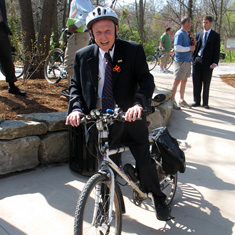
Darwin Hindman, mayor of Columbia, Missouri
Darwin Hindman, Mayor of Columbia, Missouri. Parade Magazine photo.

And the Mayor of Columbia, Darwin Hindman, will be an inspiration as well. From the Parade Magazine article:

But Columbia’s most stalwart cyclist is probably the mayor. Hindman rides about 60 miles each week—to the grocery store, to meetings, and to the dog park, hauling his faithful mutt, Loki, in a bike trailer.

Hindman’s next goal is to connect every neighborhood to a bike path, in the hope that he can continue to wean citizens from auto-dependence. “If we could get people to use their bikes or walk on 20% of their short trips, I’d be delighted,” he says.

Not just eco-towns in the UK, but cycle towns too

(I have been thinking quite a bit about transformational delivery of government services. I wrote about it last month, in terms of Arlington County specifically, but there are other examples such as Tower Hamlets' repositioning of libraries into Idea Stores and the Live Baltimore resident attraction program. I was talking about this with a colleague yesterday, and she said it's not just about transforming how the government delivers services, but about transforming people. That point has to be made clearer going forward.)

The Evening Telegraph of Kettering, UK reports, in "We're in chase to be first of cycle towns" that:

Cycling England, which was set up by the Government in 2005, is looking for 10 towns and one city to be transformed into cycling towns after a successful trial in six towns across the country.

Also see Demonstration Towns from the Cycling England website (note that this appears to be a better program than Bicycling Magazine's Biketown, which is very much focused on individuals within communities, rather than communities and the bicycling-walking-urban design environment) and Cycling Towns of the Future conference, 21st November 2007

Imagine the U.S. Department of Transportation doing that, instead of the Secretary of Transportation stating that bicycling isn't transportation. See "The bicycle thief" from Salon.

This is comparable to the Conservative and Labour Party candidates for Mayor of London competing in part on which is more committed to bicycling. (See "Livingstone plan for street-corner cycle hire stands" from the Independent.)

Labels: , ,

Leon Krier presentation in Towson (Greater Baltimore) next Monday

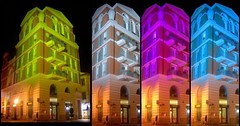
Image: Palazzo di Piazza Marconi, Alessandria, by Leon Krier. Flickr image by Liberty Place.

From the Greater Towson Committee:

Architect and theoretician Leon Krier will give a talk and book signing as part of the Towson Town Hall series of talks focused on improving the qualities of Towson (an unincorporated part of Baltimore County that is a conurbation of about 70,000 people) as a place to live, work, and visit.

The Architecture of Community

Monday, October 5, 2009 7 p.m.
GOUCHER COLLEGE
1021 Dulaney Valley Road
Baltimore, MD 21204

"No architect has explored architecture's claim to universality better than Léon Krier, and it is this which makes him the most controversial figure of contemporary architectural culture." -Demetri Porphyrios

Leon Krier is one of the most influential and provocative architects and urban theoreticians in the world. In his latest book, The Architecture of Community, Krier offers a comprehensive theory on the making of sustainable, beautiful, and most importantly, livable communities. On this stimulating evening, Leon Krier will discuss his many noteworthy projects, including the town of Poundbury in Dorset, England which is now considered a model for contemporary ecological planning and building. Krier has taught architecture and urbanism at the Royal College of Arts in London, Princeton University, Yale University, and the University of Virginia, and has received numerous awards including the inaugural Richard Driehaus Prize for Classical Architecture. A book signing follows his talk.

------------
I have been poking through the book. IT'S EXCELLENT.

Labels: ,

Audi believes that a car is much more fun than walking, bicycling or using transit

(while sure, it can be, it's a helluva lot more expensive. And if your place of residence is well-linked to amenities and not too far from where you work, walking or bicycling can definitely be as fun, even if it is within a climate uncontrolled experience)

Watch the Video (YouTube)

Labels:

Accountability and WMATA

(reprinted due to some weird problem with links)

WMATA farecard

While I am inclined to give the benefit of the doubt to John Catoe, the General Manager of the WMATA system, despite all the recent problems the system has been experiencing, because the reality is that most of the system's problems--lack of oversight, inadequate leadership, inadequate funding, the weird relationship with the federal government, bickering between the jurisdictions, a militaristic organizational culture begat from the first manager, who was a General from the Army Corps of Engineers, and a lack of significant systematic regional transportation planning--predate his tenure. He inherited these problems.

But he did just get his contract extended for three years. See "Catoe's Contract Renewed In Show of Broad Support‎ " from the Washington Post.

On the other hand, the lady bus driver who hit a jogger, but didn't kill her, was fired. See "Sources: Metro Bus Driver Ran Light, Hit Jogger" from Fox5.

So what lesson does that send about accountability when 9 people die and 70+ people are injured as a result of a subway train accident?

If the bus driver was fired (and maybe she shouldn't have been driving a bus given her other driving issues and previous accidents), does that mean that many many people will be fired from the Rail Operations Division, once the National Transportation Safety Board findings and report are released, reviewed, considered, and responded to by WMATA management and the Board of Directors?

Labels: , ,

MIT student/Cambridge homeowner runs for City Council on a quality of life ticket

Although interestingly, while promoting a wide variety of good ideas (inclusion of Cambridge in Boston's upcoming bicycle sharing program, expanding transit information, etc.) he does call for more parking, even as he favors speed and red light camera ticketing programs, as a speeding driver running a red light hit and killed a neighbor's child.

See his website: Leland Cheung for City Council and this article from the MIT Tech student newspaper, "MIT Graduate Student Runs for City Council, Hopes to Represent Students."

(reprinted due to some weird problem with the links)

Labels: , , ,

Blaming the building revisited: Takoma DC edition


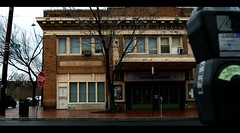
Originally uploaded by Matt**
(Flickr photo of the Takoma Theatre by Matt**)

I went for the first time to an ANC 4B meeting last night. I have to say that while I wasn't always impressed with the level of deliberativeness, the discussion was civil, the majority informed, the ANC Chair was a pretty good manager, keeping things moving, and there were a decent number of people present.

I went because of the Takoma Theatre issue. The building is located in the Takoma Historic District and therefore is protected by DC historic preservation regulations. The owner would like to tear the building down and replace it with a different, allegedly more profitable building. The historic preservation regulations make this very very difficult, but not impossible.
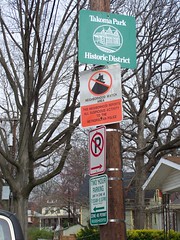
Takoma Park Historic District sign, Washington, DC
There is a hearing on the matter scheduled for October 22nd, and the ANC was considering the matter, in view of their consultative role on matters before DC government agencies and commissions. (After lengthy discussion, in order to be able to consider the issue more fully, ANC4B set up a special meeting, for Thursday October 15th.)

In some of the back and forth discussion, some of the people favored the proposal, not because they thought that a theater was not a good use, but because for all intents and purposes the owner has abandoned the building, and it sits there, somewhat decrepit and mostly unused--and the building scares them, hulking over the street, making what could be a lively intersection, 4th and Butternut Streets, empty and foreboding.

(Separately, there is the Takoma Theatre Conservancy effort which is working up a plan to buy and rehabilitate the building and get it to become an active community and city arts and cultural asset. The Conservancy has conducted a feasibility study and are now conducting a rehabilitation study, in preparation for a better future for the building.)

What these people were doing is what I call "blaming the building." In what I call the "language of revitalization," "blight" is really about "disinvestment". Too often the word is used to justify demolition when really the issue is one of investment, maintenance, and opportunity.

The answer/solution to nuisance properties/disinvestment is investment, not demolition.

Too often people are lulled into believing that demolition, especially of historic buildings, is a solution to "blight" when merely it creates a different form of blight, one that is harder and more expensive to correct (building a new building).

Besides the fact that a property owner letting a building fall into disuse shouldn't be rewarded for creating a nuisance property, the owner's belief that he can build any time soon a 45 unit apartment building in place of the theater building in this market is not credible.

Nuisance properties can be opportunities. See the past entry, "Bringing buildings back is really about bringing urban neighborhoods back."
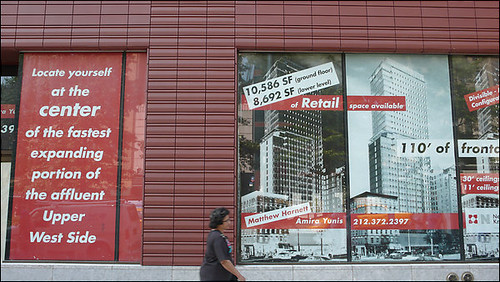
An Upper West Side advertisement by a New York real estate firm borrows from the aesthetic popularized by Barbara Kruger's art
An Upper West Side advertisement by a New York real estate firm borrows from the aesthetic popularized by Barbara Kruger's art, below, in the 1980s. "My work was always about questioning the power, the ownership of images," the artist says. (Photo by Lucy Hogg)

But not when the owner is recalcitrant.

Labels: , , , , ,

Transit heights and lows

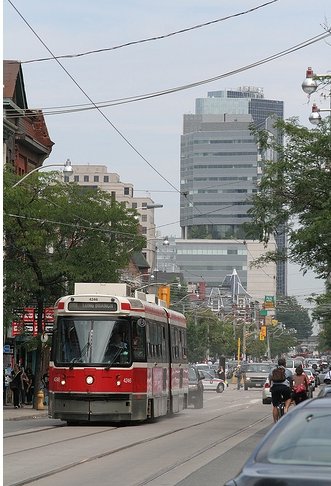
Toronto Streetcar, looking east on Queen Street West
Toronto Streetcar on Queen Street West. Flickr image by Rick Heath, used by permission.

Toronto's Mayor, David Miller, has decided not to run for a third term. Nigel sends us a link to the Spacing blog, where Steve Munro writes, in "The Mayor of Transit City," about how Mayor Miller is telling the truth when he states that one of his biggest accomplishments as Mayor and before that as City Councilor, was in expanding transit.

From the article:

... Indeed, improving public transit to make Toronto a “World Class City” was part of Miller’s first, unsuccessful, bid for a Council seat in 1991. The next election, in 1994, brought Miller to the old Metro Council.

I came to know then-Councilor David Miller in his role as a Commissioner on the TTC board after the city’s amalgamation in 1998. He had a good sense of issues and advanced his positions clearly and strongly, but without grandstanding.

After the mid-1990s funding and service cutbacks, the TTC needed strong advocacy to turn it around. Ridership dropped from a 1988 high of over 463-million to a low of 372-million in 1996, creeping back over 400-million by 2000. The TTC’s only plans for service expansion were a few new subway lines, but when these would be funded and built was anyone’s guess.

Operating subsidies fell over the years, and farebox cost recovery grew from about 70% in 1988 to almost 85% by 2000. Partly this was achieved through fare increases, and partly through service cuts. This placed a greater load on riders to fund the system while quality and quantity of service declined, particularly on the surface network.

The minutes for the April 10, 2002 Commission meeting contain a small item that would fundamentally change transit planning and advocacy:

CC-2 Commissioner Miller submitted his communication dated April 5, 2002 to Chair Ashton with respect to the development of a ridership growth strategy.

COMMISSIONER MILLER MOVED THAT STAFF BE REQUESTED TO BEGIN DEVELOPMENT, IN CONSULTATION WITH COMMISSIONERS, OF A REPORT ON A RIDERSHIP GROWTH STRATEGY.

THE COMMISSION APPROVED COMMISSIONER MILLER’S MOTION.

Later, the Toronto Transit Commission developed the Transit City Plan based on principles of both equity--that no one should be disadvantaged because they don't own a car--and mobility effectiveness. From the article:

Recently, the TTC published the Transit City Bus Plan (TCBP). This continues the focus on surface operations and transit’s attractiveness by proposing a core network of routes where service would always be at least every 10 minutes. This complements the subway policy headway of 5 minutes at all hours. Like its predecessor RGS, the TCBP makes incremental changes to the system to keep the cost of each change modest and to allow selective implementation of each stage. Most importantly, the TCBP looks at transit service from a network viewpoint, not as a single project of little benefit to most riders.

-- Toronto Ridership Growth Strategy.

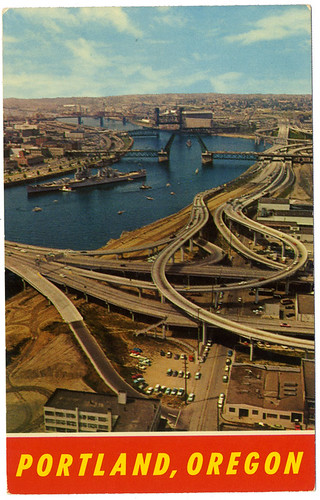
2. This article from the Portland Mercury, "The Dead Freeway Society: The Strange History of Portland's Unbuilt Roads," discusses how great Portland, Oregon is because they ended up not building planned freeways AND THEY TORE DOWN EXISTING FREEWAYS.
Portland's waterfront used to be scarred with freeways
Portland's waterfront used to be scarred with freeways.

Ironically, DC is no less great because most plans to build freeways within the city were also dropped, and instead, a subway _system_ was built. Interestingly, initial planning for freeways was paired with "rapid transit" planning, with plans to put rail lines in the middle of freeways.

(One of the most "accessible" articles about this topic is "END OF THE ROADS; In the Interstate Era, Congress ruled Washington like a fiefdom. Then a fight over some freeways inspired a biracial, neighborhood-level movement to fight the federal power" from the Washington Post, by Bob Levey and Jane Freundel Levey, Nov 26, 2000 from the Sunday Magazine. The article is not accessible for free online.)

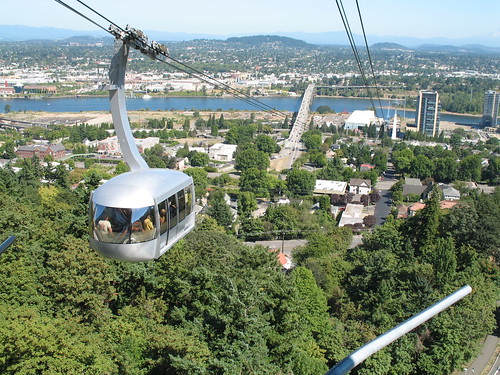
Now, where Portland differs from DC is in the quality of and the vision possessed by local political and economic elites, and in their continued commitment to transit expansion and investment and the adoption of "new" technologies such as modern streetcars and an aerial tram.
Portland aerial tram
Portland's aerial tram connects the Oregon Health Sciences University over steep terrain and the system is operated by OHSU. (An interesting public-nonprofit partnership driven by the University's recognition that certain land was developable only with better and transformative transit. The topography and river meant tram. Note the example in terms of redevelopment of large campus areas within DC and whether or not the developers are required to pay into transportation improvement such as streetcars--thus far, no.) Photo by Michael Farrell.

What's interesting is that Portland gets tremendous credit, justifiably for its vision, and the hard work it has performed in rebuilding an environment that promotes walking, bicycling, and transit.

DC proper hasn't done nearly as much focused work "lately". It has benefited from the creation of a true subway system, and in the city there are 40 subway stations, with 29 at the core of the city, laid over the top of walking-bicycling-transit friendly spatial pattern of small blocks, a grid-based street network, and "angled" arterial avenues that speed trips across the expanse of the grid.

The L'Enfant plan, developed at the outset of the "Walking City" era, combined with a strong employment center at the core of the city (the Federal Government and the entities that serve it--contractors, trade associations, lobbyists, and lawyers), plus transit means that the city is now one of the more successful center cities in the nation, despite many many persistent problems.
L'Enfant Plan, Washington, DC
The L'Enfant Plan for the City of Washington dates from 1791.

And while Portland gets all the credit it deserves, the fact of the matter is that mode split -- the number of trips to work by transit, walking, and bicycling -- is far better in DC than it is in Portland.

3. Sadly, most transit systems across the country are facing serious budget shortfalls for the next fiscal year. This is the case with the DC transit system (see "Board to Catoe: Cut service to balance budget" from Greater Greater Washington and my discussion in "Transportation stuff").

Seattle is looking to make massive cuts to eliminate a $213 million budget gap projected for the next two fiscal years. See "Triplett says his budget would stabilize Metro Transit" from the Seattle Post-Intelligencer.

Interestingly enough, the King County Metro system is looking to be somewhat more thoughtful and judicious, rather than reflexive and reactive like the mandate from the WMATA Board. From the Seattle P-I article:

A recent performance audit of Metro Transit found room to raise an additional $54 million in annual revenue by raising fares and reducing discounts for seniors, youth, and off-peak riders, which the audit said were "unusually generous." It also identified $41 million in potential savings through running more efficient bus routes.

Although Seattle does have a different reactive rule, a new mandate that service improvements can't overfavor Seattle, that 40% of service must go to east King County and 40% of service must go to south King County. But where do you think most people are likely to use transit? In Seattle or in the greater reaches of King County?

Note that the Sound Transit system of bus and now light rail also serves Seattle and King County but is managed and budgeted for separately from the King County Metro Transit system.

Labels: , , , ,

Monday, September 28, 2009

Maybe sports is like life... after all

I am pretty tired, normally, of all the sports, military, life and death discussions. Sports are games. And at the end, professional sports don't really change life very much. But there are some pretty good journalists who are into sports, and at times their writings have more global lessons.

Today's column in the Washington Post by Tom Boswell, about the futility of the Washington Redskins, which just lost to the Detroit Lions (being a Detroiter by birth--well, I was born in Mt. Clemens, but I grew up in Detroit, my loyalty is still to my birthplace, Detroit...) which had lost 19 games in a row, including every game last season, touched a chord for me.

I think he describes DC to a "T" in terms of how the city is timid, fine with mediocrity, and somewhat loose and corrupt, at the least unethical, when it comes to a lot of government dealings (i.e., the arrest of a City Council staff member on bribery charges, the passage of some ethics legislation that lacks any sanctions or other teeth, how Councilmembers produce legislation for property tax abatements, how the Executive Branch increasing governs at whim and power rather than by system, etc.).

From "In Big Picture, Redskins' Focus Disappeared Long Ago":

... That's the right attitude, without a doubt. Will the Redskins adopt it? To do so, they may have to fight through an incredible amount of self-delusion about the talent level on their team. This week, Clinton Portis said he thought the Redskins had the most talent in the NFL. Comments like that have been common in the Redskins' locker room for the past 10 years -- regardless of all available evidence. Not only is the view tolerated at Redskins Park, it is encouraged and marketed. Where does this fallacy arise? In the owner's suite, where the price of players is equated with their performance?

They refuse to define themselves by the final scoreboard but, instead, cling to their own private view of themselves and their far higher value -- sometimes based on their performances in other years or even on other teams.

After a wonderful 10-catch, 178-yard game, wide receiver Santana Moss fell into the deepest and worst snare -- and one that constantly catches the Redskins. Moss said many reasonable things after this defeat. But he also said the magic words that always make my skin crawl in a locker room. "We are the better team," he said. ...

The Redskins aren't losers. But they will never be elite winners, especially in a team sport, until they defeat the idea that their potential, their fame or their wealth matters at all. Only their performance -- which is kept on the scoreboard for a reason -- counts. That's why teams beat individuals. ...

When the Redskins stop treating outcomes like this, or their losses last year to the Rams and Bengals, as flukes, they will have taken the first step toward minimizing them.

Labels: , , , ,

Speaking of public spaces and public health

According to the Guardian, "Smoking bans may reduce heart attacks by more than a third." From the article:

Two independent health reviews have found that heart attack rates dropped steeply in areas where bans have been introduced, with one reporting 36% fewer cases three years after smoke-free legislation came in.

Smoking in pubs, restaurants and other public spaces was banned in England and Wales in 2007, a year after similar laws were introduced in Scotland. The Scottish ban led to a 14% fall in the number of people being admitted to hospital with a heart attack the following year.

A Department of Health study of heart attack rates in England and Wales is not due to report until next year, but experts believe the number of cases in the regions has already fallen by around 10% as a result of the smoking ban.

(A similar result was found in a state like Colorado, where a community passed a smoking ban, and after a year or so, it was overturned. Epidemiologists studied the heart attack rates during the ban and after.)

Labels: , ,

It's scary when the impetus for urban improvement comes from IBM...

A supplement in Good Magazine ("Rethinking Cities: Introduction") also was included in the Friday edition of the New York Times, and lists eight urban innovations/best practices projects, 3 from outside the U.S., and 5 from inside the U.S.

IBM likes intelligent transportation systems and other projects that require hefty use of information technology hardware, software, and systems integration, because they can make money on it.

But then, if making money can drive municipal innovation, real improvements, fine. They are motivated to push the changes forward, more so than activists maybe, who get tired of working the system and lack the resources and financial incentives that corporations like IBM do have.
Rethinking Cities Introduction  - IBM

Labels: , , ,

A different way of thinking about social movements

Comes to us from the organization behavior department of the Stanford University Graduate School of Business and their magazine, which profiles various efforts by faculty at the school.

The story "Market Rebels" features professor Hayagreeva “Huggy” Rao, and his work/book on the link between technology and/or product adoption and the "social movement" actions both inside and outside of an organization that are necessary for the technology to become adopted.
Market Rebels book cover

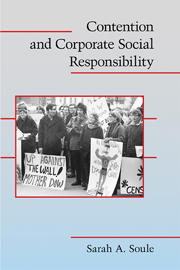
"Social Movements," features the work of Professor Sarah Soule, which has been published as Contention and Corporate Social Responsibility. From the article:

... how exactly do social movements create change? And at what stage do these movements have the most impact on governments and even on corporations?
Book cover, Contention and Corporate Social Responsibility
Sarah Soule, the Morgridge Professor of Organizational Behavior, has looked at thousands of protests staged over numerous causes to find the answers. Her conclusions? Movements have their greatest effect in the early stages of policy debate on a given issue, before the debate becomes too broad and acrimonious and before cause supporters become too outspoken. And, she says, activism often begets more activism as groups that come together over one issue find future ground for agreement and take on yet more issues.

Before 2000, researchers had not proven empirically the power of protest to create change, says Soule, who joined the Business School's organizational behavior faculty in 2008 after teaching at Cornell and the University of Arizona. She and colleagues set out to find evidence of whether social movements make a difference, and if so, when they have the most impact.

A third article is about Green Marketing. It's not as scintillating as the other articles, but is interesting nonetheless. See "Green Business."

Labels: , , ,

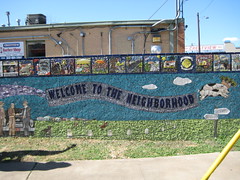
Welcome to the Neighborhood mosaic mural


Welcome to the Neighborhood
Originally uploaded by riddle
Wall of Welcome in the Brentwood/Crestview neighborhood, Austin, Texas.

Sunday, September 27, 2009

Marketing the local experience that is also DC

Tourists determinedly taking on Washington on the National Mall
People visiting "Washington." (Original photo source unknown.)

I have written about this a lot over the years, this is putting together some of my responses to a thread about the topic on the HistoricWashington e-list, with the added benefit of some post-sending editing.

The biggest problem with "selling" DC history is that the entire world interprets "local DC history" through the lens of the story of the founding and continued management of the United States of America.

And don't under consider the issue of charging admission in a city where the majority of the most in demand destinations are free. It's not like the Phillips Collection and the Corcoran Museum of Art, which need to charge admission as a part of their revenue generation model, thrive vis-a-vis the National Gallery of Art and the Smithsonian art museums, which do not charge admission fees. (See "Museum negotiates masterpiece of a deal" from the Washington Business Journal, about the Phillips Collection.)

Note also that while the International Spy Museum (a for profit entity) has thrived, despite having to charge admission, the Madame Tussaud's Wax Museum has not.

So developing the local narrative, packaging it, and selling it becomes a "Market Development" (look up the term in the marketing literature) problem of almost immeasurable difficulty.

The people who visit DC come here to go to the Smithsonian Museums, the U.S. Capitol, the White House, the Washington Monument, maybe Mount Vernon (are you familiar with the complete reworking of the exhibits/narrative there over the last couple years), as well as a visit to either or both Alexandria and Georgetown to combine both seeing "old" buildings as well as shopping and entertainment.

While the Destination DC (the local CVB) campaign "Power Play" does market, some, local destinations, the campaign is more focused on the national narrative more than the local. (And these days with the economic downturn, Destination DC has problems too. See "Destination D.C. lays off 12 employees," from Washington Business Journal.)

While it is true that the "cultural tourist" stays longer and spends more compared to non-cultural tourists according to all of the research, "cultural tourists" come to DC to consume a significantly different "non-local" but place-based experience compared to the typical cultural tourist visiting other places

Besides, depending on the tranche of tourist demographics, many stay outside of the city because of the high room rates at hotels/motels based in the city. That is a big issue with National Harbor, the soon-to-be-location of a Disney Hotel (see "Walt Disney to build at National Harbor" from the Washington Business Journal) and local tourism marketing campaigns from other jurisdictions, i.e., Montgomery County Maryland's "DC Days, Montgomery Nights" (mean visit DC during the day but stay in Montgomery County) campaign of a few years back.

To consume a portion of the local story (visit some neighborhoods, walk a history trail, go to a local history museum) visitors will need to stay at least one additional day, which means at least one more rooming night, andspending more money. (Plus let's face it, if you are visiting here with children, going to see decidedly local attractions might be a stretch.)

You mention local corporate support. The DC region has real estate developers (and their support staff--law firms, financiers, and parking magnates in the city) and military contractors primarily. The city is full of nonprofit organizations (trade associations, advocacy groups, universities). The federal government is not a donor organization either.

In short, there is limited support and limited recognition of the value of "DC" as opposed to being in DC to be proximate to the federal government. This makes it doubly difficult to promote a local narrative through a local history museum. To get a better sense of the local business establishment I always recommend the urban sociology article "The City as a Growth Machine." Promoting local history if it can't be adequately monetized isn't high on their agenda.

Then there is the issue of tourism taxes (hotel tax, car rental tax, some portion of restaurant meals taxes). Most go to pay off the convention center. Upwards of $10 million goes to Destination DC, the organization tasked with marketing the city as a place to visit.

Very little goes to fund the development and presentation of local history and cultural assets. (This is discussed in my paper on cultural heritage and assets.) And the while Convention Center supports local hotels and restaurants, although most of the hotels do not have local owners, I do question whether or not the fact that the Convention Center consumes the bulk of the local tourism tax revenue stream is the best use of the money.

The primary reason I advocate for separating out a tourism development and management element within the DC Comprehensive Land Use Plan is to reorient how the city develops, manages, markets, and funds cultural assets.

And speaking of the federal government, specifically the 435 members of the House of Representatives and the 100 Senators. They don't care about DC either. They are in DC because DC is the home of the national government, but they are not of DC.

Since so many of them position their image/role as being "against DC/running against Washington," the last thing you're going to do is see them throw off their yoke of parochialism and focus on what we might call meta-national issues, one of which would be putting resources into the National Capital (buildings, monuments, parks, transportation infrastructure, cultural assets) so that it shines and communicates a great message about "America" (the United States) as a nation that also cares about its cultural as sets and the way it is displayed to the world.

See for a contrast this 1992 NY Times Magazine article about Paris, "Why Paris Works." From the article:

FOR MANY OF THE CITY'S 2.2 million residents and many of the 20 million tourists who visit each year, Paris remains a magical, even transcendent, place. While many Americans shun their own cities as if they were places suffering from the plague, Paris is a city with which countless people still have a passionate love affair.

The people who run Paris know that if their city relied on just the charms of its past, it would lose its magic. Thus, they have sought to superimpose a smoothly running, modern metropolis on the city bequeathed them by medieval kings and 18th-century revolutionaries. And they have succeeded royally.

Garbage is picked up seven days a week, mail is delivered three times a day and all of Paris's 800 miles of streets are swept by hand each day. At rush hour, the subways come once every 80 seconds, and many Metro stops are decorated with mosaics and murals. Affluent families are rushing not to flee for the suburbs, but to buy apartments in Paris's choicest neighborhoods and to send their children to public schools.

There is no single explanation for why Paris works so well. Rather, Paris has become a shining model for urban planners thanks to numerous ingredients lacking in many other cities: ample financing, sound administration, farsighted planning, technological ingenuity, a flair for design and an ambition to always improve.

France puts more federal money than the norm into Paris because Paris is the national capital and because it defines France and how France is "consumed" when it is visited. AND because how France and Paris looks to others matters to people in France, particularly members of the government, but also to many French citizens whether or not they live in Paris.

Congress will spend money on itself--the underground National Visitors Center at the U.S. Capitol cost over $500 million to build. (Note that in the first year, not yet over, the NVC at the Capitol has received over 2 million visitors.) But Congress is less inclined to put money into other parts of the city to improve the quality of the experience. They don't think much about the "nation" and how it is perceived. They do think a lot about their districts and how to get reelected.

I meant to blog about the new "tax," or $10 fee on international visitors. (See the AP story, via the Seattle Times, "Industry pushes new international visitor fee.")

The fee is supposed to fund marketing the U.S. to international tourism markets. Most national governments in other countries have extensive marketing and tourism programs. In fact, I regularly use development materials that are produced by tourism departments from Canada, the United Kingdom, and Australia, because the materials are so good. (Actually in the U.S., most states are quite good at tourism development and marketing, even if I complain about DC's efforts in this area. While not perfect in every respect, both Maryland and Virginia are well respected for their tourism development and marketing programs.)

This fee has been opposed by some quarters, but is in some respects a desperate move to raise money for something that is necessary, but is impossible to get Congress to appropriate money for otherwise.

A dirty National Mall after the Obama Inauguration
WASHINGTON, D.C. - JANUARY 20: A man walks past trash after the inauguration of Barack Obama as the 44th President of the United States of America on the National Mall January 20, 2009 in Washington, DC. Obama becomes the first African-American to be elected to the office of President in the history of the United States. (Photo by Mario Tama/Getty Images)
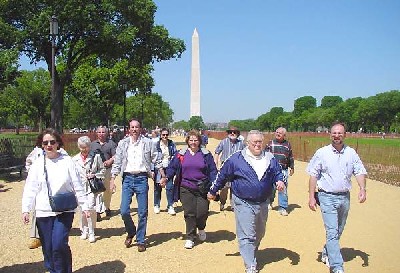
See the AP story, "Neglected National Mall languishes," which reports on how Members of Congress write earmarks for national parks and other cultural institutions in their own states, while voting against appropriations for improvements to the National Mall, which connects the U.S. Capitol, the Washington Monument, and the White House, and is visited by tens of millions of people each year.

From the article:

The mall didn't just lose out on earmarks. In January, Congress deleted $200 million in stimulus funding for the mall. And last year, a bill that would have appropriated $100 million for mall repairs failed.

Republican Rep. Jeb Hensarling of Texas said mall funding wasn't an emergency.

"It's entirely appropriate for Congress to fund repairs for the National Mall in the traditional process, but the American people are smart enough to know that it will do very little or absolutely nothing to provide economic stimulus," he said.

House Republican whip Eric Cantor of Virginia similarly derided efforts to "help upkeep the grass on the lawns of Washington."

Yet Congress invests in sod and flower beds on its own grounds at the Capitol, which are kept carefully manicured, even as the mall — which runs 2 miles from the Capitol to the Lincoln Memorial — has languished.

Congress employs about 1,900 workers to maintain its buildings and 450 acres, while the National Park Service has about 200 maintenance workers for the 650-acre mall and memorials.

To deal with all the very difficult issues recounted above you need more than a blog, you need to have people who are really really good, and very much focused on developing and extending the quality of locally based and significant cultural heritage.

My joke about DC is that the big government (the federal government) trickles down and shapes little government (the local municipal government) and civil society in its image.

So you can imagine we also have a vision and personnel problem too.

Labels: , , , , , ,

Saturday, September 26, 2009

More on arts "districts"

I wrote and presented about this topic in July. See "Art, culture districts, and revitalization."

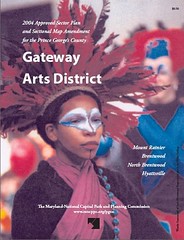
1. But the Post just wrote about this in the context of the Gateway Arts District in Prince George's County, in The State of the Arts District? So-So.. Probably the journalist didn't read the Gateway Arts District Sector Plan.

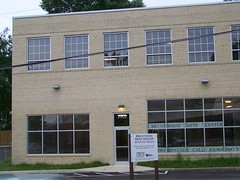
I happened to have a conversation last weekend (before the article came out) with an artist with a studio in the Gateway District, and I asked about why the Brentwood Arts Center still isn't open. It's supposed to be an education and gallery space, with working studios on the second floor for artists.
Brentwood Arts Center, Prince George's County
She's on the advisory board and mentioned that there have been a lot of permitting problems, which have kept the facility from opening for more than one year, even though the planning agency's parks division will be one of the tenants and provided funding for the building.

But she stated that one of the problems is with how people see the center functioning. A lot of the community members involved in the organization or the advisory committee are not artists, and they want the building to function more as a community center with youth-oriented arts activities--not as a place for artists.

That doesn't surprise me. And I said, they (and she) need(s) to read the Gateway Arts District Sector Plan. It covers community development sure, but it's also about economic development, building a revitalization strategy through a recognition of artists as producers and arts development opportunities.
Cover page, Gateway Arts District plan
Interestingly, the Gateway Community Development Corporation and the Anacostia Trails Heritage Areas are very interesting organizations. They are definitely community oriented arts and heritage organizations. They are supposed to be economic development organizations. The membership of the boards of the organization is structured very specifically to be led by the community.

The Gateway board is elected in tranches representing members living in Mount Rainier, North Brentwood, and Brentwood. Hyattsville, for some reason, isn't included. The ATHA board is a bit more problematic, comprised solely of elected officials representing the various jurisdictions that are in the geography of the heritage area, which is designated by the State of Maryland, and is supposed to generate economic value. (See the State report Investing in Our Heritage - Ecomonic Impact Study.)

But after awhile, imo anyway, the board members and their agendas get disconnected from the original intent of the initiatives (either the Arts District or the Heritage Area) and the projects as originally conceptualized, expressed and outlined in their respective management plans. Community members of the board become more focused on "community building" rather than economic development.

Also see these past entries, "Musings on community building and revitalization," and "Civic Tourism."

2. Interestingly, the Los Angeles Times has a story, "L.A.'s Museum of Neon Art is glowing, glowing, gone," which discusses some of the trials and tribulations of the "arts scene" as a economic development strategy in Downtown Los Angeles.

It has some of the same issues as the 14th Street DC "Arts District." (See "Panel Offers Recommendations to DC Government to Secure Mid City Arts District" from DC North.)

In terms of the Gateway District, you can't just wave a wand and create an arts district. Success in an arts district is a function of a number of factors, primarily a large inventory of low cost space, and large buildings, which is attractive to both artists for working space as well as for presenting space for performance spaces (music, theater, film, dance) as well as gallery spaces.

14th Street NW is a little different. At one time the inventory of "undesirable" and somewhat large spaces existed, starting with the ever expanding Studio Theater. But the real estate market caught up with the value of the location--you can't beat the "mid city" area for proximity and centrality--and it ceased being an area with undervalued real estate. With that change, an arts district focus can't succeed without significant subsidies. Downtown Los Angeles has similar issues.

Another trick is to balance the creation of a wide type of arts facilities, including performance spaces, studios, galleries, etc. The problem with Gateway is that for the most part it has spaces for "doing" like the Joe's Movement Emporium, but not spaces for "consuming"/buying (movie theaters, concert halls, etc.).

And the use of extant buildings. For the most part, Gateway has to build new/massively rehabilitate old buildings, and there aren't many appropriate extant buildings to begin with. So right from the start, the real estate value equation doesn't make sense.

Plus the lack of an adequate spatial pattern of blocks, streets, etc. The Route 1 corridor is not a walking environment. Not to mention the lack of density of a nearby population, and demographics that don't particularly favor the consumption of arts performances and products.

An interesting counter example is the Penn Avenue Arts District in Pittsburgh, which has similar issues in terms of household demographics. But they do have buildings, and they have been successful at attracting arts anchors such as a dance company and the Pittsburgh Glass Works, which are both very active places for performances, classes, etc.

Unlike the Washington Glass School which is next to the railroad tracks off Otis Street in Mount Rainier in the Gateway Arts District, the Pittsburgh Glassworks is prominently located on Penn Avenue.

Of course, the increasingly vibrant Station North District in Baltimore shows another example. But they are "blessed" by a still weak real estate market and a huge inventory of available buildings, many quite large (which Gateway doesn't have), which artists and arts organizations can acquire or rent for relatively low cost. Charles Street north of Penn Station has fewer and fewer vacancies now, and the area on North Avenue between Charles Street and Howard Street is slowly but surely being revitalized with significant arts-related uses.
Station North Arts and Entertainment District logo, Baltimore

But in any case, this is a long process.

It will take even longer in the Gateway District because some of the basic building blocks that support arts-based revitalization are not present, and the community leadership isn't necessarily sophisticated enough to stay focused and not let mission creep get in the way of their success.

I predict the next article you will see about failures or lack of success is in about 18 months, over "over storing" of restaurants and taverns in the H Street NE neighborhood...

Labels: , , ,

Friday, September 25, 2009

Reconsideration of my Smart Bike criticism

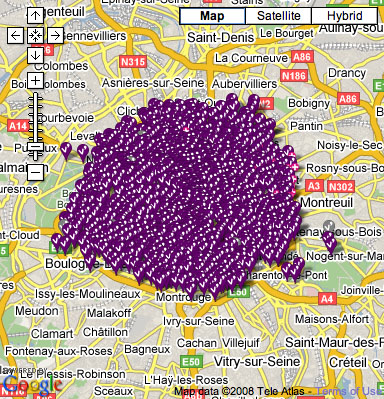
Map of bicycle sharing stations in Paris.

... well, not my criticism (see "Montreal vs. DC in bike sharing..." and "Don't "foul" up" about the U.S. House of Representatives attempt at bicycle sharing) but whether or not SmartBike DC, the bicycle sharing program could have significant impact if it is set up properly.
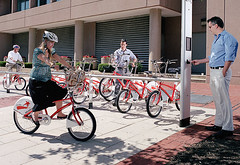
Smart Bike (bicycle sharing) on the 600 block of 6th Street SE, Washington, DC
SmartBike bicycle sharing in DC.

I was riding down Georgia Avenue this morning, and around 7th and Florida Avenue, a Smart Bike+rider joined me in the bike lane. I passed him, but he caught up at the stop light at Rhode Island Avenue, and I turned back and asked him (I found out his name is Ben) why didn't he just buy his own bike.

Ben said that it's convenient for him, because crazily enough, a SmartBike Station was installed at 7th and T Streets NW, two blocks from where he lives. So we continued riding and talking down 7th Street, and I learned that there is a station within a block or two of where he works. And that another of his co-workers uses SmartBike, because the Logan Circle area station is pretty close to where he lives.

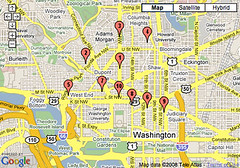
The real problem with the implementation of SmartBike DC thus far has been timidity. There are very few stations overall (although there is a plan underway for significant expansion) and most of them are downtown.
Map of bicycle sharing stations in DC
Map of bicycle sharing stations in DC.

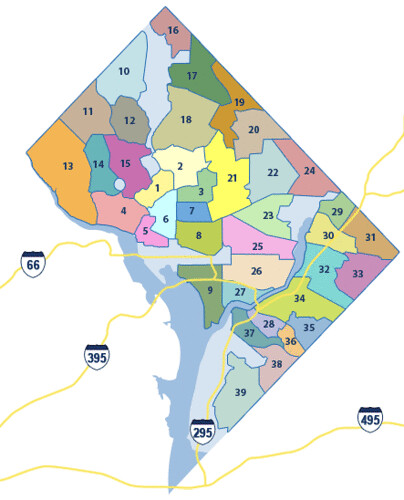
If you expect DC residents to be the bulk of the users, the fact that for the most part there aren't stations in neighborhoods, albeit in highly-traffiked locations, is a problem.
map_washington-dc
Map of DC (by "clusters" as defined by the DC Office of Planning.)

If you expect commuters (non-DC residents) to use the system, then the stations have to be by subway stations and their offices, and likely for most people how take the subway to downtown (where the bulk of the sharing stations are located presently), it's just as fast and as pleasant for them to walk, hence minimal use of the bicycle sharing program.

But the biggest problem with a focus on commuters is communicating with them as for the most part, they aren't interested in the world outside of the floor of their office, and they don't get regular communications from anybody (their building management, the Downtown DC BID, etc.) that tells them what they can do while they are here during the day.

The real opportunity will be in the core of the city, where residents, activity centers, and other destinations are in close proximity.

And there is something to be said for paying about $40 for membership, having access to a bike (although they can't be ridden very fast and I am hardly a fast bicyclist), and not having to worry about paying for it to be maintained.

Labels: , , , ,

Maira Kalman, And the Pursuit of Happiness: For Goodness Sake

Christopher sends us a link to the Maira Kalman blog in the New York Times, which features each month an illustrated story about American Democracy.

The current piece, "For Goodness Sake," is an exploration of public service and municipal government and the opportunity to volunteer in New York City, with a primary focus on "sanitation."

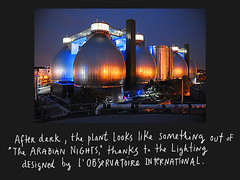
This is a photo of the city's sewage plant, Newtown Creek, at night, by Carl Ambrose.

Thursday, September 24, 2009

Plastics, computer chips, the World Wide Web, and Transportation Demand Management...

Plastics is the big thing of the future in the movie "The Graduate." In the not very good movie, "My Tutor," the young protagonist was told to get into [the] "Computer Chips" [business]. We all know about the continued boom (and occasional bust) that has resulted from the World Wide Web, the graphical and multimedia Internet, and the creation of a global interaction network that William Gibson called cyberspace in the book Neuromancer.

For cities, "transportation demand management" ought to be the next big thing.

DC is resistant. The Office of Planning rejected my proposed amendment to the Comprehensive Plan to require transportation demand management planning. (It's item 24 in this document.)

They said:

The amendment proposal does not correct an error. The current policy provides sufficient guidance to reduce the number of car trips and miles driven to increase the efficiency of the transportation system. Currently, the District does not "require" TDM planning on a neighborhood or district scale. The amendment proposal does not provide information on how this could be achieved. This idea could be discussed/studied by DDOT in conjunction with the Transportation Vision Plan.

YES IT DOES CORRECT AN ERROR. The Comp. Plan says it's important to do something about transportation demand management, but doesn't require that anything be done, with the exception of requiring TDM for planned unit development zoning actions (and as it was, I got that requirement into the Plan).

I should have written a concept paper to show them how to do it. I was about to embark on writing something like that (I was going to set up some meetings with people in Arlington and Montgomery Counties, where they do TDM planning in a variety of ways, and MoCo requires transportation mitigation planning in 4 designed transportation management districts). They should have contacted me, asking for such an additional submission.

It's a pathetic response. I guess they are afraid to have to create a method to do transportation planning instead of mandating automobile-oriented requirements ("parking") in the development review and zoning process. All that you have to do is create a checklist and targets and a system for dealing with it.

I mention this because today's Examiner has a ridiculous example of what it means to not have a city transportaton plan and to not have transportation demand management mandated within it, and to not have a plan for "Parking and Curbside Management" within a transportation plan.

See "D.C. proposes 5 hours of free parking for mourners."

What you have is City Council legislating (or attempting to legislate) piecemeal, poorly thought out "plans" and policies, you don't get anywhere, except for having a bunch of piecemeal poorly thought out policies and practices.

Businesses such as funeral parlors and institutions such as churches should have to perform transportaton demand management planning. Having mitigation plans, which could include providing a limited amount of exceptions from normal parking rules, would provide a systematic way to deal with transportation demand in a manner that promotes optimal mobility, rather than a continued privileging of automobile ownership.

The reason that the Arlington County Master Transportation Plan is "brilliant" is because it is internally consistent. The goals, objectives, and actions of each Element of the Transportation Plan derive from the MTP Goals and Policies, which comprise the Plan's overarching "Framework."

So the goals, objectives, and actions within the Parking and Curb Space Management Element Draft are focused on promoting optimal mobility--because that is the intent of the County's Transportation Plan--not on promoting suboptimal automobile (a/k/a automobile trips especially single occupant vehicle trips).

By way of comparison, DC's transportation planning and land use planning is internally inconsistent.

For those of us who care about quality outcomes, this should be of great concern.

For more on suboptimal automobility see the Robert McCartney column in today's Post on Car-Free Day, "Car-Free Diet Hard to Swallow For Many."

The title of that column is an apt description of the "Long Range Planning" unit of the DC Office of Planning.
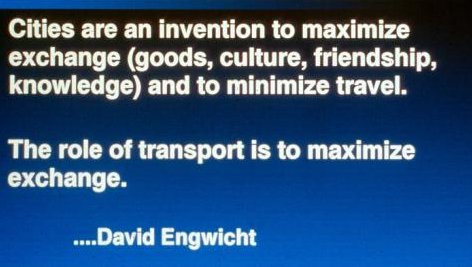
Cities are an invention to maximize exchange
Image from a presentation by Dan Burden. David Engwicht is one of the pioneers of the "Living Streets" movement.

Labels: , , ,

Transportation stuff

1. GGW suggests the honor system for streetcar payment. See "Streetcars on the "honor system"." I don't. With SmartTrip cards, which more and more people are using, especially on buses, dwell time (the time a bus spends sitting while people are boarding and exiting) is shrinking. Charge.

There's a reason that farebox revenue collection covers about 80% of the cost of operations for the subway system... Sure, fares are distance based, but fares are also collected.

2. Raising fares has also been discussed in GGW. See "Board to Catoe: Cut service to balance budget."

I think limiting fare increases to some specific percentage is foolish. Yes, I don't like the idea of fare increases, but I like the idea of service cuts even less. The Metro Board is being irresponsible by overly constraining how to rectify the budget gap through fare increases, service cuts, and other changes.

Metrobus base fare is $1.25/$1.35 (10 cents less if you pay with SmartTrip cards). In most other cities base fares are $1.50 or more. In Baltimore, it's $1.60. (But you can get an all-day pass for $3.50.)

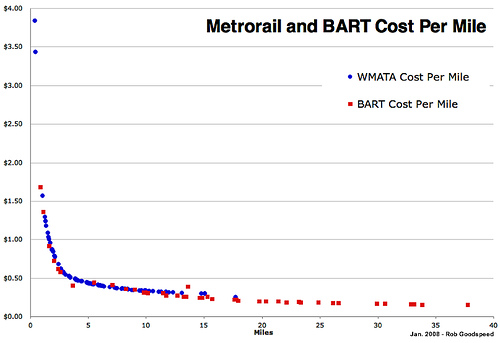
On the other hand, the fare system for Metrorail is biased against short trips, or in other words, provides cheaper fares on a per mile basis for longer trips, as Rob Goodspeed discussed some time ago, in "D.C.’s Metrorail Fares in Context." The last graphic from his entry, reprinted below, shows that on a per mile basis, the highest fares are those between 0 to 5 miles.
Metrorail (DC) and BART Cost Per Mile
Graphic by Rob Goodspeed.

I think Metrobus fares should be raised at least 10% -- an increase from $1.35 to $1.50 is 11%.

After all, in real dollar terms, the bus fare today is no higher than it was in 1988. And Metrorail fares should be raised, but in a manner that does not continue the overcharging on a per mile basis of shorter trips.

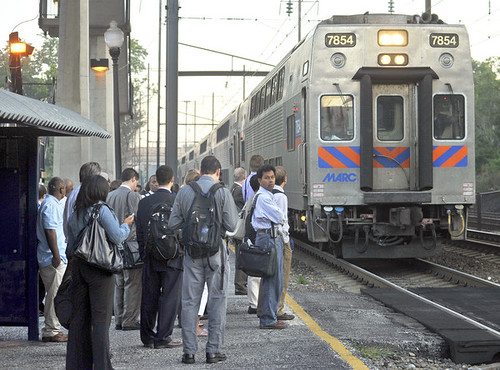
3. MARC rail commuters seeking to get from Maryland to DC are dealing with shortages of locomotives (see "Testing safety dispute idles MARC's new locomotives " from the Baltimore Sun), which has reduced the number of train cars running on the Penn Line, leading to overcrowded trains. See "Commuters frustrated with crowding on MARC" from the Baltimore Sun.
Morning commuters wait at the Halethorpe station to board the 7:13 a.m. MARC train to Washington
Baltimore Sun photo by Amy Davis / September 15, 2009. Morning commuters wait at the Halethorpe station to board the 7:13 a.m. MARC train to Washington. MARC is having to use older locomotives that can pull fewer cars.

4. Looks like toll roads are going to cost a lot of money... see "ICC Tolls Could Top 35 Cents Per Mile : Fees to Vary by Time Of Day; Trucks to Pay More Under Md. Plan" from the Washington Post about the fare structure for the Inter County Connector in Montgomery and Prince George's County.

But at least the road will "pay for itself."

5. Leader of the MetroRiders organization has it right if you ask me, in his comment in a Post article about the tenure of John Catoe as the general manager of WMATA, the Washington regional transit service. From "Metro Chief Is Facing 'The Test of His Life'" in the Post:

Jack Corbett of MetroRiders.Org, a riders group, said the group also supports Catoe's efforts to streamline staff and expenses. But he called on Metro to beef up its safety staff and to be "fully transparent" on ongoing safety issues.

Corbett said the board, not Catoe, is Metro's "weak link." The 12 members -- six of them voting -- are appointed by elected officials or elected in their jurisdictions, so "they have divided loyalties," he said. That makes them reluctant to ask local governments to increase funding for Metro.


This is the issue. We need a better leadership and oversight structure for WMATA. Board members need to respond to and consider issues more globally than strictly within the lens of the jurisdiction they represent, be it DC, Maryland, or Virginia, and consider the transit system and the region as a whole.

In some places, usually none of significant size, the metropolitan planning organization, the body tasked by the federal government with responsibility for transportation and air quality planning for metropolitan regions, also operates the transit system. At least this is the case in Minneapolis (Metropolitan Council of the Twin Cities Region) and then in Portland, there is a regional government, "Metro," which has broader planning responsibilities, and the members of the government are elected on a regional basis. However, in Portland the transit system is independent of the Metro Government. (Also see Association of Metropolitan Planning Organizations.)

I think such a system might be good to have in the Washington region. (And in the Baltimore region too. Rather than having transit planned and provided by the State of Maryland, responsibility for transit operations as well as planning should be devolved to the metropolitan region, to the Baltimore MPO maybe.)

Even though the local jurisdictions provide the bulk of WMATA's budget and you want to have oversight and accountability with regard to that, at the end of the day, the Board Members need to be better than most of them seem to be capable of...

Labels: ,

Wednesday, September 23, 2009

DC Mode shift--trips to work by transit, walking and biking--exceeds 50%

See the new data from the American Community Survey of the U.S. Census. Mean travel time to work: 29.5 minutes. National average: 25.5 minutes. The breakdown of DC mode split is:

- 35.7% transit
- 12.3% walking
- 2.3% bicycling

Arlington County has 32.8% mode split. Mean travel time to work: 27.3 minutes.
Alexandria has 25.9% mode split. Mean travel time to work: 29.2 minutes.
Fairfax County has 10.7% mode split.
Montgomery County has 17.3% mode split. Mean travel time to work: 32.3 minutes.
Prince George's County has 18.7% mode split. Mean travel time to work 36.3 minutes.
------
Loudoun County Virginia has 3.5% mode split and the mean travel time to work is 32.3 minutes.
Prince William County Virginia has 7.1% mode split and MTT to work of 38.3 minutes.
------

Portland Oregon has 23.9% mode split, but 6%! is bicycling. And the mean travel time to work is 24.7 minutes.

Baltimore has 26.1% mode split.

Labels: , , ,

Tuesday, September 22, 2009

A creative idea for adding "entertainment" to your commercial district

------
Reprinted from Summer 2005, in response to w's comment about the need for more than restaurants and taverns in a commercial district like 8th Street SE (Barracks Row)
------

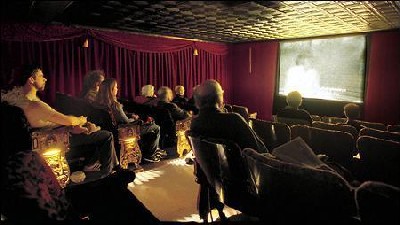
Inside the Grand Illusion Cinema, Seattle
Inside the Grand Illusion Theater, Seattle Washington. The theater is so intimate that sometimes you feel like it's your personal screening room, and sometimes a few people can make a crowd. Seattle Times photo.

From the Washington Business Journal--

Independent filmmakers now have one more place to go and screen their masterpieces.

The Warehouse Theater, across from the Washington Convention Center, is allowing groups of up to 50 people to rent space on its second floor to watch films and is also planning to host small festivals involving local artists. "The idea behind it is that there's an explosion of filmmaking in Washington and around the world, and what's missing for a lot of these filmmakers is a place to screen their films," says Paul Ruppert, producing director at the Warehouse.

Demand for new screening space became especially high after the closing last September of Visions Bar Noir, an independent two-screen theater near Dupont Circle. The Warehouse had previously held some screenings in its main theaters, but only on a sporadic basis. The theater is charging $75 per hour to rent the 300-square-foot space, with a minimum of two hours. [Tim Lemke]

___________
I wrote a blog entry in the June archives, "The Future of Barracks Row? A Counter-point to letter to the editor about Smoke-Free Restaurants", about Barracks Row Main Street and (in my opinion) their need to expand their offerings to include entertainment options--because the restaurants aren't enough, and in fact the business would be declining if it wasn't for the added push from baseball.

I was talking about this with a long-time resident last night, and she said "what would you suggest?" We talked about a bunch of things. She would like to see "family-type" entertainment, including things like billiards. She mentioned a Kramerbooks like offering--which I think is a good idea but would best work at only a couple locations -- where the Starbucks is at 8th and D Streets SE, across the street where the Dunkin Donuts is coming, where the CVS is, or where Bread and Chocolate is located.

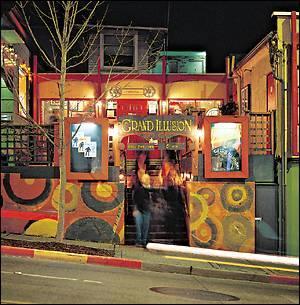
I also mentioned the "Grand Illusion" theater in Seattle, which is a grander version of what they are doing at The Warehouse on 7th Street NW. See this article from the Seattle Times Pacific Northwest Magazine, for more info on the Grand Illusion.

We talked about another idea I had, which would be to redesign the Hine JHS multipurpose room to open onto the Plaza, and to be programmed at night on Fridays and Saturdays, etc.

Lots of things could be done, again, creativity is the key.
Grand Illusion Cinema in Seattle
Grand Ilusion Theater, exterior. You get the feeling that The Grand Illusion Cinema is not your average theater the moment you approach the front door. A dentist's office in a past life, the little theater sits above what now is a used-book store. Photo from the Seattle Times.

Labels: , ,

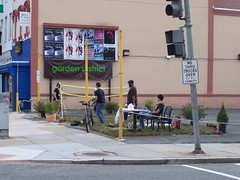
Park(ing) Day DC


Park(ing) Day DC
Originally uploaded by rllayman
I don't know, doing this in an old parking lot/car lot because DC Department of Transportation wouldn't give you permits seems not too challenging and almost pathetic.

I talked to one of the organizers. He specifically said that this wasn't intended to be a protest.

When I pointed out that the originators of Park(ing) Day, Rebar, an artist design performance collective in San Francisco, didn't "ask permission" from the City of San Francisco to do their "performance art" project when they created Park(ing) Day, he countered that California is different, that they expect and are comfortable with protest. By contrast, he didn't say this but he implied it--DC is more institutionally oriented and less open to challenging mores and conventions...

From the New York Times Book Review, "How Brandeis, Revered or Hated, Became a Giant of the Supreme Court":

“Those who won our independence by revolution were not cowards,” Brandeis wrote. “They did not fear political change. They did not exalt order at the cost of liberty.

Cato Institute is gutless and inconsistent: why aren't they calling for an increase in gasoline excise taxes to end the subsidies to automobile users

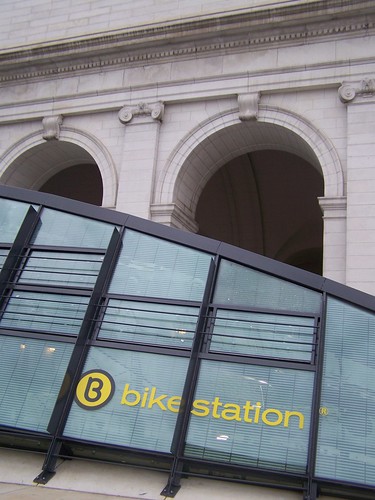
Future Bikestation at Union Station
There is a big hullaballoo about the Bikestation in DC started by the Cato Institute ("Government Pays $4 Million for a Bike Rack") which was called to task by Matt Yglesias ("Bike/Ped Safety Funds Survive Senate Vote"--he said what about parking structures, where's your outrage?). Cato responded ("Response to Matthew Yglesias re: Uncle Sam’s $4 Million Bike Rack") by saying that they would denounce federal funding of projects including parking structures, on private property.

But here's the thing that bugs the s*** out of me... Automobile use is massively subsidized in (at least) two ways.

1. Roads are paid for by gasoline excise taxes, registration fees, tolls AND GENERAL TAX MONIES. Revenues from gasoline taxes, fees, and tolls pay about 60% of the cost of roads.
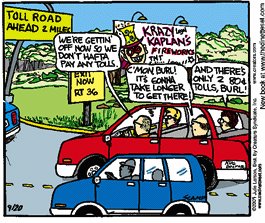
Dinette Set by Julie Larson, 9/20/2009, frame 2
Dinette Set by Julie Larson, 9/20/2009, frame 2. Getting off the highway to avoid tolls.

According to Professor Martin Wachs of Berkeley, gasoline taxes pay for 35% of the cost of roads (see this column by Neal Peirce from 2003, "GAS TAX HIKES: NEEDED BUT POLITICALLY PERILOUS").

Federal excise taxes for gasoline haven't been raised SINCE 1994!

Sure it would stink when I use a car to have to pay more money for gas, BUT TALK ABOUT A MASSIVE SUBSIDY--ALL THOSE AUTOMOBILE USERS NOT PAYING THE FULL COST OF THEIR USE OF ROADS, GETTING SUBSIDIZED BY TAXES....

Where's the Cato Institute on this issue?

The New York Times has more guts than the Cato Institute to take this issue on, and newspapers are beholden to automobile advertising. See the recent editorial, "Real Men Tax Gas‎."

2. Free Parking or very very cheap parking. As long as parking is provided for free or at low cost, driving is subsidized and people don't pay their own way, driving is over-encouraged, and it makes it extremely difficult for transit to be competitive (studies in Minnesota and Montgomery County, Maryland found that free automobile parking is the biggest reason why people won't consider transit to get to work).

And residential parking is an issue too. In a city like Washington, where residential street parking permits cost less than $20/year, for a space that is worth upwards of $2,000 were it on private property.

(Note that people with off-street parking wouldn't be subject to increases, were the city to increase the cost. Therefore, I can see doing an annual "car tax" like the reviled personal property tax in Virginia, to better capture the costs resulting from providing the roads and brides and parking spaces necessary to support automobility.)

But all those free parking spots at work, at the shopping center, etc., encourage driving and discourage making better decisions about where to live, work, and shop.

C'mon Cato Institute, show some intellectual fortitude and consistency.
http://www.fcpp.org/images/cartoon/FB077%20How%20Free%20is%20your%20Parking.jpg

Labels: , , , , ,

Montreal vs. DC in bike sharing...

(There's something about DC where "dare to be great" just isn't in the DNA, be it bicycle sharing, "Feet on the Streets," or Park(ing) Day...)

From "Do your share in cycling revolution," in the Montreal Gazette:

the city's new short-term bicycle rental service, Bixi, has attracted 10,000 members and 98,000 casual users since it hit the streets last May.
Smart Bike in DC
Time Magazine photo of SmartBike DC.

In "Washington Bike-sharing Survey Results Are In," the Bike Sharing Blog reports on the results of SmartBike DC so far:

Of the 1,000 or so members of the program, 333 responded to the survey. The SmartBike D.C. program is in its pilot stage with 120 bikes, so these results may not broadly apply to other programs, but the data is interesting nonetheless. (...)

Question #2: A majority of the respondents use the bikes less than once per week (62%). This is likely due to the lacking availability of stations. With only 10 stations in the pilot program, most of the respondents find their needs not met as station coverage is poor. However, about a third use the bike 1 - 3 times per week (28%).

Question #3: A majority of respondents use the bikes for social purposes (48%) while commuting is the second most common use (41%).

Question #4: Nearly 70% of bike-sharing trips would have been done by foot had the bikes not been available. However, bike-sharing pulled 16% of the respondents away from driving a personal car for their trip and 19% away from a taxi.

Question #7: Trips combining bike-sharing and the subway or bus was low. A smartcard usable on all three systems, like the D.C. region’s SmarTrip card, could improve these numbers. Also, more stations at transit-accessible and non-transit accessible locations could improve this.

Question #8: 60% already own a bike and 40% don't own a bike. This affirms the belief that people with bikes would use the system. Also, with 40% not owning a bike, bike-sharing is creating bike trips that otherwise wouldn't be made.

Granted, Montreal is a much bigger city than DC. But I think the most number of trips one day using the 120 bikes at the 10 stations thus far is 168.

I do think that bicycle sharing systems require some review and reconsideration over the original hype. At the outset of the Paris Velib introduction, I think all of us supporters of bicycling thought that bicycle sharing was the next best thing. Now my thinking is more considered. I think it's important to have bicycle sharing options, but I think that unless the system is ubiquitous, it's less likely that people willing to bike most every day will find bicycle sharing to be a viable option for them. Instead, they are likely to use their own bicycle.

Labels: , , ,