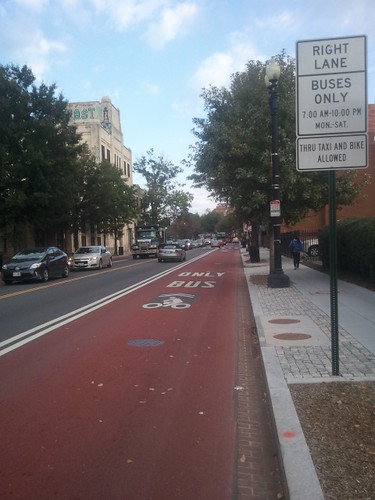
Making "Downtown Silver Spring" a true open air shopping district by adding department stores
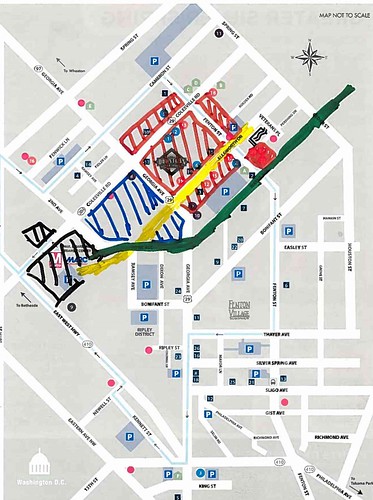
On this map of the Silver Spring core:
Hatched Red = retail district
Solid Red = retail district with potential for intensification (redevelopment of parking lot)
Blue = Discovery site
Black = Metrorail
Yellow = pedestrian path current and potential for extension (darker yellow)
Green = future light rail
I am still way behind in writing based on my trip to Liverpool and London. Overlaid with trips to Essen and Hamburg, one of the things that I intend to write about is pedestrianizing more places in cities, but not so much in terms of creating big districts, but starting "small," with the creation of small one or two block pedestrianized areas where we know they can be successful.
I wrote about big open air shopping districts as pedestrianized city centers, focusing on Liverpool and Essen, and specifically using the Liverpool One shopping center, but applying the concept to North Miami-Dade County, "Learning from Essen and Liverpool and applying it to Miami: Shopping "malls" in the city center."
Liverpool One is an open air shopping district anchored with public spaces and two department stores, John Lewis and Debenhams. In the US, we'd call this a lifestyle center, although most lifestyle centers in the US don't have department stores ("What exactly is a lifestyle center and is it just a dressed up shopping mall," City Metric).
Different from lifestyle centers in the US, Liverpool One deliberately abuts and connects and extends Liverpool's pedestrianized city center, and contributing more broadly by making a pedestrian connection between it and the city's waterfront, making the core city pedestrian district even larger.
Typically US lifestyle centers, even in urban locations, are more disconnected from the rest of the city ("Lifestyle centers vs. traditional commercial districts," 2006).

Liverpool pedestrian shopping district
As opposed to the enclosed shopping mall which for a long time dominated the retail landscape, there are some still extant open air shopping districts in the US, but not very many compared to malls.
I am sure there are many examples of which I am unaware. By this, I mean where there are still department stores as anchors. One is the Bal Harbour Shops in South Florida.
Another, and I can't believe I didn't mention it, is the Friendship Heights shopping district in Chevy Chase DC and Maryland. And the Union Square district in San Francisco, which has six department stores within a three block radius, four on the street and two in an interior mall.

Bloomingdales in Union Square, San Francisco
Bal Harbour is set up for walking once you get there, while Friendship Heights has a Metrorail station and other transit service, sidewalks and four department stores--Lord and Taylor off by itself, behind the Mazza Gallerie, which has a Neiman-Marcus, and Bloomingdales and Saks have standalone stores on Wisconsin Avenue on the Maryland side--but it's still a district dominated by the car and it's very disjoint because its mostly a creation of private property owners with limited planning coordination with and between the local governments, necessary because it is a cross-border district.
(Unlike Bethesda Row or Downtown Silver Spring, it's clearly an area that hasn't been working on enhancing its open-air nature in a concerted way.)
Fifth Avenue in New York City and the Magnificent Mile in Chicago are examples of shopping streets. State Street in Chicago too was once a great example until recently--now all the big department stores are gone. (Of course, most cities had such streets at one time. In Detroit it was Woodward Avenue, in DC it was 7th Street NW, in Baltimore, Lexington Street, etc.).

State Street, Chicago, c. 1960s

Some smaller "market towns" have or had standalone department stores as anchors to their commercial districts. Typically these were independent stores, such as Jacobson's in Ann Arbor, Crowleys and Jacobsons in Birmingham, and Crowleys in Grosse Pointe, all in Michigan, or how a Macy's still anchors Downtown Walla Walla, Washington.
The regional department store chain Boscov's, based in Reading, Pennsylvania, has two traditional downtown stores in Wilkes-Barre, Pennsylvania and Binghamton, New York.

Macy's Walla Walla
Michigan market towns lost out big time when the state's two independent companies went out of business in the 2000s, because there are fewer department store companies to begin with, and because these firms typically favor mall locations.
All of these forms are "unenclosed" compared to the typical shopping mall experience.
In an attempt to compete with the suburbs, some cities built interior-focused urban shopping malls during the urban renewal era. Examples include the Mall at Steamtown in Scranton, Pennsylvania anchored by Boscov's, Newport Center, in Norfolk, Virginia anchored by Dillards, and the Shops of Grand Avenue in Milwaukee, anchored by the now closing Boston Store, a division of Bon-Ton.
The failure of the Bon-Ton Department Store chain will cause many malls and some city centers, like Milwaukee, to lose key anchors. Although some of the locations--a handful--that remained successful despite corporate troubles are likely to be picked up by companies like Von Maur or Dillards. The Charlotte-based company Belk is taking over a Bon-Ton location in a mall in Hagerstown, Maryland, etc.
Silver Spring's opportunity to counter-program its commercial district as outdoor focused. Montgomery Maryland which borders DC, is one of the nation's wealthiest counties. Like other wealthy suburban areas, it has a bunch of shopping malls, but as a set of inner suburbs, the success of the county's shopping centers varies, and some malls and shopping centers are being redeveloped, others sputter, and some are wildly successful.
The county has invested a lot of money in Silver Spring's revitalization, in the face of economic decline typical to what are referred to as inner ring suburbs. In Bethesda, "Bethesda Row" is a national best practice example of new "urban" shopping streets, and a similar kind of redevelopment is happening with Rockville Town Center and in the White Flint/North Bethesda district.

Ellsworth Avenue, Silver Spring
Montgomery Mall is one of the nation's more successful upscale malls, while Wheaton Plaza remains successful, but with more of a middle-market orientation. White Flint Mall no longer exists, except for the lone Lord and Taylor store, while Lake Forest Mall in Gaithersburg continues to languish.
In the days of market towns, Silver Spring was the location of the DC-based Hecht's first suburban store, along with a branch of JCPenney.
-- Richard Longstreth, “Silver Spring: Georgia Avenue, Colesville Road and the Creation of an Alternative `Downtown’ for Metropolitan Washington,” Streets: Critical Perspectives on Public Space, Berkeley: University of California Press, 1994
These stores closed in the 1980s losing out to the more dominant shopping mall. Over time the shopping district has been revitalized but with smaller stores like H&M, Burlington Coat Factory, Ulta, and Michaels, complemented by restaurants, and civic and cultural uses.
Even so, Silver Spring still must compete with Wheaton Plaza, which is less than four miles away, and is anchored by Macys, Sears, JCPenney, Target, and Costco.
Arguably, "Downtown Silver Spring" has become the region's most successful night-time destination, with its walkable nature anchored by a short pedestrianized street, Ellsworth Avenue, and a large civic plaza at this street's intersection with Fenton Street. The area is home to farmers markets, festivals, and other activity, including a large cineplex, an art theater, and a concert facility.
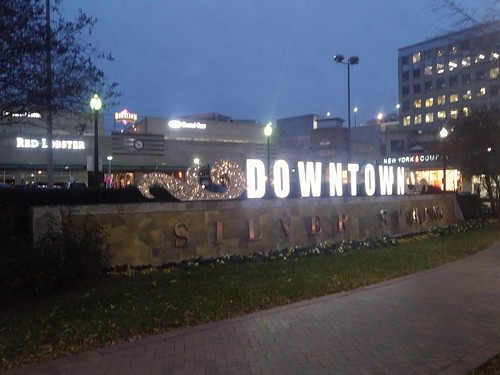
This area is two blocks from the Silver Spring Transit Center and Metrorail Station, and in between the two districts like a fortress is the Discovery Channel headquarters building. But after a merger, the company is leaving the area.

In my series of articles on how to make over Silver Spring as an "innovation district" by leveraging the coming addition of light rail to the area's transit mix, there are many recommendations for how to strengthen the area's placemaking qualities.
-- PL #5: Creating a Silver Spring "Sustainable Mobility District"
-- Part 1: Setting the stage
-- Part 2: Program items 1- 9
-- Part 3: Program items 10-18
-- Part 4: Conclusion
-- Map for the Silver Spring Sustainable Mobility District
-- (Big Hairy) Projects Action Plan(s) as an element of Comprehensive/Master Plans [now I all these "transformational projects action plans"]
-- Creating the Silver Spring/Montgomery County Arena and Recreation Center
One recommendation was the creation of a more focused retail recruitment plan, making the point that the County shouldn't rely completely on the private sector for this kind of work, because there can be a mismatch of priorities.
There needs to be a "second phase" to retail planning there, to keep Silver Spring's retail district successful and relevant in the face of greater competition elsewhere in the county and the metropolitan area.
Given my experiences in Liverpool, Essen, and Hamburg, and the already open-air orientation of the Silver Spring shopping district, albeit it's anchored also by the Ellsworth Place interior focused mall (refashioned from the old Hecht's store, while the old JCPenney's is now the Fillmore Concert Hall), it occurs to me that Silver Spring needs to go "long" and continue to plan for the intensification of the retail offer of the district.
But by further emphasizing, strengthening and extending its outdoor nature.
Retail sector is bifurcated and some companies remain successful. In the face of e-commerce, competition, and financial engineering, the retail industry is going through significant consolidation, with many firms going out of business.
That being said, even though as a sector department stores are having problems too, some department store companies continue to succeed. Even as many stores close, new stores do open here and there, depending on local economic circumstances.
Capturing the Discovery Channel building as a way to extend the retail district and connect it to the Metrorail site. The Discovery Channel is vacating a very large building that is sited between the Metrorail station and the commercial center.
The building is very much interior focused and doesn't contribute positively to activation and the placemaking qualities of the streets surrounding it, although there are some public garden and plaza spaces on the Wayne Avenue side of the site, which can be opened up and better integrated into the streetscape.

The coming redevelopment of that block offers a great opportunity to strengthen and extend the retail district and connect it more directly to the transit station. Transit stations are the hubs of successful retail districts all over the world.
Foulger-Pratt, developer of Downtown Silver Spring along with Peterson Companies, is buying the Discovery Building ("Discovery building gets new buyer," LocalDVM).
Why not redevelop that site to be way more open and connected to the street instead of closed off from it, to connect the Metrorail Station to Downtown Silver Spring, by extending it, by adding a retail to the ground plane of the block bounded by Wayne Avenue, Colesville Road, and Georgia Avenue, which is currently occupied exclusively by the Discovery Channel?
One way to do this is through the addition of a department store, further strengthening Downtown Silver Spring as a regional shopping destination.
It's counter intuitive, given that in general the department store sector is shrinking, but there are still successful firms operating in this market segment.
Options for a department store. I see four possible options. First we must dispose of the unlikely options. Silver Spring isn't upscale enough for Nordstroms, which already has a location at Montgomery Mall. Similarly, Bloomingdales has a store in Chevy Chase, and Lord & Taylor seems committed to their stand-alone location in White Flint, and their Friendship Heights location is too close to justify a close by store in Silver Spring.
Macys has stores at all the major malls and with some exceptions of large legacy stores in big cities like DC, New York, San Francisco, and Chicago, they are a suburban mall oriented company.
Boscov's. The company that comes to mind foremost is Boscov's, based in Reading, Pennsylvania. First, they have three urban stores in their portfolio, which is atypical. Second, they have stores elsewhere in Maryland including as close as Frederick, less than 40 miles from Downtown Silver Spring. The firm is still family owned, and expanding at the rate of about one new store each year.

Boscov's, Binghamton, NY.
I actually reached out to their director of real estate development about this idea. He made the point that Boscov's is merchant driven and community focused, and that if they can make the right community connections to make a store successful, they will consider it.
Yes, their stores are mostly in malls, but urban locations will still be evaluated when conditions are favorable. Store managers have a fair amount of flexibility to develop a program of store-specific promotional activities.
In terms of tax incentives, he said that deals are a transaction between a developer and the company, and the local government isn't involved directly, although they may provide incentives to the developer to facilitate the entry of a department store.
Primark. Is a firm based in Europe. Given that reality, a preponderance of their stores are in urban districts. That's the case in cities like Liverpool, Hamburg, and Essen. They are expanding to the US, albeit they are moving slowly and mostly with stores in malls. Their store in Downtown Boston is in Downtown Crossing, another example of an open air shopping district.

Primark's store in Downtown Boston

Primark store on Gran Via in Madrid
So far, Primark has limited their expansion to the Boston and New York areas, but given the firm's DNA is based on city center locations, it'd be worth approaching them.
Dillards. The firm continues to expand, often by taking over other companies or locations that have been abandoned. Their closest stores are in Richmond. The DC area is demographically attractive.
The firm doesn't seem to have much interest in urban locations, although they did open a store in the mid-2000s in Atlanta's Atlantic Station urban redevelopment. Abutting Midtown, it's the redevelopment of a former steel mill site, and while the building was new construction, it "feels" older.

Belk. Belk used to be family owned but is now owned by private equity interests. They serve the South and are based in North Carolina and serve the South. They do have stores in the outskirts of the Washington region in Fredericksburg and St. Mary's County in Maryland. They have many other stores in Virginia, and they are taking over a Bon-Ton location in a shopping mall Hagerstown, Maryland.
But they seem to have little interest in urban locations, and taking on the DC market might be a stretch.
Recommendations
1. Make as planning priority strengthening and extending the character of the Silver Spring core as an outdoor-focused retail and entertainment district.
2. Approach Foulger-Pratt about bringing retail to the lower floors of the Discovery Channel building.
3. Develop a phase two planning program for strengthening the Silver Spring retail district. A key element is extending the pedestrian-centric path of Ellsworth Avenue currently from Fenton Street to Georgia Avenue from Georgia Avenue to the Metrorail Station.
4. Develop a retail recruitment plan, including the possibility of adding one or more department stores, as part of the redevelopment program for the Discovery site.
5. But regardless, create and implement a broader retail plan for the broader district to seize on other opportunities and to fill evident holes in the current retail mix (more apparel, books, since Borders left, etc.)
6. Approach Boscovs and Primark. Be prepared to offer incentives. Sound out Dillards and Belk.
7. Ideally get both Boscovs and Primark, put one in the Discovery Building, and the other somewhere around Fenton and Ellsworth, east of Fenton, to further extend and strengthen the district (I would do this by intensifying the site shown in the map in dark red, currently the location to Strosniders Hardware, CVS, and Whole Foods).
8. Although make recruiting departments stores a two-phase plan too. Focus on redeveloping the Discovery Channel block to connect the Metrorail station to the Downtown Silver Spring District, making it seamless. Being successful with one department store and enlivening the currently dead space between the Metrorail Station and Ellsworth Avenue, makes it more possible to land a second store, after determining there is enough market demand to support both.
Labels: commercial district revitalization planning, department stores, retail planning, urban design/placemaking
posted by Richard Layman @ 10:57 AM&Permanent Link
Follow this blog
6 comments