Rebuilding Place in the Urban Space

"A community’s physical form, rather than its land uses, is its most intrinsic and enduring characteristic." [Katz, EPA] This blog focuses on place and placemaking and all that makes it work--historic preservation, urban design, transportation, asset-based community development, arts & cultural development, commercial district revitalization, tourism & destination development, and quality of life advocacy--along with doses of civic engagement and good governance watchdogging.

Thursday, January 31, 2008

Speaking of not prototyping nor learning from mistakes

From email:

The Department of Parks and Recreation invites you to the North Michigan Park Community Meeting

Friday, February 11, 2008
6:30pm - 8:30pm
North Michigan Park Community Center
1333 Emerson Street, NE

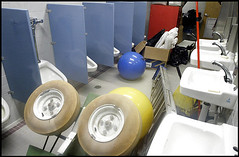
This meeting will discuss the re-design of excessive bathroom space at North Michigan Park Community Center.

For more information, please contact Jackie Stanley, at 202-671-0420.


Image from the Washington Post article from 2006, "DC Recreation Center Rich With Restrooms."

Labels: , ,

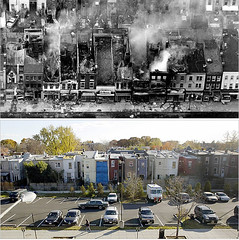
Then and now: south side of the 1200 block of H Street NE, Washington,DC


Then and now
Originally uploaded by digitaleffie

(Flickr construction by Digital Effie. The top photo is by the Associated Press.)
Reprinted because of additional content added due to the linking to the entry by DCist and others. (Thank you.)
------------
Those of you clicking into this entry from other places might want to look at my Flickr collection of additional riot photos. All aren't from DC.

And there is a great book about this time, called Ten Blocks from the White House, which was published by the Washington Post. The book is out of print but available at many branches of the DC Public Library as well as local university libraries and the Kiplinger Library of the Historical Society of Washington.

Also, if you know the Front Page restaurant on Dupont Circle, they have at least one front page from the Evening (Washington) Star posted from something like April 5th, 1968, which features all photos on the cover from rioting on H Street. The Star photographer was probably the original source of the photo that the AP ran, that Effie included in the photo above, which was taken from the recent coverage of H Street in USA Today, "40 years after the riots, King's vision 'unfinished'." (There is also a photo or two in the photo section of the book Dream City, which is a must-read book about how Washington really works.)

Another good recounting is by Sam Smith, and is on the website of his Progressive Review. Check out "Fire; A chapter from 'Multitudes; Memoirs of a Rebel' by Sam Smith" from his website.

Labels: , , ,

Man Jailed For Creating Crosswalk, Vows More


Crosswalk restriped, Spike remains
Flickr photo originally uploaded by ANC 3F-04
(DC crosswalk image from ANC3F04.)

Abe sends us notice of this story from Muncie, Indiana. The television news story includes a video--a story that is pretty good. (Note to DC Television News stations and News Channel 8, you can do stories about local issues too!)

This reminds me of the Road Witch project in the UK...
Road Witch (UK)

as well as the City Repair project in Portland (and a spinoff project in Seattle).

And this report from the UK makes good points about designing streets for people rather than cars, Living Spaces: Cleaner, Safer, Greener

Of course, so did the classic book by Donald Appleyard, Livable Streets.

Not to mention Park(ing) Day--I have two really great ideas for this for this year, based on talking to some vendors at the Mid Atlantic Nursery Trade Show a few weeks ago...

Labels: , , ,

Speaking of paradigm shifting and attracting new audiences to cities


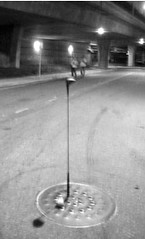
Urban Golf
Originally uploaded by rllayman
Check out Urban Golf. (Image from their website.)

Labels: , ,

I forgot to mention Arlington's core value

That power derives from the citizens. Not that citizens are to be tolerated. It's a citizen-resident-centric government, that leads from both the bottom and the top.

(An article in yesterday's Financial Times discusses "poor people entwinement" stating:

• Poor people entwinement at the leadership level sets the tone for the rest of the organization; and

• ...people are often perceived as commoditized resources (slaves) and at a personal level no more value-adding than, say, an item of stationery.

The article was about information technology, but the point is generalizable.

Labels: , ,

Social Marketing the Arlington (and Tower Hamlets and Baltimore) way

Bike Arlington logo
Okay, the Commuter blog mentioned that I wrote about the Alrington Car Free Diet Expo, and said there might be more to come. That goosed me, because I wouldn't normally be able to get to it for awhile, and I still haven't uploaded any of my own photos. But here goes...

I am not sure that Arlington fully understands exactly why they are doing so great (maybe they do, and I have never met Diana Sun, the Communications Director for the County) but here is my interpretation. Besides starting with important values and vision, and getting all County agencies committed and executing on the same page with the same philosophy, they have figured out a way to lead change by using social marketing and "design" principles. They combine

1. The Design method;
2. Social marketing principles for behavior change -- A focus on transformation -- not merely "change" or "innovation" (not to mention "system maintenance"); and
3. Development and execution of complete and strategic campaigns;
4. Built upon the creation of complete identity systems and brands. (Logos aren't brands. They are part of a branding-identity system.)

DC1974/Inaudible Noise and I have been discussing the Design Method for some time now.

Recently I went through a great book Designing Brand Identity and I came across another, WorldBranding, that I saw at the Rizzoli bookstore--the Library of Congress doesn't even have that book yet. Plus I've picked up some others, including Wayfinding: Designing and Implementing Graphic Navigational Systems. and Festival Graphics.

Walk Arlington logo
The other day he sent me a link to this piece, "How a design thinking approach can help librarians" from the Putting People First blog (which I am going to have to add to my very short list of must read blogs -- Commuterblog, Washcycle, Streetsblog, maybe CEO for Cities, Frozen Tropics). This graphic is from that entry.
libraries
The Design Process.

--------------------
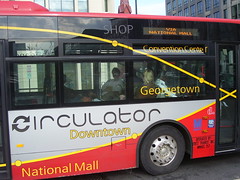
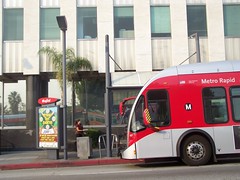
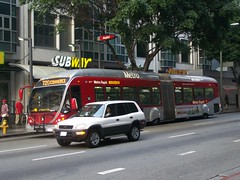
NOTE: VERY IMPORTANT. Note the "Evaluate" and "Refine" stages. Governments rarely prototype. (Not to mention aren't usually great at marketing or graphic design and as importantly, "verve" -- I mean, compare DC's "Metro Extra" bus design to the "Metro Rapid" design in Los Angeles. Or the awful "America's Metro" logo proposed for the "next generation" subway cars. Although the DC Circulator has decent graphics.)

I would probably change this schematic a little, and include prototyping and testing within a combined "Prototype, Test, and Refine" stage.
--------------------
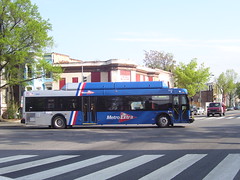
Metro Extra Bus at 9th and Rhode Island Avenue NW

Metro Rapid Bus, Mid Wilshire, Los Angeles

America's Metro

DC Circulator, 9th and H Street NW

Then you add to that social marketing, as pioneered by Porter, Novelli, and others. There are good books on the subject by Fine, one co-authored by Philip Kotler, plus Lauffer's out-of-print Marketing for Not-for-Profit Organizations and Kotler and Andreasen's Marketing for Nonprofit Organizations.

And they encapsulate this into "brands" and campaigns such as "The Commuter Store" "Walk Arlington" "Fit Arlington" "Bike Arlington" and now the "Car Free Diet."

I guess you could argue that social marketing has antecedents in direct marketing, which is testable. A particularly good, but old book on the subject is Maximarketing by Stan Rapp, and I've always liked The Marketing Imagination by Ted Leavitt.

The Commuter Store was started not by Arlington County but by the Ballston Partnerhip (or a precursor), but that set the stage for this deeper emphasis. A problem with the Commuter Store" as strong as a brand as it is, it emphasizes transit as being mostly for commuting, not transit as a way of life, as part of your lifestyle. Nonetheless, the concept is strong and has been adopted in other jurisdictions around the region.
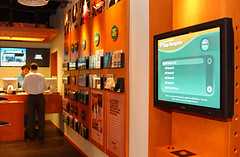
Commuter Store interior
Rosslyn Commuter Store photos from the Commuter Page website.
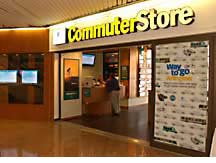
cstore_Rosslyn

I think the brand can be better extended with a good tagline linking other forms of mobility--biking, walking, etc.

Plus, biking and walking need to be given their own dedicated sections within the "stores" to emphasize their importance, as well as the emphasis that Arlington County does give to walking and mobility.

Arlington does something that I always emphasize with nonprofits, that each thing you do needs to accomplish multiple objectives. So Walk Arlington promotes mobility, promotes fitness, and on tours of neighborhoods promotes community building as well as communication about cultural and other resources, not to mention focuses on improving the physical environment (urban design) for walking.

Single-track thinking and doing is unaffordable by any municipality, given ever constrained resources and increasing demands.

Two other places that use the same kinds of organizing principles are:

• Baltimore's Live Baltimore resident attraction program, which is a campaign and focused process that also happens to have a storefront. See "Selling the city: For 10 years, Live Baltimore has been convincing Washington residents and others that city living is charming," from the Baltimore Sun.
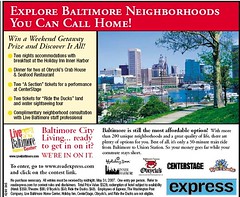
Live Baltimore ad (Express)
• The way that the Tower Hamlets borough of London repositioned their library system into the Idea Store which they describe as:

more than just a library or a place of learning. As well as the traditional library service, Idea Stores offer a wide range of adult education classes, along with career support, training, meeting areas, cafes and arts and leisure pursuits.
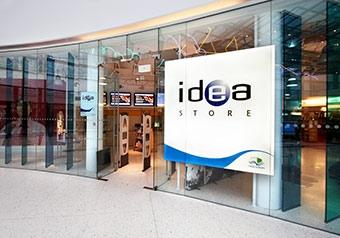
Idea Store Whitechapel

Arlington is more focused directly on behavior change when compared to the Idea Store, but Live Baltimore too is very focused, on attracting residents.

Labels: , , ,

Harvard Business Review/Learning from Mistakes


Harvard Business Review
Originally uploaded by ecentor

In an earlier blog entry on Arlington, rg comments thusly:

Excellent post. In terms of Arlington's mistakes, what I also like about Arlington is that they learn form their mistakes. Yes, Rosslyn sucks, but Arlington did not go and build more Rosslyns. In contrast, it seems like DC repeats many mistakes over and over and never learns. Mind you, my thinking on this is just anecdotal, but it's an interesting contrast.

I have been meaning to mention that the February issue of Harvard Business Review has four excellent articles:

• a case study on a hotel company creating an overarching branding strategy (my sum up, do it when the brand has value, but not when it doesn't, i.e., does "Westfield Shoppingtown" really have any meaning, isn't it just another mall?);

• "The New Leader's Guide to Diagnosing the Business" (I am working on creating similar templates for commercial districts);

• "The Founder's Dilemma" about start up organizations and the dilemma between control and success (running the show or bringing in other people with the necessary skills to grow the organization) -- this is a big issue in nonprofit organizations, and was outlined in the stages of organizational growh and developing organizational subsystems chapters in the class Social Psychology of Organization a long out of print textbook that is supposed to be revised and reprinted; AND

• "The Experience Trap" which states "as projects get more complicated, managers stop learning from their experience. It is important to understand how that happens and how to change it." (Similarly, also see the work by Chris Agyris about organizational change.)
I was really struck by the last article, that people just accept that there are going to be "problems" without really trying to figure out why problems arise, if they are a result of a faulty process or system, not just something that happens. And to change the process.
[This is what gets me in trouble in my work. People aren't comfortable challenging processes. And they think when you challenge processes that you are challenging people.]

I am not technically trained, but the process of six sigma defect reduction seems to be relevant to organizational processes whether or not you are engaged in manufacturing. The work of of Juran and/or Deming is equally applicable.

Labels: ,

Demolition of a house in the Palisades neighborhood

(Photo by Marshall Soltz, of the demolition of the "Jesse Baltimore" House by the DC Department of Parks and Recreation.)

Another example of the failure of the District Government to be "world class" is the demolition of a house next to the entry of a park in the Palisades neighborhood. This house could have been renovated and occupied by a tax paying family. Instead it was demolished... illegally by a District Government agency, an agency that failed to adhere to other laws enforced for other DC Government agencies...

But I digress, MSN has a feature, "Houses on the move: What does it take to relocate a house?," on moving houses rather than demolishing them. Now, I think that the house on Sherrier Place didn't need to move. There wasn't really a need for a more grand entrance into the park, show that it's a neighborhood park by integrating it into the neighborhood, rather than fully setting it apart. But I'd rather have had the house be moved than demolished. And the DPR set up a gamed process that led to the house's demolition, rather than fairly, openly, and transparently considering other options.

According to the MSN feature:

Each house saved diverts 50,000 to 100,000 pounds of debris from landfills.

Not to mention the embodied energy lost.

So the DC Government says it wants to be considered a world leader on environmental issues?

Right here, in one decision, probably 10 to 20 other "pro-environmental" actions were likely obviated, reversed.

Also see "Why build? Move an older house instead" from MSN.
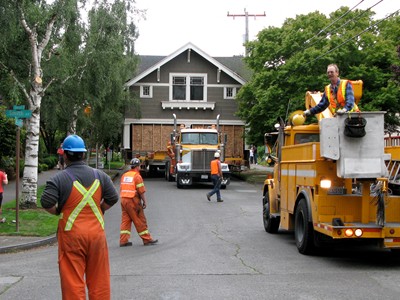
Movers guide a truck and house through a tight passage with overhanging trees in Seattle's Queen Anne neighborhood
Movers guide a truck and house through a tight passage with overhanging trees in Seattle's Queen Anne neighborhood. They had to temporarily move high-voltage, high-tension overhead trolley lines -- at a cost of roughly $30,000 -- to relocate it just 10 blocks from its original site. Photo by Jeff McCord.

Wednesday, January 30, 2008

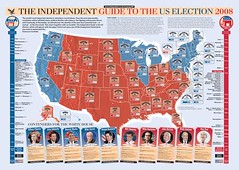
Special section in the Independent (UK)

I doubt it will make it into the edition that makes it to the United States, but the Independent newspaper of the UK announces a special 20 page section on the U.S. presidential election, including a pull out map. It's supposed to run Thursday and Friday.

Federal-level urban policies, including support for building out transit systems, even education (i.e., the No Child Left Behind Act) really matter. The fact that the U.S. is spending billions of dollars on a war for oil in the mideast certainly would justify an increase in the federal excise tax for gasoline, but the current administration doesn't support it. The cost of the war and the cost of automobility is what is driving the dollar to new lows.

Even tourism is an issue. The administration doesn't do a whole lot of support for tourism promotion, despite the best practice efforts of other countries, and the fact that international tourists spend more money...

So the presidential election does matter to cities, very much so. One source for information on this is the City Mayors website and their page on the 2008 presidential election campaign.

Labels: , ,

Tuesday, January 29, 2008

Quote of the day

(I spent much of today in Arlington at the launch of their Car Free Diet program, and then stopping at various points between Rosslyn and Brookland taking photos or talking to people such as at Rosslyn Renaissance/Rosslyn BID. Because I am going to a farmers conference tomorrow--in relation to foodways and farmers markets and recruiting farmers--in Pennsylvania, I am not likely to blog for a couple days. I have a lot to blog about in terms of my experiences in Arlington, but I don't know when I'll get around to having that much time to write...)

"Unless you tackle the whole of the problem, rather than part of the problem, ultimately you're not going to get anywhere."
-- Ewan Hunter, Hunter Foundation (he is not related to the namesake of the organization) from the Chronicle of Philanthropy, 1/10/2008

This quote is relevant to Arlington. I mentioned before Charles Landry's point that world class cities don't just take from the world, they give back too. I mentioned Paris' Velib bikesharing program as an example of this. Paris wasn't the first city to do bike sharing, but the scale of their launch and the publicity it garnered has accelerated take up of the idea in many other places in the world. That's an example of giving back as part of being world class, what maybe could be called "generativity" based on Erikson's Life Cycle Theory.

In the DC region, Arlington might be the only true world class municipal jurisdiction. They don't just beat on their chest and say they're great, like DC does. They have vision, they have values, they execute programs in high quality best practice fashion (more about that later) in concert with their values and they get results.

Now, DC actually has more walkers, bicyclists, and transit users than does Arlington. I'm not saying that Arlington just gets better press. DC has a better urban design that is more conducive to mode shift. My joke though is just think if DC marketed mode shift and incorporated transportation demand management into planning, how much better we could do.

Arlington isn't perfect. Super-sized buildings along Wilson Blvd. and in Rosslyn make the quality of the pedestrian experience somewhat hit or miss. Urban design on the first and second floors still needs some work.

But the way Arlington executes programs for transit, walking, biking, fitness, and the environment are best in class. They are comprehensive, deep, and outcomes-oriented, and capable of being evaluated.

The thing today featured talks by the Arlington County Board Chair, Walter Tejada, as well as County Councilmember Jay Fisette, and the County Manager, Ron Carlee, stopped by for awhile too (he didn't speak). Maybe it just rang true to me because I don't hear these particular elected officials speak that often (I have heard CM Fisette before, we shared a dais at a presentation once), but I was impressed with the content--I repeat--the content. Too often we don't have elected officials in the city with that level not just of knowledge, but concern from the heart, and values, not just political calculations. (And speaking of great Arlington County elected officials, I didn't even see Chris Zimmerman, who is probably the best elected official in the region when it comes to transportation and mobility issues.)

Labels: , , , , ,

Monday, January 28, 2008

Man braves cars, bureaucrats to bike on tollways

is an article in the Austin American-Statesman.
statesman.com.jpg
Larry Kolvoord/Austin American-Statesman. Texas 45 North's shoulders are wide, clean and smooth - ideal for Chuck Thomas, whose commute takes him about an hour.

This puts HOT and HOV lanes in a new perspective.

Labels: , ,

People's transportation plan: Virginia edition


bus stop
Originally uploaded by landslide virgo
The transit wish list blog entry I wrote a few weeks ago needs to be updated, but you could argue it is the basis for a "People's Transportation Plan" for DC.

See "A 2008 Transit/Transportation Planning Wish List for DC," and "Michael's Proposed Brown Line."

I asked Beyond DC to comment on the Fairfax County Transportation Plan which I haven't read, in the context of the Arlington County Transportation Plan which I have read (although not the final iteration) and it is great.

He wrote this as a comment to another blog entry, but it deserves wider attention:

No, the Ffx transportation plan isn’t very good. They’ve got a few visionary ideas in there, including light rail on Rt 28 and extension of the Columbia Pike streetcar up Rt 7 into Tysons, but for the most part it’s suburban business as usual road widenings, interchanges and new “parkways”.

If I were the god of Northern Virginia transportation, I’d:

- Build the Silver line through Tysons, with four stations as planned but in a subway rather than el. I’d end the Silver line at a park and ride station immediately west of Tysons, probably near Wolf Trap.

- Install express BRT between Leesburg and an end point somewhere in DC (Farragut Square? Foggy Bottom? Metro Center?). BRT to include a new, dedicated bus-only lane on I-66, with in-line stops at Rosslyn, one of the Falls Church Metros, somewhere at Tysons Corner, Fairfax County Parkway, Dulles Airport, somewhere in Ashburn, and Leesburg beltway, with an on-street terminal in downtown Leesburg.

- Expand the freight rail infrastructure near Alexandria to permit more VRE trains; extend VRE service to Richmond and Charlottesville.

- Construct the following streetcar/LRTs:

*Old Town – Tysons Corner via Rt 7;
*Old Town – Beltway via Little River Tnpk;
*DC – Downtown Falls Church via Rt 29;
*DC – Seven Corners via Wilson Blvd;
*Pentagon – Skyline City via Columbia Pk;
*Pengaon – Lorton via Rt 1;
*Glebe Rd crosstown route in Arlington;
*Tysons – Fair Oaks Mall via Chain Bridge Road to Nutley Street to Rt 50, with spur to George Mason Univ via downtown Fairfax;
*Purple Line extension from Bethesda to Tysons Corner;

-The following FREE bus shuttles:

*Tysons Corner loop;
*Nearest streetcar stop to Mount Vernon historic site;
*Fairfax Cnty Pkwy BRT stop to Reston Town Center;
*Fairfax Cnty Pkwy BRT stop to downtown Herndon;

Now Gleb wrote this comment, and it should be read more widely also:

Metrorail needs coverage improvements to encourage/ allow more people to live without a car. A Metro line to Dulles doesn't accomplish that.

An electrified commuter line with stops in just one or two spots in NoVa, then Union Station, makes much more sense. It could become a base for increased commuter rail service to the northwestern part of NoVa. Metrorail should be improved as an urban form of transit, which would include Tysons, but which would tie it to the city in an improved network, not just to the airport.

Overarching transit planning is necessary for the Washington region

I mean infrastructure-extending planning. The problem with Metropolitan Planning Organizations (required by Federal law) and I would extend that to the local version, the Metropolitan Washington Council of Governments, is that they don't really challenge the prevailing paradigms very much.

MWCOG, just like the WMATA board, is subservient to the jurisdictions that are members. Instead, we need to transcend that very constricted and bounded way of thinking. And we aren't.

Contrast this article in the Post, "Contradictions Surface in Dulles Rail Talks: Kaine Says Federal Slam Is a U-Turn; FTA Says FTA Says Va. Knew of Its Concerns," to this article from the Dallas Morning News, "Rising costs put DART in tough spot with loyal suburbs" and this one, "DART board to hear revised expansion plans today." While they haven't done everything right in Dallas either, there is a recognition that the system is being planned and constructed by the transit authority, and overseen by the Board.

In our region, in 2003, region-wide transportation planning was scuttled on the part of WMATA due to budget problems, and the responsibility was devolved to the local jurisdictions, which for the most part (Arlington is an exception) focus very narrowly on their own concerns, without looking at extending the power of the whole system.

The Dulle rail proposal is a perfect example of an overly narrowly construed project. It could have been used to bring back the separated blue line proposal, add an additional tunnel crossing over the Potomac, and set the stage for adding stations in DC, ,providing more service, and adding redundancy and capacity to the core of the system, which is increasingly "congested.'
Proposed changes for the WMATA system, 2001 (separated blue line)
Separated blue line proposal. Washington Post graphic.

But that wasn't done. The entire process has been managed by the State of Virginia and focused on Virginia, and boxed out WMATA for the most part.

Had the system been conceptualized along the lines outlined above it would have cost more sure, but it would have served far more people, and been able to justify the amount of federal funding requested. Although it's true that as Gerald Connolly said in "Dulles Rail proponents fending off blame " from the Examiner:

Connolly rejected Byrne’s assessment as “utter nonsense,” arguing the Bush administration’s Department of Transportation is ideologically opposed to large-scale rail investments. “There is no way to get a passing grade here because the whole system is skewed toward an F no matter what we do,” he said. “This was a ‘no’ in search of a rationale.”

But that's aggravating too. Congressmen Davis and Wolf could have stepped up and forced a change in how the FTA grades projects. Instead, they sat on their hands, and told the transit planners to cost contain the project.

About 3 years ago, I wrote a blog entry about network "theory" and transit, "The Vitality of the Transit City is Dependent on Transit Expansion--Applying Metcalfe's Law," it's just as relevant today.

But why didn't the Transportation Board of MWCOG and the WMATA Board step in and demand better planning and the creation of a better project to begin with? As the Examiner says in this editorial, "Metro outruns its supply lines":

One of the main reasons the Federal Transit Administration wisely considers the Dulles Rail project a bad risk for federal funding is the shaky financial condition of the Metropolitan Washington Area Transit Authority, including $7 billion in unfunded maintenance needs that threaten the safety of Metro’s current passengers. Before any money is spent on expansion, Metro must fix the existing Metro system. Metro’s situation has deteriorated so dramatically over the last year that it has significantly added to the already substantial technical, financial and institutional risks that the FTA was required to weigh while evaluating the Dulles Rail project, FTA Administrator James Simpson told The Examiner.

Labels: , , , , , , ,

Sunday, January 27, 2008

Sometimes working with independent businesspeople is almost impossible

A case study example is the announced dissolution of the popular and seemingly successful Karibu Books, a small regional and recently growing chain of African-American/people of color-oriented bookstores. According to newspaper reports, disagreements between the two partners, not to mention the divorce of one of the partners, and the loss therefore of their chief bookbuyer, couldn't be resolved. Rather than trying to sell the chain, they are closing. It seems ridiculous to me, but many independent business proprietors are independent for a reason, so that people can't tell them what to do.
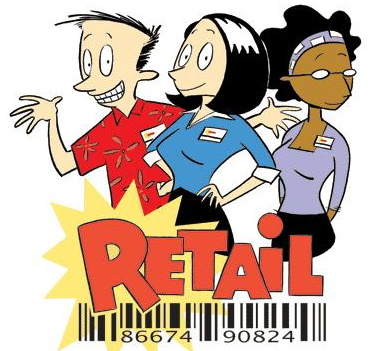
Retail by Norm Feuti
The Retail comic strip by Norm Feuti is particularly excellent on these kinds of issues. It's available on the Seattle Post-Intelligencer website. He's also written a book that is pretty funny: PRETENDING YOU CARE: THE RETAIL EMPLOYEE HANDBOOK.

Labels: ,

New proof that green building verges on being total bull****

A GreenMcMansion
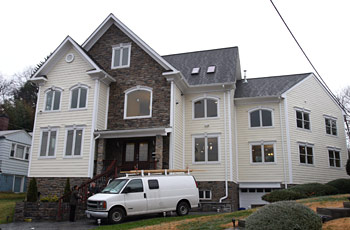
The 6,500-square-foot house that Jerry Zayets has constructed in the District uses energy-efficient products. (By Susan Biddle -- The Washington Post). Question: but how many people live there? And could you accommodate more houses on the same amount of land, especially if they are attached rowhouses, thereby accommodating more people, and being able to include affordable housing?

The U.S. consumes a disproportionate amount of the world's resources, in terms of per capita use. Now I don't know how much our country uses of all the world's resources, and historically the country has possessed a goodly amount of the natural resources we used. But I do know that the U.S. has about 6% of the world's population, and uses about 25% of the world's oil supply.

I am not a moral philosopher (Rawls, etc.) or too conversant with the literature but it's likely that a sustainable land use and resource planning paradigm would mean that the U.S. would, overall, consume a total amount of resources that is more in balance with the world's population. (Of course, another way to calculate the "acceptable" proportion of resource use would be to measure it according to national economic output, but there is no question that this would "privilege" the U.S.)

So we likely have to start consuming fewer resources. Therefore, the article in the Post real estate section about building GreenMcMansions, "Can Big Be Green?," is pretty funny.

Clearly the people at the Natural Resources Defense Council need some deeper learning in the subject, and I am unlikely to ever join, given their lack of deep thinking on the subject. From the article:

The two concepts of "green" and "big" hardly seem compatible. After all, green is synonymous with conservation. Big is closely linked with waste. Yet some eco-friendly homes these days are not just big, they're huge, and the relationship between size and greenness is not as clear-cut as one might think.

All else being equal, a small home is more eco-friendly than a big one. It eats up less in raw materials, emits less greenhouse gas and is more energy-efficient simply because it's smaller.

But who is to judge how much space a person needs, asked David B. Goldstein, energy program director at the Natural Resources Defense Council, an environmental group. If one 10,000-square-foot house owned by a family of four is "a bad thing," what about two 5,000-square-foot houses owned by the same family?


It's not a matter of value-neutral or relativistic thinking. I would refer people to Kohlberg and the highest moral reasoning stage of "Universal-Ethical-Humanism" or William Perry's cognitive and affective development theory and the stage of "commitment in relativism."

Now these are world figures, but they make judging easier than Mr. Goldstein seems to believe:

… Inequalities in consumption are stark. Globally, the 20% of the world’s people in the highest-income countries account for 86% of total private consumption expenditures — the poorest 20% a minuscule 1.3%. More specifically, the richest fifth:

- Consume 45% of all meat and fish, the poorest fifth 5%
- Consume 58% of total energy, the poorest fifth less than 4%
- Have 74% of all telephone lines, the poorest fifth 1.5%
- Consume 84% of all paper, the poorest fifth 1.1%
- Own 87% of the world’s vehicle fleet, the poorest fifth less than 1%


From Behind Consumption and Consumerism - Global Issues. Also see the AAAS Atlas of Population and Environment. And "Is Ethanol for Everybody?" from the New York Times. From the article:

Danuza, round-faced and soft-eyed, makes between $8 and $13 a day depending on her productivity. At 35, she has four young children. Only 20 percent of the 7.5 million acres planted with sugar cane in Brazil is mechanized. The rest depends on manual labor like hers....

If the vast potential of sugar cane ethanol is to be realized, in Brazil as in poor African countries, its development must come in ordered ways that allow the likes of Danuza and her children to benefit. A new fuel should not carry oil’s frequent curse: the enrichment of a narrow elite.

This will depend on several things: the labor standards adopted by the growing hordes of international investors drawn to ethanol; the opening up of the global trading system to this biofuel that many poor tropical countries will be able to produce; and the development of a global traded commodity market in ethanol with established norms.

Labels: , ,

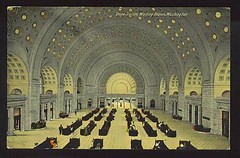
Union Station waiting room, Washington, DC (postcard)

One problem when somewhat disconnected organizations manage key cultural assets is that they don't pay much attention to culture. Last year was the 100th anniversary of the opening of the station. No notice was taken of this whatsoever. There isn't much in the way of interpretive signage in the station, and frankly, there needs to be a true visitor information center based there.

Preservation planning and the Armed Forces Retirement Home

From Reyn Anderson of the Washington Central Parks initiative:

The Historic Preservation Review Board (HPRB) has extended its hearing time on the AFRH’s development plan in order to ensure that all community members interested in testifying are given an opportunity to do so. PLEASE COME THIS THURSDAY, JANUARY 31st at 1:50 pm to 441 4th Street, NW (#1 Judiciary Square) in Room 220 South to voice your concerns about the adverse impact this plan will have on this historic site and the surrounding neighborhoods. If you cannot attend the January 31st hearing, but wish to submit comments on the AFRH development plans, you can e-mail them to timothy.dennee@dc.gov or david.maloney@dc.gov. The HPRB members will take a site visit to the AFRH this week, prior to the January 31st hearing.

Brief overview of the January 24th hearing:

- The Board voted unanimously to designate the AFRH as a District of Columbia Historic District.

- The State Historic Preservation Officer presented his report and, among other things, suggested that the HPRB should accept a continuing responsibility to review any proposed private development on the AFRH property

- The National Trust for Historic Preservation expressed concerns about a proposed building to be constructed near the National Monument/Lincoln Cottage and stated that they would prefer to see no development on Zone C, as this would adversely impact the Lincoln Cottage’s setting and interpretation.

- The National Park Service stated that it would like to see the AFRH put Zone C out for tender or lease to the NPS or the city of the District of Columbia to be used as a publicly-accessible park space, especially as this part of the city is sorely underserved by parks

- The Commission on Fine Arts reported that at their January 17th hearing on the AFRH’s development plan, they had decided to take no action as they thought that the proposed development on Zone A was not in line with the principles of the McMillan Plan and they wished to see other design alternatives. The CFA representative requested that the HPRB also delay its vote on the AFRH plan.

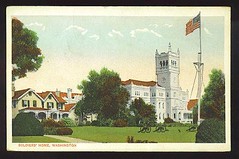
Soldiers Retirement Home, DC (postcard)

Labels: , , ,

La ciudad es para nosotros

Unfortunately, I haven't taken up the study of Spanish lately, as my life is more focused on English speaking matters. But I was looking at some Spanish language music videos by one of my favorites, Julieta Venegas, and the video "Eres para mi" is set on the streets of a city (more likely a production set). I liked the fact that the video is set in a public place, with people, when compared to the typically very much self-involved music video.


This also brings up the great song, and video, "En la ciudad de la furia" para Soda Estereo.

Labels:

Dumb stuff about the legislative process and retail and commercial district revitalization: Alcohol

1. That for the most part, it isn't legal for art galleries to serve wine and beer during openings. See for example, "Art galleries move closer to approval for serving alcohol," from the Denver Business Journal.

2. That it is illegal in Virginia to mix wine or beer with liquor (spirits). See for example "Virginia's Sangria Ban At Issue in 2 Hearings," fom the Washington Post. What this means is that it is illegal for Spanish-oriented restaurants to serve authentic sangria

3. And I know that Montgomery County, Maryland's liquor sales system (the county sells it, the only jurisdiction in the country to do so), means that innovative discount sales operations of an independent nature are restricted from creation. Plus, the limit of two liquor licenses for the same owner in terms of restaurant sales means that the ability to have multiple "stores" in places throughout the county means that most investment occurs along Rockville Pike and western Mongtomery County (Bethesda, Rockville Pike) rather than in a more balanced fashion to include Silver Spring and up Colesville Road.

4. In DC, neighborhood residents tend to have a hard time distinguishing between restaurants and liquor stores, and between restaurants and nightclubs, in terms of licensing and measuring the impact on a neighborhood.

Also see these past blog entries:

-- An interesting look back in time (8/2006)
-- Restaurants and liquor licenses--How much is too much on H Street? (4/2005)
-- Local involvement is so much fun (from 4/2005, also including testimony before City Council that I gave in 2002)

Labels: , , ,

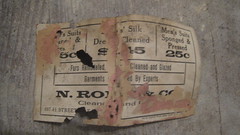
Promotion card from an old H Street Dry Cleaner


IMG_0892
Originally uploaded by digitaleffie
(Found by friends doing renovation work in their newly acquired rowhouse.)

Saturday, January 26, 2008

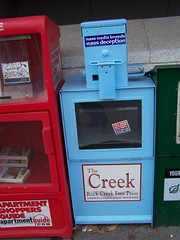
Rock Creek Free Press Newspaper box, at Tenleytown Metro station

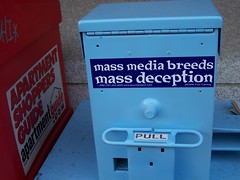
Mass media breeds mass deception

Bus map on a NYC transit bus


Bus map on a NYC transit bus
Originally uploaded by rllayman
Cableflame believes, rightly, that bus transit maps need to be displayed on Metrobuses. That's something I'll add to the rewrite-expansion of the Transit wish list entry I wrote a couple weeks ago.

Bicycling is but one segment of mobility and mobility is more than making the car supreme

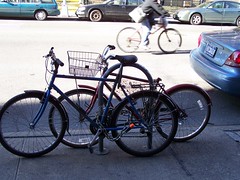
Bicycles, Avenue A, Lower East Side, Manhattan
Bicycles, Avenue A, Lower East Side, Manhattan.

Streets are for mobility, not just for cars.

1. There is a new yahoogroup on bicycling, worldcitybike@yahoogroups.com, sponsored by the Paris-based New Mobility project.

2. The Boston Globe had an article, "Pedaling through winter on a bicycle built for one," and a letter in response, "Footloose and fancy freeze," on biking in the winter. I ride during the winter, except when it is very wet, like Thursday January 17th, or icy.

3. There has been an exchange of letters to the editor in the Washington Post about bicycling. The first letter, "Don't Honk If You Hate Bicyclists," makes the logical point that if you startle bicyclists by honking and screaming at them that accidents can happen. The second, "The Point of Bike Paths ," argued that roads are for cars and bike paths are for bikes. David Cranor, the blogmaster of the region's superb Washcycle bicycling blog, responded, in "Why We Ride in the Road." Today has another response, "Why Can't We All Just Share the Road?."

Again, roads were created long before cars. And mobility is more than just about cars, or even about transit. (See my previous writings on the mobilityshed.)

4. In an unexpected development, I might help implement a free bicycle sharing system in a smaller town. One of the the things that I think we need to address is helmets and locks. I was thinking of a returnable vending system, or something like lockers. Although that would mean that the lock and helmet would have to be returned to the original renting station.

On the other hand, there is opposition to helmets out there, such as on the website, Cycle Helmets.

Labels: ,

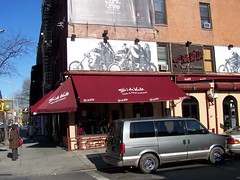
Sidewalk Bar & Restaurant, Avenue A, Manhattan

Ironically, the images above the awning of the "Sidewalk" Cafe promote motorcycling.

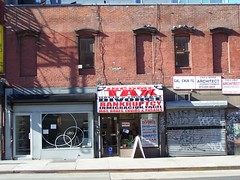
Essex Street Storefronts including an architect, chic salon, bricked up windows, graffiti, and a bankruptcy lawyer


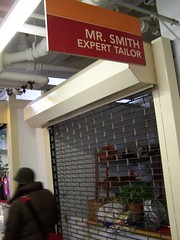
Tailor booth, Essex Street Market

Maybe one way to help a public market stay neighborhood-focused rather than get touristified is to allow other neighborhood services like tailors and shoe repair etc. to locate there, presumably at lower than outside-of-the-market-based rents.

The big problem with Eastern Market is that the space is limited. It can't add new vendors, new ways of reaching new market segments, because the space is fixed, and because the "North Hall" is a gallery-theater.

I have been a strong supporter of Market 5 Gallery, because I think it is the primary reason that Eastern Market is a diverse place, one of the only places in the City of Washington where people of all races and income levels mix.

But the food part of the Market needs to grow, or it's going to continue to get its clock cleaned market-wise, especially as Harris-Teeter opens supermarkets east and west of Eastern Market.

And there is a great auditorium at Hine Junior High School that is barely ever used, and almost never used at night.

Granted that Hine is going away somehow.

But if there were a "master plan" for the Eastern Market District, then this could be figured out so that the whole is greater than the current sum of the parts now.

Mirrors at Essex Street Market


Mirrors at Essex Street Market
Originally uploaded by rllayman

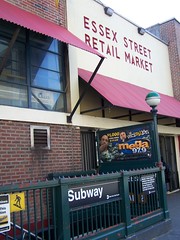
Subway entrance at the Essex Street Retail market

When the APA conference was in DC in 2004, I went to a session on Cerda and Barcelona (figuring that was a topic I really didn't know anything about). One of the comments by the presenter was how "surgical" the approach is in Barcelona in terms of incorporating uses within the public space. The example he showed was the entrance to an underground parking garage located below a public square.

Manhattan in NYC has the same approach, because the value of land is so high. Subway entrances were 'surgically' inserted into the street and sidewalk scape in a manner that maximizes the use of space, and minimizes the intrusion.
Compare this subway entrance to a DC subway entrance.

Now, I realize that DC's subways are much deeper below the surface. My understanding this is because the red line had to go below Rock Creek. And, we have, justifiably, requirements for elevators for the disabled, although that doesn't really have to impact the main entryways...

The overuse of land for subway entrances in DC gives a much different feel. I guess the entrances that come closest to a "New York" state of mind are the ones for Gallery Place at 7th and H Streets, 9th and G Streets, and at the Verizon Center, the south entrance for Dupont Circle, and the McPherson Square, Farragut West, and Farragut North stations. Maybe Ballston, Clarendon, Courthouse, and Rosslyn stations as well.

Friday, January 25, 2008

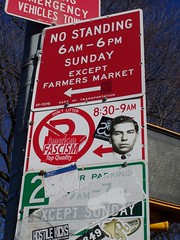
Stickered street sign, Essex Street, NYC

I have to admit I like the middle sign.

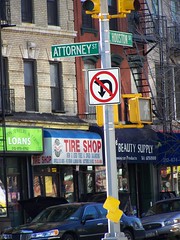
Attorney Street, Manhattan, NYC


Attorney Street, Manhattan, NYC
Originally uploaded by rllayman

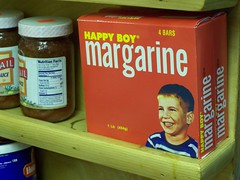
Happy Boy Margarine (Essex Street Market)


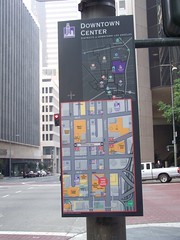
Directional sign, Downtown Los Angeles

The bus rapid transit blog entry is making me go back to my October photos, and upload them. (I have thousands of photos to upload to Flickr...) Yesterday, while traveling and looking at maps at a particularly well appointed truck stop in North Carolina, and thinking about the midtown Manhattan map we bought last weekend, that there is a difference in orientation between creating maps for drivers and creating maps for pedestrians. Of course, this wayfinding map sign makes the distinction pretty clear as well.

Dulles Transit: Plan B

Photo: Metro Rapid bus, Wilshire Blvd., Los Angeles.

Design a Bus Rapid Transit system for the corridor. Proof of concept. Then convert. But figure out how to do it really really cheaply.
Metro Rapid bus on Wilshire Blvd. (Mid-Wilshire), Los Angeles

Metro Rapid bus, Wilshire Blvd., Los Angeles

Labels: ,

Ad for Henson Ridge in the Express

I find the images in this ad interesting, considering the demographics of the neighborhood, which are higher than 80% African-American in the various Census tracts.

Asking the wrong question #2

Transit. WMATA no longers does regional transit planning. Individual jurisdictions pursue their own projects, independent of setting regional priorities. And independent of setting regional priorities focused on generating the most riders. The Dulles subway proposal is very expensive. That's okay, but it doesn't generate great ridership either. Anyway to build it, Virginia should create its own urban renewal district, put out the bonds, and pay for it without federal funding. And in the interim, we need to change transit planning responsibilities within the region.

See "Dulles Rail Project All but Dead: With Federal Funding at Risk, Some in Va. Say Demands for Major Revisions Can't Be Met," "Dulles Derailed: The feds have a lot of explaining to do," and "Raw Fisher: Metro to Dulles: What Next?," "'Does Not Appear to Be a Prudent Investment' " and "Dulles Rail Project Verging on Collapse: Federal Officials Won't Fund Plan Without Major Changes," all from the Post.

Anyway, the yellow line in Portland was built after three defeats of bonding proposals. It was kind of complicated. Statewide votes were required because original proposals had the line running from Vancouver, Washington to Portland, and then further west into the suburbs. So they slimmed down the route to serve just the City of Portland, and they created an urban renewal district, with bonds against anticipated increases from property tax revenue to pay for it.

But that's Virginia's problem.

We still need to deal with the overarching problem of coming up with a better way to plan and execute transit infrastructure expansion in the DC region.

Labels: ,

Asking the wrong question #1

Too often government programs and actions are (rash) responses to actions or proposals rather than a proactive decision made in terms of overarching priorities and commitments.

The McFarlane Group is so great at playing off the various jurisdictions with regard to a stadium. See "Pro soccer stadium may come to county" and "State, municipal leaders cool to Prince George’s soccer plan: Potential sites for the new stadium include Greenbelt, College Park, New Carrollton," from the Gazette and "Md. Weighs Stadium for D.C. United: Study Will Gauge Pr. George's Benefits," from the Post.

It's but another classic example of the Growth Machine at work. As I say time and time again, if you haven't read that classic article by Harvey Molotch, or the book, Urban Fortunes, that was published later, you're going to get your clock cleaned time and time again, if you are a community-oriented representative dealing with developers.

According to the Post, Vincent Gray, Chair of the DC City Council, is looking at how to keep DC United in DC. From the article:

The step concerned Vincent C. Gray, chairman of the D.C. Council, who noted the team's success and potential for financial growth. "I continue to believe that we should work with D.C. United to construct the stadium in Poplar Point," Gray (D) said.

The real question is what is the best way to build a local economy in DC proper. It is not "how do we keep DC United in DC?"

First, you determine what is the best way to revitalize Anacostia and what to do at Poplar Point.

Second, you determine how much you are willing to spend to do this and why.

The earlier DC United proposal called for about $300 million in infrastructure improvements. That's a lot of money. What's most important is figuring out the best return on investment on $300 million in public investment in incentives and infrastructure.

If a soccer-based development is the way to do that (which I seriously doubt), then go ahead.

If not, make the hard choice, be a leader, and tell them to go to PG County.

Note that the impact of the Redskins in PG County would be minimal if there weren't a local tax on concessions and ticket sales. According to the Post article, PG County nets $10 million in Redskins-related economic benefit, but 80% comes from the additional tax on concessions and tickets. Even $10 million annually might not be an adequate return on investment in terms of what was expended by the State of Maryland and the County to land this facility.

Soccer has fewer patrons and the tickets cost much less compared to football. Likely the average additional spending/patron is much less too. Soccer teams do play more games than professional football teams. But just doing a back of the envelope calculation, it's likely that the economic impact of soccer in DC is less than $5 million/annually.

If you are looking for a 10% return on your money, that means it isn't worth much more than $50 million in public incentives to spend on keeping DC United in DC. And that is dependent on assessing taxes on tickets and concessions. Likely most of the players and team officials don't live in DC, meaning that the city won't collect additional income and property tax revenues from the employees. I don't know how much the team pays in business taxes but it isn't likely to be much.
I will say that Jack Johnson, County Executive of Prince George's County, understands one key thing, that if they are to place a soccer stadium in the County, that it should be adjacent to transit. Furthermore, it could help push the Purple Line forward. From the second Gazette article:

Prince George’s officials said they would like to see a stadium built at either the Greenbelt or New Carrollton Metrorail stations to serve as a centerpiece for development. ‘‘We are the last county in the region to really develop around our Metro stations,” said David Byrd, the county’s deputy chief administrative officer. ‘‘[A stadium] can be a great anchor for mixed-use development at Metro stations. ... When the game is over, there will be lots of things for people to do when they leave the stadium.”

Labels: , , ,

That language law...

I have been away a bunch so I am behind in reading newspapers. (I will read them all, but out of order, and over a few weeks...) A letter to the editor in the Post commented on a proposal for an anti-immigrant law in Virginia allowing firings for cause without penalty because of poor English language skills. The writer made excellent points about how such a law would likely be misused by employers as an excuse to fire people.

Now, the law is oriented to non-English speakers, but I figure that so many people who are "native" speakers butcher the language, don't know what words mean, etc., so why should such a law merely target immigrants.... not to mention the fact that less than 100 years ago many of our forebearers were in the same "boat", reading and speaking German, Norwegian, Swedish, Yiddish, Russian, etc. -- newspapers in those languages had tremendous circulation numbers for decades in the early 20th Century.

(Anti-immigrant legislation and the current hype about it is about a dislocation in time, about people focusing on the moment and not the continuum, the process of assimilation.)

But really brought it home is today's Express newspaper and the cover of the "Style" sub section with the cover art and the headline "Put a Fork In It". In Spanish, combined, the first two English language words in this sentence spell "a bad word." Maybe I just have a nasty mind, but...
Put a Fork in It

Labels: , ,

Thursday, January 24, 2008

Tax cuts and stimulus, arguments miss the point

Why bother reducing the corporate tax rate. According to this piece, "New Data Show U.S. Has Fourth Highest Corporate Tax Rate," the U.S. has the fourth highest tax rate of industrialized countries, especially when state tax rates are included.

However, most companies, at least the large corporations that generate lots of revenue, pay little taxes. E.g., "Most US firms paid no income taxes in '90s," from the Boston Globe. From the article (2004):

More than half of US corporations paid no federal income taxes during the boom years of the late 1990s, and those that did were able to shelter much of their income, according to congressional accountants.

The report by the General Accounting Office raises questions about whether the corporate income tax burden is too light and distributed unequally. It could undermine arguments that US companies are overtaxed and provide ammunition to politicians and activists who claim companies are using loopholes to avoid paying their fair share.

"This describes a problem in the corporate tax system in which a good many of these companies are avoiding any tax obligation at all," said Senator Byron L. Dorgan, a North Dakota Democrat and former state tax commissioner who requested the GAO study. "We've got a bad tax law that tells ordinary folks, `You pay up,' and allows some of the largest enterprises to avoid paying."

The share of tax receipts paid by corporations has been declining for decades, US government figures show. But it has been falling at an even faster rate in many other countries, said Gary Hufbauer, senior fellow at the Institute for International Economics, and any attempt to raise corporate taxes or close loopholes in this country runs the risk of making US companies less competitive in world markets.

Labels:

Speaking of the law

I had a long drive back from Georgia and so much of the time gets spent in discussion/argument. We were talking about mayors/Governors and who might be remembered-recognized in 20 years for having substantive impact, changing their communities for the better. E.g., Mayor O'Malley (now Gov.) was a "rock star" but he's no Richard Daley. Let's see what happens as Governor. Similarly, if it weren't for Bill Bratton, what accomplishments would Rudolph Giuliani really have? If Michael Bloomberg didn't succeed Guiliani, it's likely that the changes that Giuliani instituted (Giuliani was personality rather than systems and robust-processes-based) wouldn't have had longevity. Ed Rendell, Mayor of Philadelphia/Gov. of Pennsylvania...

Gov. Glendening was key in bringing about a realization of the importance of "smart growth" principles although too many politicos from the other side see "smart growth" as a Democratic party thing in Maryland, which was one of the reasons that Gov. Ehrlich dumped it. Similarly, Republican Gov. Romney in Massachusetts created the Office of Commonwealth Development to coordinate growth planning amongst state agencies and to incentivize smart growth planning at the local level. His successor, Democrat Deval Patrick, dumped the OCD, just like Gov. Ehrlich dumped Smart Growth...

Not good.

Anyway, I am coming to believe that the most important political figure for urban revitalization in the last 15 years has been William Bratton, police chief in Boston, NYC, and now Los Angeles. In each city there has been fundamental improvements. 30 years ago, people felt that NYC was going to the abyss, people didn't ride the subway, etc. It's not like that now. Guiliani gets the credit, but safety is the foundational principle of urban revitalization as it is a necessity in order to attract residents (and workers) who have choices and money to spend and invest.

The solution to disinvestment is investment. It's all about the green.

Labels: , , , , ,

What about quality of life infraction courts at the neighborhood(s)-district level

Maybe a couple per ward? See "It’s Not Like Solomon, but It’s Village Justice," from the New York Times for something semi- but not really related. Also see Teen Courts: A Focus on Research from the US Dept. of Justice.

Labels: ,

North Carolina Train service sign on I-95


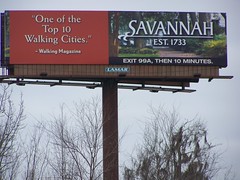
Savannah: One of the Top 10 Walking Cities billboard


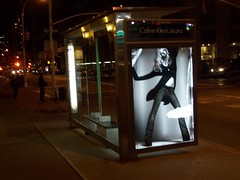
Cemusa bus shelter at Night, NYC

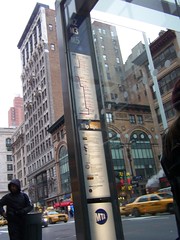
I don't understand why DC's bus shelters don't, as a matter of course, include information on bus schedules. The bus shelters in NYC do. Each bus stop, whether or not there is a shelter, also has stop specific information about the bus schedule. (DC's schedules list the times at major embarkation points along the route. This is useful too, because you know when you are supposed to reach a certain point.)
Cemusa bus shelter