Rebuilding Place in the Urban Space

"A community’s physical form, rather than its land uses, is its most intrinsic and enduring characteristic." [Katz, EPA] This blog focuses on place and placemaking and all that makes it work--historic preservation, urban design, transportation, asset-based community development, arts & cultural development, commercial district revitalization, tourism & destination development, and quality of life advocacy--along with doses of civic engagement and good governance watchdogging.

Friday, January 24, 2014

The rise of Oakland County is built upon Detroit's fall

The other morning the tv was on a channel showing a repeat of a Dateline NBC show on a cable channel.  It featured a crime spree in the Detroit suburbs that started with a car jacking.  The driver of the car was killed and his body was found in a burned out, vacant bungalow on Detroit's east side.

These abandoned houses, some touched by fire, are actually in Highland Park, an incorporated community separate from Detroit, but completely enclosed by it.  Photo: Patricia Beck, Detroit Free Press.   Note that this block looks way better than the area where Matt Landry's body was discovered.

Television footage of the mother of the dead man, Matt Landry, was featured in the story, plaintively calling on the mayor of Detroit "to clean up your city and tear down all those vacant houses."

Understanding her pain, I was still pissed, because she saw no connection between the exodus of 1.2 million Detroit residents out of the city to the suburbs, and how this exodus has produced the city's cycle of abandonment and failure.  Outmigration has been a plague that has been brought down on the city.  People like she and her husband have some responsibility, even if minute, for Detroit's decline.

-- "GOODBYE DETROIT: The Bulldozing And Burning of Detroit," Radiant Writing blog

2.  The connection between Detroit's abandonment and the rise of Suburban Detroit is made even more directly in the story "Drop Dead, Detroit!:  The suburban kingpin who is thriving off the city's decline," featured in the current issue of New Yorker Magazine.   (I too was part of the suburban outmigration, having finally left Detroit by 1972, for Oakland County, with interim stops in Wayne County towns along the way.)

The story is a profile of L. Brooks Patterson, Executive of Oakland County Michigan.  He has been County Executive for 20 years and for 20 years before that he was the elected County Prosecutor.

Media in Detroit have picked up on the story ("New Yorker article quotes L. Brooks Patterson with choice words about Detroit," Detroit Free Press; "'Drop Dead Detroit' remarks," Oakland Press).

The article is chilling in describing how L. Brooks Patterson-Oakland County has been systematic in taking every advantage possible from Detroit's decline--of course, the City of Detroit's leaders have made it easy for him.  Oakland County is still one of the wealthiest counties in the US, and one of the best managed.  Its economy is thriving.

But success is built in large part by Patterson taking every opportunity he can to benefit the county at the expense of Detroit, including opposition to mass transit, which if constructed, would begin to rebalance Detroit's economic opportunities at the metropolitan scale, and opposition to creating a regional water system which would offload some infrastructure costs from the city to the counties.  Rightly, he sees these kinds of steps as better balancing costs amongst the jurisdictions, whereas he would rather that Oakland County continues to benefit at Detroit's expense, in this case by actively disadvantaging Detroit.

To strengthen Oakland County's positioning, he doesn't miss an opportunity to criticize Detroit as crime-ridden and a basket case, with such jokes as:
... when asked what advice he would offer embattled Wayne County Executive Robert Ficano. He said: “Go in the garage, pull the door down, leave the engine running.”

From the article:
... From memory, she cited Patterson's governing philosophy: "If it's good for Detroit and good for Oakland County, I'm for it.; if it's good for Detroit and neutral for Oakland County, I'm for it; if it's good for Detroit and bad for Oakland County, I'm against it."

Tellingly, Patterson leaves "good for Oakland County and bad for Detroit" out of his formulation.  It is possible to see the county's success as largely dependent on the city's decline, as white flight dispersed some of Detroit's strongest resources into suburbia.  McGraw, of Deadline Detroit, said, "Patterson had a platform and he used it to denigrate Detroit and Detroiters, and to give voice to people who moved out of the city and resent what the city has become--even though their departures contributed to it.  Instead of being a leader who says, 'We're gonna work with Detroit,' he's been perceived as an enemy of Detroit, because he's acted like an enemy.  For so many years, he's been a drumbeat: 'Detroit is bad.  Detroiters are out to rip us off.  They want tax breaks, but look how well we're managing our county.'  He did manage the county well.  But it's so much easier to manage growth than it is to manage loss or blight."
Interestingly, it turns out that Patterson grew up in the same Detroit neighborhood, Rosedale Park, that I once lived in,  where our Congresswoman lived a block or two down my street (I think that's why snow was cleared from our sidewalks, but we'll never know now, 45 years later), home to public officials, business leaders, a future Mayor, etc.  It was a solid middle class neighborhood.

3.  The article points out that things are changing a bit for Oakland County, as some businesses like Quicken Loans, attracted by historic building stock and urban opportunity, have relocated to Detroit out from the suburbs.

Woodward Avenue, Detroit, 1942.  Wikipedia image.  The manufacturing prowess of the US auto industry was one of the key elements of the success of the US military effort in World War II.

Still, it will be a long time before Detroit can stabilize, in large part because of the city-suburban divide and the advantages of greater suburban population which also means more legislators in the State House and Senate to represent suburban interests.

A solution would be reorganizing how government is structured in the tri-county area (Wayne, Oakland, and Macomb Counties--Macomb County, located mostly east of Detroit, is where Matt Landry was carjacked).

There should be a hard "metropolitan-scaled" government created (1) to take responsibility for certain infrastructure and civic assets like the Detroit Institute of Arts, the Zoo, and other cultural assets that are used by the entire region, but paid for by the city (recently, a regional tax of a 10-year duration was instituted to support the museum) and (2) to re-integrate transit back into the city and suburbs, (3) if only to staunch and reduce the costs to government of sprawl and exurbanism--the Detroit metropolitan area is the most spread out of any US metro--and (4) to reposition the region for the 21st century economy (not unlike what is happening in Fairfax and Loudoun County with the opening of the Silver Line Metrorail extension there).

And I think about a merger of Detroit and Wayne County, but as the article points out, the real wealth in the region is in Oakland County.  How do you restructure the way the local municipalities and the counties are structured to correct the clear economic and political imbalances that currently exist?

4.  But it won't happen.  While the Michigan State Government could probably force a reorganization of Metro Government in Greater Detroit, comparable to how Toronto and Montreal were reorganized by their provincial governments, it would require legislation and agreement, including agreement by "out-state" legislators, legislators from outside of Southeastern Michigan.

And not unlike how the rest of New York State derides New York City, the State of Michigan has spent 40+ years deriding Detroit and the Detroit Metropolitan area, while sucking money from it--for example, one of the reasons that Michigan still has a constellation of great public universities is because they were built on auto industry money.

This is proven by the bankruptcy process foisted on the city by the Governor.

Location, location, location.  Image of abandoned bungalows on Moran Street from Detroit Unreal Estate Agency blog.  Houses like these in my neighborhood in Washington, DC are worth close to $400,000.  In Detroit, similar houses are worthless.

Not that that bankruptcy isn't necessary if only to rightsize financial obligations to the city's current ability to pay--but it wasn't the only choice and it mostly was political, another example of politicians using Detroit as a scapegoat and whipping boy, blaming the city's condition as the result of personal failures of its leaders and residents--not that they haven't contributed--rather than on the structural conditions and processes that produced the desolation that now has come to a head (see "Six decades in Detroit: How abandonment, racial tensions and financial missteps bankrupted the city," Detroit News).

5.  Parenthetically, note that L. Brooks Patterson operates similarly to Gov. Chris Christie.  Oakland County has one of the strongest County-based Main Street commercial district revitalization programs in the US.  In 2005, When the City of Ferndale opposed the widening of the nearby I-75 Freeway as not beneficial to the city (not unlike how Arlington County Virginia opposes HOT Lanes in their county as oppositional to their transportation priorities as set forth in their planning documents), they were dropped from the Main Street program, because the County Executive supported the freeway widening.

But the projects have moved forward.  See "SEMCOG approves $1 billion I-75 widening project for Oakland" from the Oakland Press and "$2.6 billion I-94, I-75 widening projects in Detroit and suburbs move forward" from MLive.

That massive highway widening projects are still being pursued in Greater Detroit (I-94 is also to be widened) demonstrates how automobility--once Detroit's biggest strength, is now its bane.
6.  Note that this process is not atypical, it's how it works in other regions across the country.  Baltimore suffers from almost exactly the same process, but it lucks out in that the County Executives from the suburban jurisdictions mostly aren't as skilled as L. Brooks Patterson, so Baltimore City still manages to compete for residents and jobs, although it still mostly loses out.

DC has been saved from a similar fate by (1) the federal government's presence in the core--a certain percentage of federal government activity is required by law to remain in DC, although suburban and West Virginia legislators do everything they can to move federal agencies to their communities--which helps to fill up Downtown office space with organizations that benefit from being located close to the government; (2) attractive neighborhoods filled with historic building stock; (3) that once subway service was added to the city, made living in these neighborhoods worth it even in the 1970s, 1980s, and 1990s, as the city became less safe and municipal services declined, because it was more "efficient" to get to work than it was living in the suburbs.

But it's still a struggle.

------
Note that I do intend to write a piece comparing the response by Pittsburgh, Bilbao, Detroit, and Liverpool to similar circumstances.  Both Pittsburgh and Bilbao lost their steel and chemical industries (Bilbao also suffered from the decline of its role as a port), while Detroit lost its role as a center of production for the auto industry--and the gas crisis in 1973 should have been a wake-up call to the city of a change in material conditions.

Pittsburgh and Bilbao responded with wide ranging revitalization plans--it helped that both cities didn't have to deal with racism and segregation--and Detroit didn't, although it was a place where a number of successful one-shot projects (Renaissance Center, casinos, People Mover, new convention center, new baseball and football stadiums, etc.) that didn't contribute well enough to an overall program for reversing decline.

In that sense, Detroit's elected leaders did fail, and do bear some responsibility for the current failures, because they didn't act to manage the city's decline in a manner that would reduce the negative impact.

Labels: , , , , , ,

Saturday, July 14, 2012

The backlash against "the creative class" as a revitalization augur

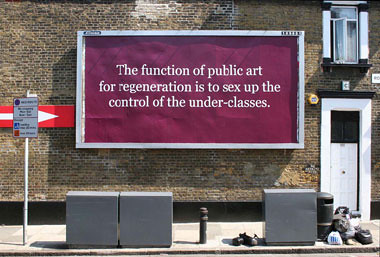
Hewitt & Jordan - The Aesthetic Function.jpg
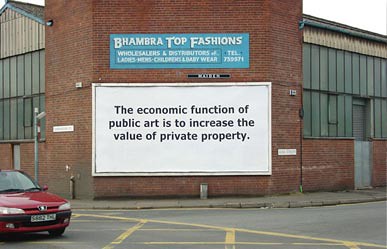
Images:  Hewitt & Jordan in collaboration with Dave Beech.   © 2005 


Real Estate: Art in a Changing City, an exhibition curated by B+B As part of London in Six Easy Steps at the ICA, 23-28 August, 2005.


A text work sited on a billboard in East London during Real Estate, 'The function of public art for regeneration is to sex up the control of the under classes', is a work concerned with the way in which culture-led urban regeneration is advocated within regeneration strategies. Regeneration aims to change the 'mindset' and 'behaviour' (Landry, C., 'The Creative City: A Toolkit for Urban Innovators', London: Earthscan, 2000) of residents, to improve their effectiveness in creating capital and growth in order to reduce what is seen as a dependency on state provision. Whereas the need for change in terms of social justice and parity is necessary, the methods and motivation of these cultural policies, particularly the roles assigned to art and culture within them, need to be examined. This new work is a continuation of a series of text works entitled the Three Functions that discuss the functionality of public art.
------------

Salon has a piece "Hipsters won’t save us: Buzzed-about essays debate the "creative class." Maybe coffee shops and bike shares aren't a real urban policy!," summing up some of the recent pieces around the blogosphere that criticize the "creative class" thesis of urban revitalization, especially in how it is being pushed forward as the "creative placemaking" initiative of the National Endowment of the Arts.

(cf.  a survey of the issue in 2005 London, "Get Real! Art, Regeneration, and Resistance from Mute.)

The reality is that the creative class idea is merely application of Jane Jacobs' writings on innovation and economic development (Cities and the Wealth of Nations, Economy of Cities, the point on a large stock of old buildings being a necessary component of healthy cities as discussed in Death and Life of Great American Cities).  I think that Richard Florida acknowledges this.


I think the real issue, as with anything, is the over-extension of the precepts of the Creative Class idea to any and every situation, and the failure to develop a more nuanced understanding and implementation scheme for revitalization efforts of all types, not just arts- or creative-based endeavors.

Arts-based revitalization is a tool, but like any tool, is just one piece of a total.

It's not hipsters anyway per se that are the augur of revitalization, but the process of redefining and repositioning space that has been disinvested.  But in and of only themselves, the creative class isn't necessarily gonna do it.

>In urban regime theory (it's good for explaining how the Growth Machine works, but not for explaining what it does) the focus is on how to sustain the effort (resources, governing coalition, agenda).

Many of the negative reactions to creative placemaking initiatives, not the createequity piece cited in the Salon article which is superlative, can be "misguided" not because they are wrong, but because for the most part they aren't figuring out what the problem is and why things aren't working.
Hewitt & Jordan - The Economic Function.jpg
The issue comes down to the difference between arts as production and arts as consumption, and artists/artistic disciplines representing their own interests--and artists, arts organizations, artistic spaces, and capacity building institutions don't always necessarily have the same interests--vis-a-vis the interests of commoditization and monetization of the "surplus value of artistic creation" by real estate interests.

I've written about that in various pieces including this one "Arts, artistic production, and culture districts revisited," which repeats the paper that was the basis of my presentation at the 2009 conference of the Literary Managers and Dramaturgs of the Americas, but the ideas are hardly new or unique to me.

The reality is that the ideas as expressed in that paper are drawn from the work of people like Sharon Zukin, John Montgomery, Ann Markusen et al, and the Creative City Network of Canada, combined with my experiences in commercial district revitalization and cultural heritage promotion here and elsewhere.   (I didn't acknowledge Charles Landry's work, but it's pretty relevant as well.)

But since most practitioners aren't exposed to theory and best practices typically aren't shared that much across jurisdictions, and because everyone wants the silver bullet rather than the hard slog (and who can blame them?), we continue to run in place.

My piece has links to some of the more accessible papers and reports on the issue.  (Pre- the NEA effort.)  But sure, if you don't delve more deeply into the literature and case studies, you're likely to  get flummoxed.

This came up at the recent forum at the National Building Museum on art, space and revitalization. Most of the reason that space is made available to artists at low prices has to do with a lack of a market for alternative uses, so when there are more profitable alternatives, artists get displaced, especially in DC, which has a limited inventory of potential spaces to begin with.


* The Aesthetic Function of Public Art is in collaboration with Dave Beech

Labels: , , , , , ,

Tuesday, August 24, 2010

The most important books in planning (although I am behind on my reading)

http://pdf-ebook.org/datupian/51iYo1FmLZL.jpg

1. Death and Life of Great American Cities - to understand what urbanism is and why it works or doesn't. (For extra credit, you can read her first substantive article on the subject, "Downtown is for People," which was published in Fortune Magazine in April 1958, and later in the compendium The Vanishing Metropolis--which compiled the 6 articles in the series of pieces commissioned by William Whyte, then the editor of Fortune Magazine. I am proud to say that not only do I have the book, I have 5 of the 6 original magazine issues, including the issue in which Jacobs' article appeared, which I found--really Suzanne found them--at an estate sale in Bethesda.)

2. Cities in Full -- takes Jacobs' concepts to the next level by providing deeper insight into why places work the way they do, in terms of housing, commerce, employment, and transit.

3. Geography of Urban Transportation Systems -- it's a textbook, with chapters by a variety of individuals. It's very well written and straightforward. Every planner should take at least one course in transportation planning.

4. Building Neighborhood Confidence and Understanding Neighborhood Change by Rolf Goetze -- these two books, long out of print, explain the processes undergirding the stabilization and improvement of neighborhoods. (My friend Tom Litke also really likes The Art of Revitalization, which is a study of a number of neighborhoods in Chicago.) You could also complement these books with Mallach's Bringing Buildings Back.

5. To understand commercial district revitalization and neighborhood economic improvement, probably Community Economic Development Handbook by Mihalio Temali, as well as the handbook from the Main Street Center, Marketing an Image: How to Develop a Compelling Message and Identity for Main Street. (I suppose then you would have to read Economy of Cities and Cities and the Wealth of Nations by Jacobs, but I have to admit that I have only skimmed these books, although I own both.) + the various ULI "ten steps" papers:
Although the description of the Main Street book is completely misleading. It discusses how to position a commercial district based on its economic capacity and opportunity, and how to do a market study and why. I haven't read the new Downtown Revitalization Handbook, but at least compared to all the other Main Street publications that I've read and worked to apply, this is the best one. Temali's book goes beyond the Main Street approach and takes on microenterprise development and rebuilding jobs at the neighborhood and sub-district levels in cities. He is a leading community development practitioner in the Minneapolis-St. Paul region.

Note that I basically can't talk to "average" people, including planners and area bloggers, about commercial district revitalization and retail development, because they don't understand how retail business works, how the industry is organized, entrepreneurialism, etc. Read this stuff, then we can talk.

6. Urban Design Compendium --
a great introduction to urban design, along with William Whyte's City: Rediscovering the Center. The latter book is out of print, but a portion of it is in print in the book The Social Life of Small Urban Places. Of course, Jan Gehl's paper, "Close Encounters with Buildings" covers much of the same ground, and extends the principles, and is a lot shorter. (I haven't yet managed to acquire or read any of Gehl's books. They are usually out of print.) Oh, and Cy Paumier's Creating a Vibrant City Center, published by ULI.

7.
If you don't want to read all those other books and you don't want to get too technical, I always recommend Robert Gratz's Cities: Back from the Edge as a good case study book, based on Jane Jacobs. The case studies make the concepts much easier to grasp. I say if you're only going to read one book, Cities: Back from the Edge is the one to read.

At this point, we go into advanced level work...

8. If you get to this point, you really need to understand the unseemliness of it all, the politics and the process. Planning the Capitalist City by Foglesong is long out of print, but an excellent primer on the development of the roots of urban capitalism and urban planning in the late 19th and early 20th centuries. Urban Fortunes: Towards the Political Economy of Place by Logan and Molotch outlines the Growth Machine thesis, which I am very fond of in terms of its explanatory power in why local political and economic elites are united and do what they do. That's from sociology.

The political science approach is called the Urban Regime, which I think is better than the Growth Machine in terms of explaining how the process actually works, how the local political and economic elites organize and coordinate their agenda. Clarence Stone's Regime Politics: Governing Atlanta, 1946-1988 is a solid tome from that school.

Then to understand how it works in DC, Dream City: Race, Power, and the Decline of Washington, D.C. is the best--theory into practice so to speak--especially chapter 4, on real estate development. The authors are journalists, and unfamiliar with either the growth machine or urban regime theories, but their book is a powerful case study that shows how the theories are in fact executed.

9. Then, I would say the books on the creative economy by Charles Landry and Richard Florida. They each have a few books between them, pick one from each and you can't go wrong. Landry really challenges how we should think about the revitalization process, while Richard Florida focuses more on human capital.

10. You need to understand "branding and identity," and there is no better resource than Simon Anholt. Either Brand America or Competitive Identity: The New Brand Management for Nations, Cities and Regions.

Damn, I see he has a new book, Places, which I will have to get and read forthwith.

11.
I would follow the readings on branding and identity with with a bunch of books on marketing and design so you can put it into practice. Start with Maximarketing* (an old book but still worthwhile even from the pre-Internet days), maybe the Marketing Imagination*, Strategic Marketing for nonprofit organizations*, Social Marketing*, The Wayfinding Handbook, Festival Graphics, Designing Brand Identity, Worldbranding, and Wayfinding: Designing and Implementing Graphic Navigational Systems. (I still need to find a great book on branding.) I read these books with an * long before getting interested in planning.

-------------
What's missing?

12. A solid set of recommendations on community engagement, civic participation, and organizing.

13. Understanding organizations. Although one of the most important books I ever read was the Social Psychology of Organizations.

14. Parks planning.

15. Housing. Which I don't work on.

I've only taken a couple planning classes. Note that only Planning the Capitalist City was on the reading list for one of the courses, although reading a syllabus for a class taught by Dolores Hayden of Yale University is how I was introduced to the Growth Machine theory, in the paper City as a Growth Machine: Toward a Political Economy of Place.

Of course, you can't get a planning degree without reading Death and Life. The others? I doubt it.

Labels: , , , , , ,

Saturday, October 13, 2007

Biking and the World Class City

(A very long piece about bicycling and saftey by Alan Durning of the Sightline Institute, Safe Streets: Not bicycling is dangerous to your health.)

And Portland Oregon is adding smart bike rentals. See "City gives bike rentals a spin: Bids to launch a 500-cycle fleet are due today, with subsidies, ads to be decided," from the Portland Tribune.

Montreal too. See "Montreal pedals way to 'self-serve' first." From the article:

The city of Montreal plans to be the first North American city to set up a large-scale "self-serve" public bike rental service. Following in the footsteps, or pedalling along the same path, as European cities such as Paris and Lyon where such systems have recently exploded in popularity, Montreal hopes to get its project started by next fall and fully operational by late 2009...

The first city-issue self-serve bicycles will start to appear at specially designed outdoor bike stations in the fall of 2008, By the fall of 2009, he said, there should be 2,400 bikes available for rent for as little as $1 per half-hour of use at 300 stations around the city's central neighbourhoods, he said.

The idea is to encourage Montrealers and tourists to use the public bicycles instead of cars for short, inner city trips, allowing them to pick up a bike at one station, use it for half an hour or an hour, and then drop it off at any other station of their choice.

The city wants to use locally designed bikes and bike stands, but the set-up will likely mimic the one introduced in Paris last summer, Lavallee said. Paris started with 10,000 bikes at 750 stations in mid-July, but demand for the bikes has been so strong that the city is adding 10,600 more bikes and moving to 1,451 stations by the end of 2007.

He said the city is responding to an observed changed of attitude among Montrealers towards cycling. "We used to see cycling as recreation, but now thousands of people are using bikes to get to work, or school. This summer, we actually saw traffic jams of cyclists on some of our new bike routes, like St. Urbain. Something is changing right now in Montreal and we all have to come along on this wave."


Although I guess it's gonna be a race with DC, which will be the first major city in North America with such an offering, when it launches the first 10 rental locations in the downtown area this coming Spring.

But Montreal merchants aren't happy about the loss of parking spaces to a bicycle lane. See "Time running out: merchants." The accommodation of bicyclists with a new bike path isn't going smoothly, as the construction caused great hardship when an error closed a subway line for a time. See "Paths pose no threat to business," and "We still have much to learn from Paris," (Cited articles are from the Montreal Gazette.)

From the latter article:

Another initiative has been launched by about 30 Montreal businesses and organizations including Parks Canada, Hydro-Québec, McGill University, Plateau Mont Royal borough and the city of Montreal. The institutions provide their employees and students with bicycles, to encourage a method of transportation that is non-polluting and physically active.
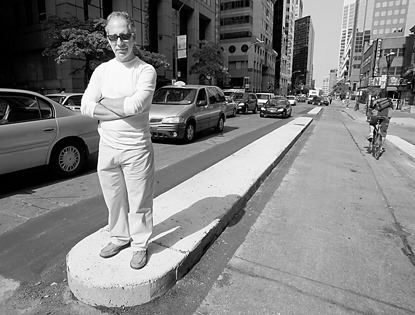
new bike path on de Maisonneuve Blvd, Montreal
Unhappy trader: Jean-Jacques Trudel, manager of the Wm. Layton Audio store on Ste. Catherine St., stands on the concrete barrier for the new bike path on de Maisonneuve Blvd. that will cut parking. JOHN MAHONEY, THE GAZETTE.

Of course, as Kim Smart writes in a letter to the editor of the Montreal Gazette:

Drivers are not to blame for the sad parking and traffic situation in downtown Montreal. No blame rests on the shoulders of all those drivers who bring their cars into town - no passengers, just them - in their four-doors and SUVs. No blame rests on drivers' daily peregrinations trying to locate a parking spot as close as possible to the office/restaurant/store because it's cheaper than a parking lot. No blame lies with those who drive to work, even though they live close to a métro station or on a good bus route.

No, no - the lack of parking causing the beleaguered businesspeople to lose custom because their clients can't park their cars right in front of their doors is solely the fault of uncaring city planners and cyclists.

Take a bus, take the métro, or - gasp! - walk.

And if dear Sal Parasuco wouldn't be caught dead doing any of those things, he could always take a taxi to that high-end restaurant. He would arrive relaxed and on time, without having wasted 20 minutes in the rain trying to find a parking spot or fiddling with a meter.

But the entitlement culture about driving, as well as fear of change and the other, makes it difficult to move forward on improving cities.

There is an article in Der Spiegel about the "Slow City" movement from Italy, "Taking Life Easy in Urban Italy."

Like the "Keep Austin Weird" independent retail campaign, it doesn't sit well with me that great livable places or independent retail is marketed as odd or weird or different behavior. Instead, quality of life should be what matters most and should be the primary goal when creating any city-urban policy.

Shouldn't a focus on placemaking and livability be considered "standard operating procedure"?

What's weird about that?

Speaking of calling your city world class, Charles Landry makes a point in his latest book, The Art of City Making, and presentations, that to be world class isn't only what the city does for itself, but how the city in turn contributes to the world.

Paris, by introducing the bicycle rental system (even though other cities like Oslo and Lyon have already done so), has given cachet and sanction to this type of transportation offering, and has made it acceptable for other cities to consider the adoption of similar systems. Now cities are "competing" to accommodate non-automobile forms of mobility.

I think that's the kind of contribution that Landry is referring to when writing and talking about what it means to be a "World Class City."

Labels: , ,

Wednesday, October 16, 2019

New York's 14th Street, San Francisco's Market Street (and Toronto's King Street): When major cities adopt innovative practice it makes it easier for other cities to do something similar

Following up on last week's entry, "Speaking of "Just Do It": A 14th Street bus transit mall for Manhattan," on the introduction of a highly visible transit-prioritized street in New York City.


Many years ago, I heard Charles Landry, author of books such as The Creative City: A Toolkit for Urban Innovators and The Art of City Making, speak and I thought I heard him say something like "Great cities don't just take, they give" -- providing examples of best practice and innovation that other cities can learn from and adopt/adapt on their own.

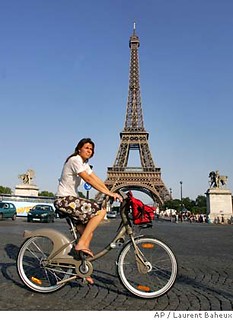
Velib at the Eiffel TowerParis and bike share.  A particularly good example is Paris and bike share.  They weren't the first city to do bike share, hardly.  But they were the first to do bike share at a large scale, with an initial deployment of hundreds of stations and more than 20,000 bikes.

It electrified not only cyclists but city leaders all over the world and it significantly increased the take up and deployment of bike share in cities all over the wrold.

It turns out he didn't exactly say that and Aaron Renn of Urbanophile credits me with making this point.

Toronto prioritizing transit on King Street.  A more recent example is Toronto prioritizing King Street for streetcar service.

It came with a fair amount of controversy, and while streetcar throughput has improved significantly and ridership increased by X%, some businesses did lose patronage and sales -- although in that case, I argued it is because the city failed to develop a parking wayfinding and validation system to complement the changes.

Wikipedia photo.

From the Toronto Star article "Latest King St. pilot data shows higher ridership, shorter commutes":
New data released on the King St. pilot project shows overall ridership was up 11 per cent during May and June.

According to the new numbers released Wednesday, ridership rose by 35 per cent during the morning commute and by 27 per cent during the afternoon rush hour.

Travel times have also been reduced by approximately 4 to 5 minutes, according to the city. This is in each direction during the afternoon commute for the slowest streetcar travel time. Average travel time during the midday also improved by 2 minutes.

The data also shows transit has become more reliable in the downtown core, with 85 per cent of streetcars arriving within four minutes during the morning commute. ...

The project has attracted controversy, especially from local business owners such as Al Carbone, owner of Kit Kat restaurant at King and John Sts., who called on Tory back in January to reverse it “immediately.” He said revenue for some establishments dropped by half.

However, according to the release, “Customer spending on King St. since the pilot began has seen a slight growth (0.3 per cent) from the average rate of spending over the same months from the year before.”
Dedicated transitways aren't a new urban design treatment. Dedicated transitways aren't new--many cities had them in the 1970s and 1980s -- but as city centers declined as a loci for shopping and pedestrian movement, many cities dropped them.

Even so, smaller cities like Portland, Denver, and Minneapolis not only introduced "transit malls" where bus service was prioritized (Portland later added light rail) and automobile traffic banned, but have continued to invest in and improve these spaces.

Still, the concept of more cities adopting dedicated transitways as a method of improving transit service -- the speed of vehicles -- in recognition that it's more important to focus on moving lots of people more quickly rather than facilitating the movement of a person or two in every car, and that high use bus and streetcar lines move significantly more people more efficiently has been pushed forward not by the great examples of Portland, Denver, and Minneapolis, but of King Street.

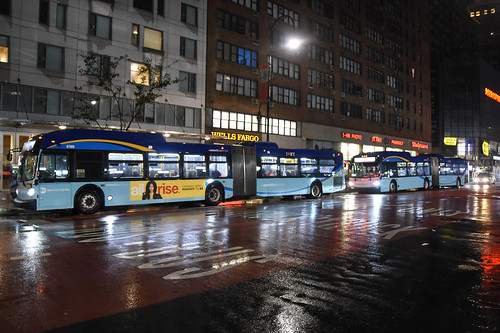
New York City's 14th Street.  Pushed forward originally because the L subway line was scheduled to be closed for 18 months for repair and rehabilitation, New York City has moved forward with a "pilot" of its own -- making a central section of 14th Street in Manhattan a transit priority street, with most motor vehicle traffic being banned.

Despite all the clamor of all the likely negative effects, traffic on other streets didn't come to a standstill and bus movement has improved significantly ("Cars Were Banned on 14th Street. The Apocalypse Did Not Come" and "Riding the Bus on the New 14th Street," New York Times.
14th Street Manhattan dedicated transitway, at night
Seth Gottfried, New York Post


It helps that Manhattan has a robust grid-based street network, so there are many other options for drivers other than 14th Street.

And while the city was initially somewhat diffident about stating whether or not what happens on 14th Street would lead to the creation of other transitways elsewhere, now they are being more declarative about the concept.  Not that the New York Post is happy about it ("14th Street is only the beginning for NYC car bans, top transit official says").

San Francisco votes to ban motor vehicles from Market Street
. Like King Street, San Francisco's Market Street is a major and central thoroughfare and spine in the core, and a major route for both streetcars and buses. In fact, historically at one point it had four streetcar tracks, which is one of the only examples I've come across where streetcar traffic was so heavy.
Market Street, San Francisco, vintage postcard, showing four tracks for streetcars
(It wasn't unusually for a street to have more than two tracks when part of the street was used for another route, but usually this was for a short section, while the Market Street double trackage was for a significant distance.)

Yesterday, the transit agency board in San Francisco moved to make Market Street a transit prioritized street also ("SFMTA votes to restrict private vehicles from Market Street in bid to make area safer," San Francisco Chronicle).

The Better Market Street Project will make sustainable mobility (not just buses and streetcars but cyclists and pedestrians too) the priority on a two mile section of the street.

Incremental change.  While I argue above that Toronto set the stage for New York and San Francisco, that may be overstating the case.  SF and New York City have been recent leaders in creating dedicated lanes for surface transit, albeit in corridors that remain open to motor vehicle traffic.

Moving from mixed trnasitways to dedicated transitways can be seen as but an incremental step forward, but still a quantum jump in practice.

And Brooklyn's Fulton Street Mall has been a transit mall since the 1970s ("The Fulton Street Mall: Retail Success on NYC’s Original Transitway," Streetsblog). And outside of Manhattan, the transit and pedestrianized Fulton Street district has remained a successful retail center that draws crowds and higher than normal rents.
Before and After in Times Square, pedestrian-placemaking
Before and after, Times Square.  NYC DOT photo.

Other initiatives that transitways build on include "road diets," initiatives in New York City (which also triggered adoption of the practice elsewhere) to shift road space to pedestrian uses in Times Square and along Broadway in Manhattan (and then in other places around the city), creating and extending bikeway networks, and reducing the amount of space dedicated to parking, for parklets, bicycle sharing stations, dedicated bikeways (cycletracks), and other uses.

Long process.  And all of these projects take a long time.  Toronto first proposed the King Street initiative in 2007, but it was not until 2017 that they were able to do it.  New York City has considered transit priority streets for quite awhile, and past initiatives did not move forward.  San Francisco has been working on speeding up transit on Market Street for a long time also.

Each of these cities deserve a lot of credit for making key streets transit priority in the face of intense opposition from businesses, residents, the automobile lobby, and other stakeholders.

Other benefits.  Canada's Atmosphere Fund argues that the benefits of transit priority streets are considerable and greater than mobility throughput, including:

1. Improved public health
2. Vibrancy & accessibility
3. Economic prosperity

Labels: , , , , , ,

Thursday, February 22, 2018

Revisiting past blog entries: College Park as a college town and economic development | PG County and Amazon

The Washington Business Journal has an interesting article, "Exclusive: Here's what Prince George's pitched for HQ2 — and why it lost," about why Prince George's County's bid for the Amazon second headquarters wasn't one of the short listed sites, even though DC, Montgomery County, Maryland, and Northern Virginia (Arlington, Fairfax, Loudoun Counties) each made the final Top 20.

From the article:
Weeks after being shut out of Amazon's short list of contenders for HQ2, Prince George's County learned Wednesday morning why it did not make the
cut: The county doesn't have a large enough pool of senior-level software engineers.

... The answer brings some closure to a multifaceted effort by Prince George's to attract Amazon's second headquarters with a strong proposal that county officials say met all of the online giant's requirements in terms of talent, land and transit.

The county's nearly 120-page proposal, obtained by the Washington Business Journal through a Freedom of Information Act request, reveals that Prince George's pitched College Park and Greenbelt together as a way to fulfill Amazon's plans to develop 8 million square feet for 50,000 employees.
In 2005, I interviewed for an economic development job in Hyattsville, a few miles south of College Park and the University of Maryland, and the main point I made was that they looked for their economic energy to emanate from DC up the Rhode Island Avenue/US 1 corridor, and yet the University of Maryland is a leading research university, and that if you did a Google search on "Prince George's County" and "creative economy" (a term used by Charles Landry and others) you got fewer than 100 hits.

One of the things I suggested was trying to get the University and Prince George's Community College to relocate their arts related academic programs to Rte 1 in the "Gateway Arts District"--imagine the College of Art anchoring the arts district, etc.

Another was that they should strive to be great, for example by changing their town slogan from "A good place to live" to "Maryland's Rising Star."

A few years ago I wrote a couple pieces about how College Park and the Prince George's County economies are crippled by the city's adamant desire to not be a college town, even though big college towns like Ann Arbor, Madison, Cambridge, and Berkeley are awesome (and small towns anchored by colleges can be great too, such as Walla Walla, Washington; Chestertown, Maryland; and Shepherdstown, West Virginia).

-- "To be a great city, College Park Maryland needs some "there", it needs a center," 2013
-- "More Prince George's County: College Park's militant refusal to become a college town makes it impossible for the city(and maybe the County) to become a great place," 2015
-- "College town follow up: alumni as residents and contributions to community capital," 2015

To be fair, it is the case that those area communities are starting to figure out that that this is important ("How Wallace Loh is impacting development in College Park," Washington Business Journal; "University of Maryland is bringing upscale hotels," Washington Post).

President Loh has made a difference, reversed the university's previous animus about a more direct campus routing for the forthcoming Purple Line light rail ("UMD and City of College Park officials show excitement for Purple Line," Diamondback), the University and developers are creating what is being called the "Discovery District," north of the campus, which will be a mixed use  academic, research, and commerce district ("University of Maryland debuts Discovery District," press release), etc.

In my writings about the quest to land the Amazon project, I mentioned that in any case, the process was a good opportunity to objectively assess where a community is, to do what's called a SWOT (strengths, weaknesses, opportunities, threats) analysis, to figure out where it can do better.

Rendering showing a Purple Line light rail train on the routing through the University of Maryland campus.

I specifically mentioned how communities with weaker higher education programs in the sciences and engineering need to look at that and come up with responses such as those initiated in places like Spokane ("President of Washington State University dies: fostered development of the "University District" adjacent to Downtown Spokane," 2015), Greensboro ("Better leveraging higher education institutions in cities and counties: Greensboro; Spokane; Mesa; Phoenix; Montgomery County, Maryland; Washington, DC," 2016 ), Portland State University ("Nohad Toulan: The University in the City," PSU Metroscape Magazine), New York City with Mayor Bloomberg's technical university initiative on Roosevelt Island, the biotechnology focus in Cambridge, Massachusetts ("A real estate empire grows in Kendall Square" and "State pushes for biotech beyond Kendall Square," Boston Globe), and Harvard's push to develop an expanded engineering and business programs emphasis in the Allston district of Boston ("Harvard unveils plan for major commercial development in Allston," Boston Business Journal; "Harvard's Expanding Allston Plans," Harvard Magazine).

Prince George's needs to do a deeper re-assessment. Which I have written a fair amount about including shifting their development paradigm around transit:

-- "The future of mixed use development/urbanization: Part 3, Prince George's County, where's the there?," 2011
-- "A recommended new planning direction for Prince George's County," 2011
-- "Another lesson that Prince George's County has a three to five year window to reposition based on visionary transportation planning," 2011
-- "Prince George's County still doesn't get "transit oriented development" and walkable communities: Greenbelt edition," 2012

and the PG-related recommendations in my 2017 series of Purple Line articles including:

-- "Setting the stage for the Purple Line light rail line to be an overwhelming success: Part 1 | simultaneously introduce improvements to other elements of the transit network"
-- "Part 2 |   the program (macro changes)
-- "Part 4 |   Making over New Carrollton as a transit-centric urban center and Prince George's County's "New Downtown""
-- "Part 6 |  Creating a transportation development authority in Montgomery and Prince George's County to effectuate placemaking, retail development, and housing programs in association with the Purple Line
-- "Part 7 | Using the Purple Line to rebrand Montgomery and Prince George's Counties as Design Forward."

=====
Separately, Maryland is figuring out the value of linking the University of Maryland campuses in College Park and Baltimore--the Baltimore campus focuses on life sciences ("Lawmakers approve University of Maryland partnership," Baltimore Sun).

Labels: , , , , , ,

Tuesday, December 09, 2008

Pushback against the 24 hour/creative city

(Flickr photo by wallyg.)

In the Mount Vernon neighborhood in Baltimore, at the location of a defunct restaurant in a reasonably prominent location on Charles Street, 7-11 proposes to open a 24 hour store. Residents have resisted, see "Bid to block 7-Eleven in Mount Vernon falls short" and "Mount Vernon activists decry plan for 7-Eleven" from the Baltimore Sun. In response to their opposition, a City Councilmember has introduced legislation barring stores from being open between 11 pm to 5 am in "historic districts." See "Bill introduced to block Mt. Vernon 24-hour store " from the Sun as well as these letters in response:

-- 24-hour store boosts the area's vitality
-- The wrong location for convenience store
-- 7-Eleven would sully Mount Vernon Square
-- New convenience store could add to crime
-- A blight on charm of Mt. Vernon Square

I think it's fair to say I am a fervent preservationist. At the same time, I balance co-equal concerns of commercial district revitalization, neighborhood vitality and urban competitive advantage, and optimal mobility.

Such legislation misuses preservation.

Ironically, as one thread of the urban narrative is creativity, diversity, and innovation (see the work by Jacobs -- Death and Life of Great American Cities, Economy of Cities, Cities and the Wealthy of Nations; Richard Florida -- Whose Your City, Rise of the Creative Class; and Charles Landry -- Creative City, Art of City Making) it's a struggle to make that happen on the ground.

Interestingly enough, I can think of a couple 7-11s in the Capitol Hill Historic District (DC) that have issues, but by and large, are assets. And in a crunch, and you need something late or early, they are open. In my new neighborhood, there is a 7-11 a couple blocks away, but with the limited amount of business, it has only a couple sorry shelves worth of groceries and bread. Key to success of 24 hour stores anywhere is strong management and a good security plan.

Plus, what about 24 hour pharmacies such as CVS in Dupont Circle and elsewhere?

In fact I have been thinking about how 7-11 is missing a great opportunity to reposition its urban stores around the broader array of goods including prepared foods model pioneered by Sheetz and WaWa (both based in Pennsylvania) and Tesco's new Fresh & Easy concept that is being tested on the West Coast, even the "convenience/grocery" store in the student union at George Washington University is a good model. The trade publication Convenience Store News has many stories about such stores.
Tesco Fresh & Easy Produce aisle
Produce aisle, Fresh & Easy. Reuters photo.

Although there has been a discussion in the urban revitalization field over the difference between a 24 hour city and an 18 hour city. It seems the 18 hour city--from 6 am to midnight, might be what's preferred by older residents in the core of Baltimore.

However, one of the revitalization concepts I am working out is planning the retail and service mix of commercial districts by "daypart" and demographic to build and spread patronage throughout the day and into the evening hours.

When planners attempt to plan for different demographics, this allows for a demonstration that different consumer segments are necessary to support a successful commercial district, and that living in a diverse city requires compromise and a willingness to meet the needs of demographics other than your own.

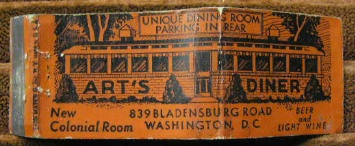
And it is frustrating that DC has very few 24 hour establishments, especially diners, especially diners that might have survived from the 1950s and 1960s. Tastee Diner in Silver Spring is not that good and hardly worth a trek out of the city late at night... (My girlfriend and I idly discuss creating a "Blair Road Diner" with an old diner building on Blair Road near Kansas Ave. or what about a 24 hour diner in Union Station? Etc.)
Art's Diner, matchbook

Labels: ,

Monday, July 28, 2008

The federal government and cities

Professor Sudhir Venkatesh of Columbia University has an op-ed in the New York Times, about the Dept. of Housing and Urban Development, entitled "To Fight Poverty, Tear Down HUD." He says that HUD is focused on cities, and that metropolitan regions and connections between cities are more important.

I would say that HUD has two missions that aren't necessarily congruent. One focuses on developing housing for poor people. The other is on urban development and revitalization.

The belief in the field is that these missions are in one and the same. But I think it's fair to say that improving housing for poor people didn't improve cities.

I have the same reaction in reading Barack Obama's platform on city issues, partly a response to Philadelphia Mayor Michael Nutter's call for a debate between Democratic presidential candidates on urban issues. (See Urban Policy.)

The Obama platform focuses on poverty issues. I understand that. He was a community organizer. But cities and metropolitan regions are also about economic development and growth. It's the basis of how and why and where cities and regions develop. It's the heart of the field of urban economics. And it's the heart of arguments in Jane Jacobs two books after Death and Life of the Great American City, The Economy of Cities and Cities and the Wealth of Nations.

At the library today I happened onto a monograph series from the Society of Economic Anthropology. One of the collections is entitled "Economic Analysis Beyond the Local System."

I thought about the aptness of that title in terms of what I think about and discuss in terms of thinking and addressing local issues on the different scales of local-neighborhood, local-city, and even local-region, although for the most part I think about this within the city, so that I think about this mostly in terms of how neighborhood planning processes fail to engage with and acknowledge citywide needs and concerns simultaneously.

But this idea of analysis beyond the local system is key to understanding urban issues and urban poverty and urban growth, as well as the relationship between municipalities and other levels of government be they local such as with counties, regional such as with metropolitan planning organizations, states, or the federal government.

A very practical guide to dealing with local economic development engaging improving the lives of people rather than focusing on jobs more theoretically is Temali's Community Economic Development Handbook.

Getting back to Prof. Venkatesh's article, cities need to be innovative and energetic (see the writings of Richard Florida, Charles Landry, even Edward Glaeser, among others) and the last thing a government agency, especially at the federal level, is concerned with is innovation.

In short, looking to government for the answer is likely a failing strategy.

As aggravating as it is, working on urban revitalization from the ground up level is exciting, challenging, and worthwhile. But dealing with it from the aspect of dealing with government regulation, electoral politics, and working with appointed government officials, it can be terrible, difficult, and seemingly intractable.

One of the ways that HUD could be better is if it too focused on "indicative planning" or building the capacity for vision. The UK planning agencies produce memos and reports, ranging from "Planning Policy Guidance" memos, to incredible reports such as Living Places: Cleaner, Safer, Greener, as well as the work done by organizations such as the Commission for Architecture and the Built Environment and English Partnerships.

I don't really feel as if we have an equivalent set of planning guidance and stretching and pushing and striving in a similar fashion here in the United States.

If HUD published PPG memos on linking land use and transportation planning, shifting from an automobility planning paradigm, the link between density and livability as well as transit success, building a local economy, foodways and urban agriculture, eliminating free parking, accessibility planning linking land use and transportation infrastructure in land use decisionmaking, rebuilding a system of railroad-based transportation, etc., we would be far better ahead than we are now.

Labels: , ,

Tuesday, August 25, 2009

Montreal, bicycling and the world class city

Charles Landry makes a point in his presentations and his latest book, The Art of City Making, that to be world class isn't only what the city does for itself, but how the city in turn contributes to the world.

Montreal's Bixi bicycling sharing system is a fascinating example of this, showing that the public sector can be transformative and innovative in ways that challenge convention. Also see the articles "Public sector innovation" from the Ottawa Citizen. and "Montreal Exports Its Bike-Sharing Program" from the New York Times.
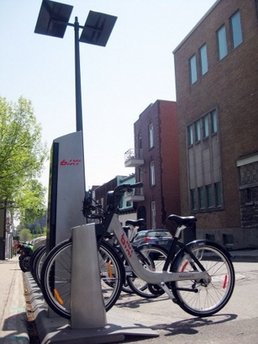
Bixi bicycle sharing in Montreal
Montreal launched 3,000 bicycles called " Bixi", available from May to November with the help of a subscription rate of 78 dollars a year, $28 for one month or $5 for the day. A combination of bicycle and taxi, the BIXI program offers 3,000 bikes for Montrealers to ride around the downtown core, from as far west as the Atwater metro station to as far east as the Prefontaine station. (AFP/Clement Sabourin)

For example, one of the biggest problems with the "traditional" bicycle sharing systems and their stations is that they require electricity. This is a problem not only in dealing with recalcitrant local utility companies (at least Pepco in DC is problematic, maybe this isn't the case in cities like Paris), but in finding locations where electricity connections can be made, and then in having to construct and make the connections. All in all this adds time and significant cost to the process.

The city's parking authority, Stationnement de Montréal, decided to create their own system rather than have to pay others for one. Typically bicycle sharing systems are developed through a kind of "ransom" as a city sells the privilege of placing advertising in public spaces in return for various benefits from the contractor, including outfitting a bicycle sharing system.

This creates a negative dynamic between the operator and the municipality, because the municipality wants to expand the system, while the operator wants to minimize costs to maximize profitability.

BIXI, the project of the parking authority in Montreal, has just won the contracts to provide bicycle sharing systems to Boston (see "Vendor selected for Boston area bike-sharing program " from the Boston Globe) and London (see "Serco wins race to run London hire bikes" from the Times of London).

Impressive.

Labels: , , , , ,

Wednesday, June 04, 2014

the more things change, the more they remain the same: Could McCormick Spice Co. move back to Baltimore City?

The company was founded in Baltimore in 1889 and grew through acquisition.  They left the city for quarters in Baltimore County in 1989.  Their old main headquarters building in the city is long gone.

The Baltimore Business Journal reports ("Spice company McCormick is considering 4 states for its new HQ") that the company is considering Pennsylvania, Delaware, Northern Virginia, and Maryland as sites for a new consolidated headquarters.

The article states that easy access to an international airport is highly desired, mentioning BWI Airport outside of Baltimore.

Why not just move back to Baltimore City?

Too bad the old headquarters is no long around for a triumphant return by the company.

Also see "Silicon Valley Fans San Francisco's Flames" from the Wall Street Journal about how many Silicon Valley tech firms are building up their operations in San Francisco, to have better access to quality talent, the same issue that is motivating McCormick to consider options other than their very suburban location in Baltimore County.

-----
In my forthcoming summary article for the EUNIC Washington Cluster "Europe in Baltimore" project, I suggested that the next phase for culture districts is to move towards knowledge clusters, and I suggest that Baltimore City and the city's higher education institutions need to consider this.

From the article:

From creative clusters to "creative economies" and knowledge quarters/knowledge precincts.  The basic precepts for the development of cultural districts as a revitalization strategy were laid down beginning in the 1980s, starting with various projects in the UK.   Researcher-consultants such as John Montgomery, Simon Roodhouse, Charles Landry and others have written extensively about "the creative city," and culture district development, planning and management.


The "Five Star" Model of Knowledge Development-Innovation Districts.  Source:  Aalto University.

As more places took on culture-based regeneration projects, the field has continued to develop and advance and define culture more broadly and integrate additional disciplines into more wider scale "creative economy" initiatives which tend to be focused on what are called "knowledge quarter" initiatives, as opposed to arts districts.  Perhaps knowledge quarter initiatives should be considered "next generation" culture district initiatives.

The Knowledge Quarter in Liverpool, which includes higher education institutions, government research facilities, private research ventures, medical and health care institutions, and research parks is one example.

-- "Liverpool City Region's Knowledge Economy: Delivering New Opportunities for Growth

Helsinki's Arabianranta district, which is centered around the design oriented University of Art and Design (now part of Aalto University) is another as is the Alexander Innovation District in Thessaloniki.  (There are many other examples around the world, including the MaRS Discovery District in Toronto.)

The URBACT publication, Creating knowledge hotspots in the city: A handbook | Practical guidelines for developing campuses, science quarters, creative districts and other knowledge hotspots, provides guidance for considering the development of broader knowledge development focused initiatives.

and...

3.  Baltimore has an incredible array of higher education institutions and while research and technology development initiatives by certain of the institutions have high profiles and there is the Baltimore Collegetown effort focused on retaining students in the metropolitan area after they graduate, there isn't the sense of Baltimore's higher education institutions operating at the scale of an integrated "knowledge quarter."  This needs to be addressed. 

Presently, there isn't a network of all of Baltimore's higher education institutions, although there are many examples of cooperation between institutions on more bi-lateral bases.  And Johns Hopkins University's president, Robert Daniels, who previously had been Provost at the University of Pennsylvania, which has a wide-ranging revitalization program within its urban interest area ("The University and Urban Revival," Judith Rodin, former president of Penn) has stepped up JHU's interaction with the city at large.

The Baltimore Student Exchange Program, like the Five College Consortium in Western Massachusetts, lets students take courses at different colleges and universities in the city, and is an initiative that can be built upon.

Could Baltimore's higher education institutions develop a network comparable to the Committee on Institutional Cooperation linking the Big 10 universities and the University of Chicago or the Washington Research Libraries Consortium in DC?

4.  Definitely there isn't a university-involved initiative within Baltimore that operates at the scale of Liverpool's Knowledge Quarter.

Could such a district be created in Baltimore, as the next generation of "culture district" development initiatives?

The way that the Arabianranta district was regenerated in association with the relocation of the University of Arts and Design and how design and information technology initiatives developed around it is another example of university-business-community revitalization that is especially relevant to the Station North Arts and Entertainment District as a way to better leverage and heighten the integration of these educational institutions into a broader program.

Also, the City of Helsinki's information technology innovation unit, Forum Virium Helsinki, a public-private partnership but also an agency of the city government, is another example that Baltimore could consider in the development of broader knowledge innovation efforts.

That being said, the East Baltimore Development Initiative, in part focused on leveraging the opportunities present within the medical research community at the adjacent Johns Hopkins University Medical School and Hospital is an example of a nascent effort along these lines.

Labels: , , , , , ,

Friday, January 01, 2016

New Year's Post: 2016

With all due respect to U2, there are a few changes on New Year's Day in 2016.  Best wishes for 2016!

1.  2016 is the 100th anniversary of the US National Park system.
-- The Future of America's National Parks (2007)
-- "How National Parks Tell Our Story—and Show Who We Are," National Geographic Magazine.  NG will be running articles throughout the year on the National Parks and the anniversary.

2.  2016 is the 50th anniversary of the US National Historic Preservation Act.

3.  In 2016, the European Capitals of Culture are Donostia-San Sebastián (Spain) and Wrocław (Poland).

4.  In 2016, the European Green Capital is Ljubljana, Slovenia. (Next year it's Essen, Germany, which I visited in 2014. Hopefully I can figure out a way to go back.)
-- EU webpage, with application
-- Green Ljubljana, European green capital 2016

5.  In 2016, the European Youth Capital is in Ganja, Azerbaijan.  Ganja is outside of the EU, but the EU Capital designation programs occasionally stray outside of the formal EU membership boundaries for various reasons  including strengthening contact between the EU and nearby nations.  For example, Istanbul was the Capital of Culture in 2010, but Turkey is not an EU member (although it is expected to happen at some point in the future).

6.  In 2016 (held every two years), the World Design Capital is Taipei, Taiwan.
-- World Design Capital 2016 Taipei|

==================
In some years, I've written posts on New Year's Day, such as this series in 2011:

-- New Years post #7: Anacostia and sustainable economic development and revitalization
-- New years post #6 -- the crazy thing about U.S. zoning is that it's not designed to maximize overall land value
-- New years post #5: DC City New years post #5: DC City Council Committees and striving to be a world class city
-- New years post #4: How to Keep Resolutions and change behavior
-- New Years post #3: How about more community self-help
-- New Years post #2: sustainability and energy
-- New Years post #1

Although for the most part, posts like these are still relevant 5 years later.

Some world class actions I wish that the city where I live would take.  Aaron Renn of Urbanophile/The Manhattan Institute gives me the credit for making the point that "world class cities don't just take, they give."

It extends from a point made by Charles Landry in The Art of City Making.  The idea is that world class cities act "big" and the policies and practices they enact and implement end up being examples for others.  Paris, London, Singapore, Tokyo are places that come to mind.

Think NYC under Mayor Bloomberg and the way the city started "giving space back" to pedestrians (and bicyclists) by taking it away from roads.

NYC wasn't the first city to do that.  But they did it on a bigger scale and with a lot more visibility than other cities ("15 Ways Janette Sadik-Khan Is Making New York City A Better Place," Business Insider), not just in the US but on a global scale.

The same with Paris and bike sharing.  They were by no means the first.  But they were the biggest by a factor of 3x or 4x.  In both cases, these cities set the stage for other cities to adopt and adapt these programs and create similar practices their own jurisdictions.

This year, I don't have enough critical distance and perspective to write something like that.  Maybe a list of a few things that the city could do that would be "world class" or at least transformational (not in order) in the context of the US and/or the multi-state region:

- legislate the Idaho Stop for bicycling.  Paris did it and the world hasn't ended.
-- "Paris follows the path of Idaho, and lets bicycles run red lights," Public Radio International

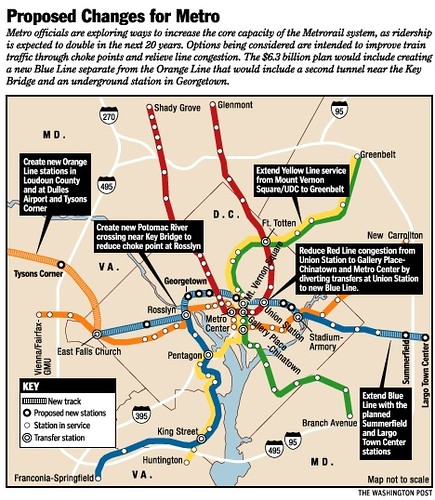
- commit to, plan, fund and build Metrorail transit expansion within the city, starting with the separated Silver Line (formerly blue in this 2001 graphic from the Washington Post).  I have updated my ideas on Metrorail expansion more recently and will post about it soon.
Proposed changes for the WMATA system, 2001 (separated blue line)

- to fund it, increase the height limit at the core (this would increase the value of commercial property thereby increasing the property tax revenue stream which could finance bonds)
-- DC Height Study Public Meetings This Week and the long term implications for transit expansion in DC

- with Maryland and Virginia and the federal government (not likely while Republicans control Congress) pass a multi-jurisdictional transportation withholding tax (versement transport) on wage income to fund transit and transportation improvements
-- Musy vision won't yield great transit

- work with Maryland and Virginia to combine the MARC and VRE railroad commuter services into one integrated system and work to extend services with MD, VA, DC, WV, DE, and PA
- and to integrate Metrorail fare systems with MARC and VRE
-- One big idea: Getting MARC and Metrorail to integrate fares, stations, and marketing systems, using London Overground as an example

- add yard waste and other "waste diversion" programs by starting with differentiated waste collection programs in the outer city
-- More on zero waste practice

- rethink/reposition the Central Library as the city's leading "local" cultural asset.  I intend to write a position paper on this sometime in 2016.
-- The Central Library planning process in DC as another example of gaming the capital improvements planning and budgeting process
-- National Library Week

- create a local fine arts museum separate from the national museum system which has a different agenda not focused on anchoring local arts.  I realized a couple months ago that I blew it when writing a couple years ago on the debacle of the Corcoran Gallery of Art.  Instead of allowing the Gallery to dissolve, with the National Gallery and GWU taking it over, it should have been taken over by the city and reconfigured as a "local" fine arts museum.

- pilot the International Garden Festival/International Building Exhibition large scale revitalization programs in Germany in the US, as a way to reshape and improve the economic circumstances of the "East of the River" section of the city.  This is a way to develop the "Marshall Plan" for Wards 7 and 8 that one of these days I will finally write.
-- DC has a big "Garden Festival" opportunity in the Anacostia River
-- European Garden Festivals as a model urban planning initiative

- pilot a US Green Capital program modeled after the European Green Capital program as a way to further focus cities on developing sustainable practice, with DC as the first city designated.  Other cities are way ahead of DC on sustainability (other than the number of LEED buildings, which is a function of the nature of the real estate market, not something that the city "did"), although the city is moving forward, and the water system has implemented one of the world's most innovative energy production systems as part of the treatment process.
-- "San Diego Vows to Move Entirely to Renewable Energy in 20 Years," New York Times

- redevelop the Walter Reed campus around biotechnology and life sciences, in addition to the residential and real estate program currently slated for the site.  More on this later.

- make more of the city's organization processes focused in a systematic way on generating outcomes that strengthen and improve neighborhoods
-- Outline for a proposed ward focused (DC) Councilmember platform and agenda
-- Rethinking community planning around maintaining neighborhood civic assets and anchors
-- The layering effect: how the building blocks of an integrated public realm set the stage for community building
-- Transit stations and placemaking: stations as entrypoints into neighborhoods

- DC Public Schools should shift meal services to "family style preparation and service" as a new competitive advantage.  I wrote about this a couple years ago, suggesting that instead of looking at food service as a cost and something to outsource, the school system should rethink food as a part of "school" and a way to teach and shape behavior--in short, as a competitive advantage.  Note that I am told, but haven't had a chance to follow up, that the CentroNia charter school in Columbia Heights does something along these lines.

A third-grader serves milk at the Umejima Elementary School lunchroom. Ko Sasaki/For The Washington Post.

I mention this because of the recent increased attention on this issue more generally, which bugs me because it's something that I dealt with 25 years ago working at the Center for Science in the Public Interest.

Commenter christopher pointed out in a comment thread that in Japan, elementary school kids serve lunch and clean up after, although the meals are prepared by professionals.
-- Shrinking to oblivion: managing the demise of the DC Public School system
-- "A top chef from a world-famous restaurant wants to fix America's school lunches, Washington Post (2015)
--  "On Japan’s school lunch menu: A healthy meal, made from scratch," Washington Post (2013)
-- "WHAT JAPAN CAN TEACH US ABOUT SCHOOL LUNCH," BeyondChron

- DDOT should create and empower a new position of "Chief Thoroughfare Architect" comparable in authority to the "Chief Engineer" with responsibility for ensuring that the urban design, placemaking, and civic architecture elements within DDOT projects.
-- How I would approach organizing the DC master transportation planning process and plan
-- DC's bad urban design as it relates to new transportation infrastructure
-- Lies, damn lies, and obfuscations: placemaking, place qualities, historic preservation and transportation infrastructure
-- Transportation bridges as an element of civic architecture, urban design, and placemaking
-- Transit (transportation) infrastructure as an element of civic architecture
-- Design as a city branding strategy: transit edition
-- An argument for the aesthetic quality of the ensemble: special design guidelines are required for DC's avenues
Montpellier France trams, livery design by Christian Lacroix
Montpellier France trams, livery design by Christian Lacroix.

Tunnel of Lights, Railroad Park, Birmingham, Alabama,  "Light Rails" by Bill FitzGibbons
Tunnel of Lights, Railroad Park, Birmingham, Alabama, "Light Rails" by Bill FitzGibbons. Photograph by Jenna Nicole Photography.

Labels: , ,